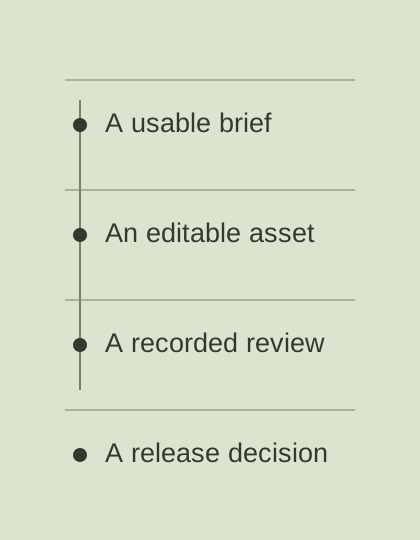
Build the stack around four handoffs: a usable brief, an editable asset, a recorded review and a deliberate publish decision. Assign the people before buying another tool.
Our recommendation is a shared plan, the production tool your team actually needs, and a review or publishing route appropriate to the output. The order below reflects workflow priority, not measured product performance. Public documentation supports the capabilities; no commercial accounts were tested for this guide.
Plan the next action
Asana presents tasks, owners, deadlines and project views in one project-management system. Use a project plan to connect the current brief with the next deliverable and its reviewer. A named task owner helps with accountability; it does not guarantee that a person has the skills or available hours.
Descript documents exporting subtitle files and publishing compositions through web links. A share page can expose a transcript, comments and downloads depending on its settings. It can be a practical editing and handoff route for spoken content; check the supported export and permission settings for the actual deliverable.
Frame.io V4 documents time-based comments, annotations, completion marks and comment exports including CSV and plain text. Use those records to make feedback actionable on a specific asset. Marking a comment complete describes feedback progress; do not treat it as evidence that an unrelated release has approval.
Buffer documents channel access roles and an approval workflow. Posts by people with the Needs Approval role are saved as drafts awaiting approval, including posts created through its API. Full Access or the organization owner can review drafts. Choose permissions for each channel deliberately; having an editable asset and feedback does not establish authorization to publish it.
Capabilities checked against current official documentation. Prices, plan-specific entitlement and signup availability are not compared. An implementation built here does not connect to these services or publish to their accounts.
A useful handoff carries the decision with it.
Brief to production
Supply the audience, required deliverable, acceptance criteria, current inputs and unresolved assumptions. Name an owner and estimate the work that remains.
Production to review
Send the current version with specific questions. Separate a review response from the production work needed to apply it.
Review to release
Record the release decision, channel and final version. A private draft remains a draft until the actual authorized publishing step happens.
Skills describe eligibility.Hours describe capacity.Neither replaces a conversation.
Bring responsibilities inside before adding software
Moving production in-house changes who supplies judgment, craft, coordination and follow-through. A tool can help organize or produce work, but it does not automatically provide the agency's missing expertise. Begin with the work your organization actually needs, the evidence behind it and the people who can perform it.
Review the existing deliverables and trace how each was produced. Identify strategy, research, briefing, planning, design, writing, capture, editing, review, publishing and measurement where relevant. These are responsibilities rather than a universal staffing formula. One person may cover several, and some may remain with specialists.
Separate the message from the production request
A usable brief explains the audience, purpose, intended takeaway, destination, deliverables, sources, constraints and decision responsibility. A request such as “make something for the launch” omits most of the information a creator needs. Resolve the important questions before treating the work as ready to produce.
Preserve the current source of product facts, event information and claims. A subject expert should be able to verify the relevant wording without becoming responsible for every creative preference. Keep factual review distinct from brand review and the final publishing decision, and identify who consolidates conflicting comments.
Build a production inventory with real owners
List each work package and its expected result. Include research, asset preparation, accessibility, review and delivery checks alongside the visible design or edit. Identify the skill needed, the available person and the capacity required. A title on an organization chart does not establish either skill or free time.
Use actual availability after other commitments. If a marketer has only a limited production window, the entire working week cannot be assigned to content. Include contractor availability and the time internal people need to brief and review that contractor. Outsourced execution still requires an internal owner for the handoff.
Choose an achievable production cycle
Start with a manageable set of deliverables around a meaningful audience question. A substantial source asset can support adaptations when each has a clear purpose. An interview might inform a written answer, a captioned clip and a visual explanation, but each still requires its own edit, context, preview and review.
Record dependencies. A designer may need checked copy; an editor may need permissions and footage; a publisher may need an approved destination page. The ownership worksheet on this page allocates whole packages for one undated period. It does not calculate task dependencies or real delivery dates, so review that sequence separately.
Give review an input, a decision and an owner
Send the exact version that needs review with a clear request. Identify which comments are advisory and which decisions release the next step. Agree on a workable review window for the actual participants. If a required decision is late, explain the impact or reduce scope instead of labeling the content ready.
Keep the accepted version and subsequent changes visible. An image replacement, altered claim or new destination can require another check. A chat message saying a concept looks good does not necessarily approve the final caption, legal wording or publishing settings.
Treat publishing as a separate handoff
Transfer reviewed content into the selected channel or scheduler and inspect the actual preview, account, format, time zone and destination. Identify any manual publishing step and its responsible person. Check the final delivery state in the publishing system rather than assuming that a queue entry succeeded.
Assign community response and measurement as real work. Decide which questions need subject-expert input and which signals relate to the outcome you chose. Publication volume, clicks, inquiries and completed actions answer different questions. Preserve that distinction in the team's review.
Evaluate the transition with actual evidence
Compare complete workflow costs, including internal hours, contractors, equipment, software, asset rights, storage and maintenance. An inexpensive subscription stack does not establish that in-house production costs less or achieves the same result as an agency. Use real estimates and observed work rather than a universal savings claim.
Pilot the new process on a representative project. Review what was completed, where decisions stalled, which craft needed specialist help and how much effort the team spent. Keep a limited specialist relationship when gear, expertise, access or a difficult deadline requires it. Bringing responsibilities inside does not require pretending every capability already exists.
Use AI with a clear source and a human decision
A model can organize supplied research, propose a brief, draft variations or expose missing questions. Give it verified facts and the project's actual constraints. Review the output for unsupported claims, accessibility, tone, format and feasibility. Generated work is a proposal until the responsible people check it.
Do not turn a model's suggested staffing or schedule into an accepted commitment. The local ownership tool uses explicit human-entered skill labels and available hours; it does not infer qualifications or obtain anyone's agreement. Its calculation supports a capacity discussion, while the organization remains responsible for assignments and outcomes.
A production cycle for a neighborhood library
This independently authored fictional example demonstrates decisions and entered capacity assumptions. It claims no campaign results, measured production times or recommended universal workload. A library wants residents to understand how its new borrowing service works. It needs a checked written explanation, a short captioned demonstration and a visual reminder that points to the current service page.
Build the brief and evidence first
The communication lead records who the service is for, what readers should understand and what action they can take. A librarian verifies eligibility, opening details and the actual borrowing process. The brief names those sources and distinguishes confirmed information from unanswered questions. The destination page must be ready before the publishing handoff.
The team chooses one source explanation that supports three adaptations. It does not claim that each adaptation is a duplicate: the written version needs context, the demonstration needs a clear view of the steps and captions, and the visual reminder needs a readable instruction and destination.
Enter the production capacity explicitly
For this planning exercise, Mina has four available hours and the declared skill write; Lee has four hours and edit; Omar has three hours and design. These are fictional entered values rather than a forecast for a real project. The team enters a 3.5-hour written-explanation package reviewed by Lee, a four-hour edit reviewed by Mina and a three-hour design package reviewed by Mina.
The worksheet can assign the writing to Mina, editing to Lee and design to Omar because the entered skills and capacity fit, and each production owner differs from the named reviewer. It does not establish that those people are qualified, accepted the assignment or are available on the required dates. Review effort is not automatically deducted. This example must be expanded with review work and its eligible owners if that effort should consume the same capacity.
The team checks prerequisite order outside the worksheet: verified service details support the copy, capture supplies the edit, and approved destination information supports the reminder. The solver has one undated planning period, so a feasible assignment is not a production calendar.
Review the actual versions
The librarian checks the explanation's factual accuracy. The communication lead consolidates the creative feedback and confirms the destination. Each adaptation is inspected in its actual format. If a service detail changes, the team checks all three outputs against the revised source rather than updating only the article.
An automated caption draft is checked against the recorded demonstration. A visually attractive reminder is checked for readable information and a useful next action. The review record identifies the exact version and outstanding changes. An export file or a completed task label does not supply an approval decision.
Publish and learn without inventing attribution
The publisher inspects the actual channel preview, account, link and timing, then checks delivery state. Someone is responsible for questions from residents. The team reviews the inquiries it actually receives and any available destination evidence, keeping clicks distinct from successful borrowing-service use.
At the end of the cycle, the library records actual effort, bottlenecks and recurring questions. If the demonstration took more editing than expected, the next plan changes its scope or capacity assumption. If residents still misunderstand eligibility, the team improves that explanation rather than merely increasing posting frequency.
Who can actually own the next work package?
This worksheet uses a real binary optimization solver to assign each complete work package to one person. A person must have the exact declared skill, enough production hours, and be different from the package’s named reviewer. Everyone’s availability and skills are your inputs; the worksheet does not infer qualifications, assign tasks to accounts, invite people or send messages.
Important planning limits: this is one undated planning period. It has no dependency graph, holiday lookup or daily calendar. Reviewer hours are not subtracted automatically: enter separate review work packages if review must consume capacity. Skill labels are exact and case-sensitive. The model chooses any complete feasible assignment; it does not rank people or optimize quality. A feasible result is a planning aid, not proof that the people accepted the work.
Changing inputs invalidates the previous result. Restoring JSON validates and recalculates the source instead of trusting saved results. JSON and notes retain all entered people, work and notes, even for an infeasible plan. Data remains in this worksheet’s memory and clears on reload; review source files before sharing.
Review the assignment before making the handoff.
Is the skill label backed by a real, agreed capability?
Why might enough total hours still produce no assignment?
Hours can belong to people without the required skill, or the only qualified person might also be the named reviewer. A complete assignment must satisfy every condition at once. An infeasible result does not establish a single cause.
Does this allocate time to reviewers?
No. The reviewer field enforces a separate person but does not add review effort. Enter a review package with its own hours and eligibility if you need that effort included.
Does this automatically update a project-management tool?
No. The exported ownership table is a document for review. Account assignment, invitations and publishing remain separate actions in your actual systems.
Choose tools by the responsibility they support
These eleven documented approaches serve different production jobs. Official pages were reviewed October 6, 2026; the summaries are not authenticated trials, measured rankings or promises that software replaces a specialist. Test a representative deliverable and recipient workflow before purchasing.
Storyflow: draft the planning context
Storyflow describes a visual brief-to-board workflow using supplied material and AI assistance. Its documentation separates that role from running tasks, approvals and time tracking. Inspect drafted interpretations against the source brief, then establish real execution responsibility in the team's workflow. Official brief-to-board workflow.
Canva: organize recurring brand assets and layouts
Canva documents Brand Kits and Brand Templates. These help make shared design inputs available to creators, but a configured kit does not independently verify copy, rights or accessibility. Test representative long copy and required information in actual layouts. Official Brand Kit documentation.
CapCut: prepare captioned video work
CapCut documents automatic speech-to-text captions. Treat the result as a draft: inspect names, meaning, timing and the actual picture. Check the required export and available feature in the version and account your team uses. Official subtitle documentation.
Descript: coordinate spoken-media editing and usage
Descript documents media minutes and AI credits as different usage measures. That distinction matters when estimating an interview or editing workflow: the subscription price alone does not describe processing and AI use. Inspect the actual edit and subtitle output rather than assuming transcript changes preserve every intended meaning. Official usage documentation.
Frame.io: connect feedback to a moment and version
Frame.io's V4 comments documentation describes timestamp-linked comments and export. Use it when feedback needs precise asset context. Keep a comment distinct from the decision required by your project and identify the actual version reviewed. Official V4 comments documentation.
Buffer: connect reviewed content to channel schedules
Buffer documents per-channel timezones and posting schedules, while displayed times may reflect browser-local settings. Review the actual account, format, preview and timezone during handoff. A planning calendar and a publishing queue represent different states. Official timezone and schedule documentation.
Notion: connect complete documents to structured work
Notion documents sub-items and dependencies. A team can keep a brief alongside linked work records when it defines useful fields and ownership. Check configured date behavior, permissions and the actual current document. A relationship in a database does not provide a missing creative decision. Official task documentation.
Adobe Creative Cloud: equip specialist production
Adobe describes team subscriptions with app bundles or single-app choices. Select the actual editing or design application the work requires, and consider training, hardware, licenses and file handoff. A broad bundle's availability does not establish an employee's production skill. Official team offerings.
Trello: keep visible work states and dates
Trello documents board, calendar and other views. Define what the cards and dates mean in your production process, then keep the current brief and asset connected. A moved card records a workflow action; it does not establish that the final post is published. Official view guide.
ClickUp: coordinate actual prerequisites
ClickUp documents task dependencies. Use relationships for work that genuinely needs another output or decision. Test the interfaces your participants use and the behavior of the current configuration before relying on date changes. Official dependency documentation.
Asana: manage changes in a connected task sequence
Asana documents automatic date shifting for dependent tasks with preferences and feature availability. That can help coordination when one change affects later work. Review real resource availability and decision windows separately from a propagated date. Official dependent-date documentation.
Keep the stack proportionate
A writing-led team may prioritize source documents and editorial review. A video-led team may prioritize footage, edit versions, captions and precise review. A design-led team may need shared brand inputs and production files. Choose a common operating record and the production tools that match the actual craft, rather than buying all eleven.
If the company already uses another capable workspace, test whether it can hold the required records before replacing it. A spreadsheet, document system or existing project tool can be sufficient when the handoffs and owners are clear. Add a specialist layer when a specific review, publishing or production problem needs it.
Compare complete costs for the actual team
List creators, reviewers, occasional contractors and channel owners. Verify current seats, roles, storage, processing minutes, generation credits, channels and commercial-use terms. Keep monthly and annual billing distinct and check the current feature tier at purchase. Do not add entry prices together and call the result your organization's cost.
One person needs a manageable workload and an appropriate factual or approval reviewer. Two or three people need clear division of craft and consolidation. A larger small team may need better version and access administration before adding volume. Team size alone does not determine either the right stack or its price.
Resolve these operating questions
Can AI replace an agency?
A model can draft or organize parts of the work. It does not automatically provide strategy, craft, participant consent, factual verification or production accountability. Assign those responsibilities explicitly and inspect actual output.
Is in-house production always cheaper?
No. Compare internal time, contractors, software, equipment, rights, maintenance and the results required. A low subscription bill is not a complete production budget.
How many people do we need?
Map the required work to actual skills and available hours, including review and community response. Pilot a representative project and use observed effort. There is no universal headcount for every format and volume.
What should the brief contain?
Record audience, purpose, message, destination, outputs, verified sources, constraints, owner, reviewer and decision process. Identify missing information before work begins.
Should we choose a single all-in-one tool?
Test the complete workflow, including exports and recipients. One interface can simplify coordination, but specialized production may still need another application. Choose based on the real handoff rather than the category name.
Should we use Canva or Adobe?
Choose the actual deliverable and the team's craft skills first. Test required layouts, source-file handoff and licensing. Neither a template tool nor a specialist application removes the need for review.
Should we use CapCut or Descript?
Trial the actual footage, editing approach, captions, export and review path. Short visual edits and spoken-media workflows can have different needs. Avoid a universal winner without that context.
Do we need a separate video review system?
Use one when your work requires precise asset or timestamp context your current process does not preserve. Define the decision record as well as comments. A separate product is useful only if reviewers can complete the handoff.
What should remain outsourced?
Keep specialist work outside when gear, expertise, access, availability or a difficult deadline requires it. Include briefing and review time for the contractor in the internal plan.
Why can enough total hours still be infeasible?
Hours may belong to people without the required entered skill, or the only eligible creator may also be the reviewer. Whole packages must satisfy all constraints together. The solver does not establish a single cause of infeasibility.
Does the worksheet include reviewer time?
The reviewer field enforces a separate person but does not add review effort. Enter review packages with their own hours and eligibility when that work must consume capacity.
Does a feasible assignment mean the deadline is safe?
No. The worksheet uses one undated period. Review dependencies, calendar availability and actual deadlines separately, and confirm assignments with the people responsible.
How should we review each cycle?
Inspect upcoming work, blocked sources, required decisions, actual capacity and final publishing state. At the end, compare effort and outcome evidence with the original assumptions and update the next plan.
What should we keep as a reusable kit?
Keep a complete brief format, deliverable register, source links, task ownership, asset versions, review requests, publishing checklist and learning record. Templates support the process when someone maintains their meanings and current versions.