Start with the question your manuscript raises
Visual plotting works best when the picture has a job. A scene sequence helps you explore order. A chapter-by-strand grid shows where a thread appears, disappears or repeats. A chronology separates what happened from when the reader hears about it. None of those views automatically tells you whether the novel is good.
Choose the smallest useful record for the problem you can name. If you cannot yet describe the problem, write down the reader's experience: “I forgot why the sister mattered,” “the ferry journey seems too short,” or “the protagonist stops making decisions.” That statement gives you something more useful to investigate than an app ranking.
This guide compares documented workflows, not measured vendor performance. The local workbench below supports chapter order, explicit strand cells and a graph of tension scores you enter. It does not read your manuscript, rate your prose or infer the correct plot. Its downloadable source lets you keep the observations and return to the actual chapters.
| What you are trying to inspect | A useful view | The next decision |
|---|---|---|
| The order of scenes feels arbitrary | Beat board | Try an alternative order and read the transitions |
| A thread vanishes or only repeats | Chapter grid | Check the actual scenes before cutting or adding material |
| Dates, ages or travel seem inconsistent | Chronology | Reconcile entered times with sources and story constraints |
| A section feels slow or unvaried | Subjective tension graph | Re-read the section and ask what changes for the reader |
| A character seems inert | Arc track | Identify their decisions, changes and consequences |
| A reveal depends on unexplained knowledge | Knowledge ledger or web | Trace acquisition, use and what the reader is allowed to know |
| Geography does not support the action | Map and travel record | Test routes, distances and explicit assumptions |
| You are decorating a system instead of writing | A short action note | Return to the scene or revision you have avoided |
Seven views, with concrete records rather than labels
Beat board: make order something you can change
A card represents a scene or a meaningful beat. Give it a stable identity and an actual event, then try arranging the sequence. Include the point of view, location and the change the scene makes. A card headed “Act two development” is harder to evaluate than “Nia trades the depot key for a copy of the missing ledger.”
For the fictional novel The Salt Ledger, one card reads: “B07 · Nia · depot office · She gives up access to the original account book to obtain a copy; she can investigate, but she has lost the chance to verify the handwriting.” Moving that card before the confrontation changes what Nia can plausibly claim. Keep the previous order or an export before experimenting, and read the new transitions rather than assuming an attractive board improves the book.
A spatial board may help you see scenes together. A sortable list can be more usable on a phone. Neither by itself exposes every missing subplot, duration or knowledge error: those require the relevant data and a different view.
Chapter grid: record presence and movement separately
Put chapters on one axis and strands on the other. Each cell describes something that actually happens on the page for that strand. Empty cells remain empty. Read across a strand for absence and recurrence, and down a chapter for how its threads interact.
Consider three filled cells in a family strand: “Nia asks Ivo to identify the handwriting; he refuses”; “Ivo gives Nia the torn envelope but withholds its sender”; “Nia discovers that Ivo copied the signature.” They contain observable changes. Replacing all three with “family tension” would make a populated grid that says very little.
A blank run is a prompt to inspect, not an automatic defect. Absence can create suspense, protect a point of view or keep a secondary cast proportionate. A sparse chapter can be intentionally focused. The workbench counts entered blank runs against your chosen minimum; it does not decide that the manuscript needs new scenes.
Timeline: separate story time from telling order
Record when an event occurs independently of its chapter position. A flashback can appear in chapter nine while occurring before chapter one. Keep duration, location, people present and the source of any important date with the event. Relative story days can suffice where a calendar date would add invented precision.
A filled record might read: “E14 · story day 6, 09:00–10:15 · Ivo waits at the inland depot · told in chapter 11 · source: the scene's departure and arrival sentences.” Another event places him on an island at 09:45. That is a question to reconcile using actual geography and travel assumptions, not proof that every overlapping event is impossible. A remote call or an incorrectly entered interval might explain it.
For historical fiction, distinguish researched dates from fictional ones. Age, seasonal references, pregnancy length and travel are different constraints; an app does not necessarily check all of them. Chronological consistency also leaves unanswered whether the order of revelation engages the reader.
Tension graph: make your reading impression visible
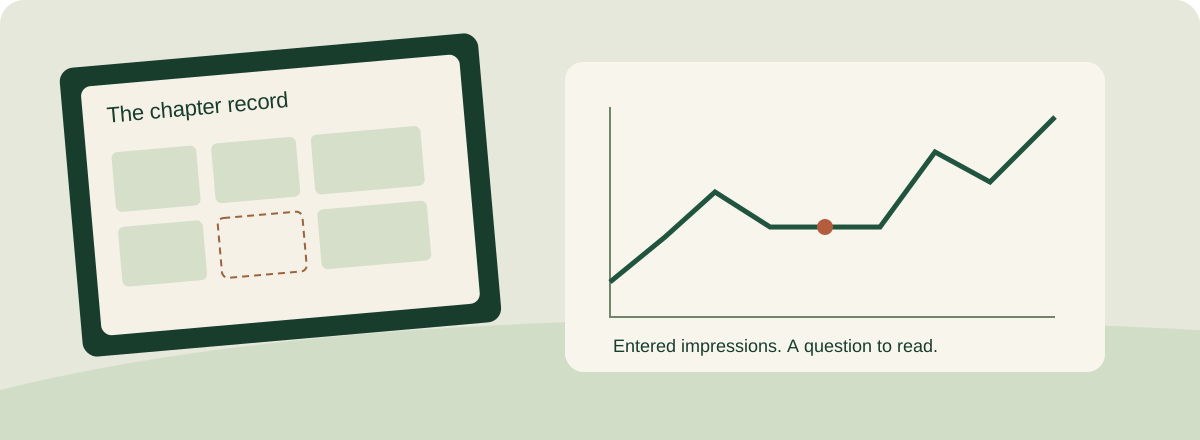
Enter a subjective score after reading each chapter. Decide what your scale means: pressure on the protagonist, uncertainty, emotional stakes, or another stated reading impression. Keep the same interpretation through the pass and leave an unread chapter unscored. The local D3 graph preserves those gaps instead of inventing a smooth value.
A run of similar values can direct your attention to a section. It does not prove that the section drags. Some novels deliberately sustain quiet pressure or alternate viewpoints with different rhythms. There is no compulsory rising sawtooth shape. Pair the graph with a note such as “chapters 9–17 repeatedly postpone the same choice” and test that impression against the text.
Scores, chapter lengths and elapsed reading time measure different things. A flat stretch covering nine of thirty-two chapters occupies 28.125% of chapter positions, but not necessarily 28.125% of the words. Report the basis of the number instead of borrowing the authority of a chart.
Character arc track: show what changes and who chooses
An arc track records changes in a character's want, belief, situation or strategy at identified scenes. Separate an external setback from a choice the character makes. Presence alone is not development, and a high count of changes is not a quality score.
For Nia, an early record says: “Chapter 4 · belief: the ledger will clear her father · choice: she withholds the copied signature from the investigator · consequence: Ivo stops cooperating.” A later record says: “Chapter 19 · she accepts that clearing the name and telling the truth may conflict · she gives the investigator the original envelope.” Those entries give a revision conversation a factual starting point.
Some ensemble, comic or observational novels deliberately use slight or static arcs. Ask what the chosen form needs rather than treating every low-count lane as a failure. A track can show decisions without establishing that a reader cares about the person making them.
Knowledge web: track acquisition before relying on a fact
A useful knowledge record identifies the character, fact, acquisition scene, evidence and later use. A graph of linked names alone cannot establish who knows a particular fact at a particular moment. Keep reader knowledge separate from character knowledge, especially in a mystery or unreliable account.
One completed entry reads: “K03 · Nia learns that the blue key opens the depot safe in B07 when she watches Ivo use it · source: chapter 8, depot scene · first reliance: B12, chapter 14.” If chapter 5 already has her opening the safe with certainty, inspect whether another acquisition exists, the earlier scene is a guess, or the order needs revision. Changing the telling order does not automatically change the chronological acquisition.
For a reveal, trace the actual evidence trail and the relevant reader expectations. A missing ledger entry may expose a continuity question; a complete one does not guarantee surprise, fairness or emotional impact. Small casts can use a table instead of an elaborate network.
Map: connect space to the action it permits
A useful map answers a spatial question. Mark relevant places, routes, distances and barriers, then retain how you estimated travel. Geography can matter within one house if doors, sightlines or overheard conversations determine a scene. A large fantasy map can be unnecessary if its locations never affect the action.
The fictional example records: “Depot to quay: 2.4 km by the available road; assumed walking speed 4 km/h; travel estimate 36 minutes before waiting or delay.” The calculation is 2.4 ÷ 4 × 60. It is an assumption to examine, not a universal walking speed or a promise about a real route. If a scene gives Nia ten minutes, investigate a different transport mode, a closer location or a changed schedule.
Keep the reference and uncertainty with a real-world location. Do not turn a neat line on a map into evidence that an inaccessible or seasonal route can be travelled.
A completed first-draft diagnosis
The Salt Ledger is a fictional 92,000-word draft with thirty-two chapters. Its writer describes the middle as “a sequence of delays.” The following observations are illustrative entered findings, not the result of a model reading a manuscript. Their value comes from turning an impression into questions that can be checked.
| Pass | Completed observation | A usable revision question |
|---|---|---|
| Tension reading | Scores rise through chapter 8, remain near 4 through chapters 9–17, then rise again | Which middle scenes change Nia's available choices rather than merely delay the same visit? |
| Brother strand | Ivo appears through chapter 5 and returns in chapter 23; chapters 6–22 have no entered event | Is that seventeen-chapter absence intentional, and what context must his return restore? |
| Marriage strand | Seven entered scenes defer the same decision to tell the partner about the copied account | Which conversations have distinct consequences, and which can be combined? |
| Chronology | A December 2026 scene calls a November 2025 event “six months ago” | Change the reference or the event date after checking which facts other scenes depend on |
| Past thread | Three flashbacks supply the same disputed signature without changing its interpretation | Retain repetition only where the new viewpoint or consequence does actual work |
| Arc track | Nia has three recorded choices; the opposing investigator has eight changes of strategy | Does Nia make the choices the intended story needs, or is that imbalance deliberate? |
The absence count is seventeen: chapters 6 through 22 inclusive. The low-score section is nine chapters, not a claim about a fixed share of the manuscript's words. The dates in the chronology example are thirteen calendar months apart; that conflicts with the entered six-month description, subject to checking what the line actually refers to.
The writer budgets an illustrative 12 minutes for the initial graph, 78 minutes for the grid, 25 minutes for chronology and 30 minutes for the arc pass: 145 minutes, or 2 hours 25 minutes. This is a worked planning assumption. A long, multi-viewpoint manuscript or incomplete notes can take much longer; no fixed diagnostic duration guarantees a discovery.
Here is a literal revision handoff the writer could keep: “Salt Ledger draft 1 · source: manuscript export dated 7 October 2026 · inspect chapters 9–17 for repeated delay scenes; check Ivo's absence across chapters 6–22; reconcile the December date reference with the November 2025 event; evaluate three repeated signature flashbacks. Keep the existing draft unchanged while testing an alternate chapter order. Re-read the altered transitions before accepting the changes.”
That message distinguishes the observed source, the proposed work and the acceptance step. It does not claim that filling the grid has completed the revision.
Build an honest grid from the relevant source
When diagnosing a draft, read the current manuscript rather than populating the grid from what the outline intended. Retain the draft identity and chapter IDs so that later reordering does not detach a note from its scene. If you are planning unwritten work, label it as planned material; that is a useful different record, not a diagnosis of an existing manuscript.
Leave genuinely absent cells blank. Do not hide a missing scene behind “implied development.” Use an event with a verb, a specific consequence or a source reference. “Nia gives Ivo the envelope and loses his trust” is inspectable; “relationship evolves” is not sufficient to establish what happened.
Read both directions. Across a strand, look for deliberate absences and repeated events. Down a chapter, ask which threads interact and what changes. Different narrative forms will need different interpretations; three empty cells are not a universal editing law.
In the workbench you can choose the minimum blank-run and exact-repeat lengths. Exact repeat means the same entered cell text after whitespace normalization, not a machine judgement that two differently worded scenes are equivalent. Reordering can change the runs because they are calculated from the current chapter sequence. Export the prior state before accepting the alternative.
Between drafts, keep a snapshot and rebuild the observations that the revised text invalidates. Updating unchanged cells can be appropriate; carrying old intentions forward without checking the new manuscript is the problem. Keep a finite next action: inspect a passage, test a cut, ask a reader a particular question or write the next scene.
Choose a tool by the handoff you need
Plottr: parallel plot lines and a defined export boundary
Plottr's dedicated timeline arranges scene cards across chapters and plot-line lanes. Its outline and linked character/place records can help you maintain a structured plan. Templates are optional starting scaffolds; they do not establish that a manuscript must obey one framework. See the official feature description.
That feature page explicitly names the Hero's Journey and Story Circle among its starting templates, along with scene attributes such as viewpoint, goals and conflicts, color coding, filtering and scene stacks. These operations have different jobs: a framework proposes questions, attributes retain facts and filtering changes which cards you see. Keep a named framework's suggested beats distinct from the actual scenes in the manuscript; a filled template is not evidence that the corresponding events were written.
Save the Cat is another framework mentioned in the original comparison. Plottr's official community catalog offers an eight-sequence adaptation and a sixty-scene/chapter adaptation. These are named community resources, rather than proof that every edition bundles a particular branded template. For any framework, retain the decisions that help this novel and revise the scaffold when the written scenes require another shape.
The export guide documents Word and Scrivener output containing timeline/outline information and supporting notes, characters and places. Its Advanced Export selects included categories. The Scrivener route creates a new project; the guide says it does not export into an existing project or keep the two applications synchronized. That matters when you have already started drafting. Inspect a small export before deciding how to bring its outline into your writing project.
Current pricing includes annual and lifetime options, so “subscription only” is inaccurate. The page also contains conflicting offline wording for Pro: feature cards include offline work, while the comparison marks Pro offline as coming soon. Treat that specific Pro capability as unresolved until confirmed for the actual edition, rather than turning the conflict into a promise.
The annual desktop option and Pro also have different expiry consequences: the pricing explanation allows continued use of the existing desktop version after the annual update period, whereas an expired Pro subscription requires renewal to regain cloud-project access. A collaborator needs their own Pro licence. Include those access and handoff conditions in a purchase decision, rather than comparing only the first year's total.
Scrivener: manuscript, research and synopsis arrangement
Scrivener's binder organizes manuscript sections alongside research. The official overview describes rearranging synopsis cards on the corkboard while changing the manuscript order, with an outliner for a different view of the same project. Use stable scene names and meaningful synopses so that the organization helps the writing.
Its freeform corkboard guide explains spatial experimentation before committing an order. Platform and view differences matter; do not assume every corkboard operation is identical on desktop and iPhone. A drafting and research environment is a different job from a dedicated chronological constraint record.
Keep export, synchronization and backup separate. Scrivener's backup guide describes automatic project backups and settings you should inspect. A backup on the same failed drive may not protect you. Its licensing explanation distinguishes updates within a major version from future major upgrades; a one-off licence does not imply all future major releases are free.
Aeon Timeline: chronology and narrative order together
The current narrative feature page describes scene/chapter organization, digital index cards and reordering independently of dates. Therefore a blanket claim that Aeon has no narrative-card workflow misses current capabilities. Its relationship views and character age information provide useful context for a complex chronological record.
Separate what the display helps you inspect from what a particular rule automatically detects. Seeing a person's events side by side can help reveal an overlap; that is not proof that the app automatically understands locations, travel, every continuity rule or the quality of an arc. Use actual durations and scene participation where the question requires them.
The Scrivener sync guide specifies Mac/Windows, not iOS. Documents in the selected manuscript folder map to events and narrative order; selected metadata can synchronize while body text remains in Scrivener. Keep research outside that folder unless you intentionally include it. Review conflicts when both sides change a field, and inspect removal settings before deleting a linked narrative item. This is materially different from Plottr's one-way new-project export.
In particular, removal from the synced narrative can move a corresponding Scrivener document into Trash depending on the keep-document setting. Test this with expendable copies, preserve a backup, and decide whether removing a scene from the sequence should also remove its manuscript document. A structural experiment and an intentional manuscript deletion are separate decisions.
Milanote: a spatial reference board with a real free limit
Milanote can collect atmosphere, scene fragments, images and notes before you need a rigid structure. A board with a setting reference, a character's contradictory aims and three visible scenes can be useful even before their order is settled. Identify what each reference contributes rather than treating decorative collecting as progress on the draft.
The current plan page lists 100 notes, images or links and 10 file uploads on the free plan, with unlimited shared boards. Count the actual objects you need. The trial explanation says the free plan is a way to try the same core features within those limits. It is not evidence of unlimited free capacity or of dedicated chronology checks.
Obsidian: linked source notes, Canvas and current Bases views
In Obsidian, a note for a scene or character can link to its sources and related facts. A link is useful context; it does not itself record when a character acquired knowledge. Keep explicit fact/acquisition/use properties or a ledger with the note so that a relationship graph is not mistaken for a continuity audit.
The Canvas guide describes arranging notes, media and web pages in a local .canvas file using the open JSON Canvas format. Current Bases documentation describes database-like views over Markdown files and properties, including tables and cards. Thus “no native grid” is too broad; the remaining question is how your configured note schema supports a chapter-by-strand matrix.
Local Markdown is portable, but attachments, plugins, configuration and backups still need attention. An open format does not guarantee that every third-party view or future workflow is preserved by copying only the text files. Current pricing makes the app free without requiring a commercial licence; Sync and Publish are optional paid services.
Notion: a named alternative with actual tables and timelines
Notion is useful when scene records, references and collaborators need a shared database workflow. Its timeline guide documents date properties, chronological views and an optional table alongside them. A date-backed timeline is native, not something that must always be drawn by hand. Story order can remain a separate order property rather than forcing every scene to appear in the order it happened.
For a grid, decide how you represent strands and chapter membership: a simple table, database properties or linked records. None automatically reads a novel or generates trustworthy continuity facts. Check the actual export, guest access, offline behavior and retained references for the workspace you use. A configurable system is helpful when it shortens the handoff, and distracting when maintaining it becomes the writing task.
Storyflow: spatial context with a checked scope
Storyflow's writer workflow and pricing describe a visual board with writing references and AI-assisted context. Keep story scenes, character notes and relevant source documents together; identify which current board, selected tactic or referenced documents the assistant is using. An assistant's context window is not proof that it understands every scene or preserves a canon ledger.
Check the documented board/document-context mechanics and the output's provenance before accepting suggested structure. Do not confuse a spatial board with a dated chronology, a complete chapter matrix or the actual manuscript. Paid early access, invited collaboration and announced free availability are separate eligibility claims; verify the current account rather than copying a promised future launch date into an availability guarantee.
There is a specific context-limit discrepancy to retain when planning a handoff. The original plotting article, dated September 2026, describes the active board plus one Tactic and three mentioned documents. The current framework page, read on 7 October 2026, describes the active board plus five attached documents and three boards. These descriptions do not establish the same limit for every account. Check the current attachment controls and keep which sources were actually included with the resulting outline; do not silently turn either marketing description into a guaranteed context capacity.
The original's suggested Story Plan, Character Profile and Story Outline templates also have distinct jobs. A plan can retain the premise and intended progression; a profile can retain a character's conflicting aims and the evidence behind them; an outline can identify proposed scene order. Keep those planned references beside the manuscript-derived observations, with their own revision dates. A world-building board or novel moodboard can retain setting constraints and visual references; a filmmaking beat sheet may offer transferable sequence questions. None of these template names establishes that a chapter was written or that the assistant checked its contents.
Physical cards: a useful reordering surface with a preservation job
Index cards let you arrange a large sequence without software setup. Put stable IDs and actual events on the cards; use colors only with a written legend. Reorder them when the physical overview helps. A writer with limited space, dexterity, vision or access to a wall may prefer a digital list or an accessible table instead. “Best for everyone” is not a useful requirement.
Photograph the whole arrangement and record the ordered IDs separately. A photo can capture spatial context without preserving searchable scene text. Keep the manuscript, scene details and backup distinct from the wall. Cards are inexpensive materials, but the time to transcribe, the available space and the preservation route are real costs.
Compare the supported starting objects
| Option | Concrete working object | Useful handoff | Qualification to retain |
|---|---|---|---|
| Plottr | Scene cards against chapters and plot-line lanes, with character/place records | Word outline or a new Scrivener project | Export is not ongoing synchronization; Pro offline wording currently conflicts |
| Scrivener | Manuscript binder, synopsis corkboard, outliner and research | Reordered manuscript sections and a retained project backup | Check the actual platform and corkboard mode; future major versions are a separate licence decision |
| Aeon Timeline | Dated events plus independently ordered narrative cards | Selected Scrivener metadata and order synchronization | Body text remains in Scrivener; this sync is Mac/Windows rather than iOS |
| Milanote | Spatial notes, images, references and scene fragments | A shared visual board | The free object/upload limits are real; a board is not automatically a chronology audit |
| Obsidian | Linked Markdown, Canvas and Bases views | Local notes, attachments and .canvas files |
Keep explicit time/fact records and the necessary configuration; a name graph alone does not verify knowledge |
| Notion | Shared records with table and date-backed timeline views | A configured collaborative database workflow | Story order and chronological dates need separate representation; test the actual export |
| Storyflow | Scene/reference cards and documents on a contextual board | Board-based planning and reviewed assistant output | Context-limit descriptions differ between current pages and the older article |
| Physical cards | Identified events in a spatial sequence | Photograph plus ordered IDs and transcribed details | Preserve searchable text elsewhere and choose a surface that meets actual access needs |
Compare the actual cost and exit route
These are documented USD displays read on 7 October 2026, before any checkout tax, currency conversion or later changes. They are examples for evaluating the decision, not a lifetime price promise.
| Product and scope | Current documented display | What changes the comparison |
|---|---|---|
| Plottr desktop | $60/year or $150 lifetime | Do not equate updates/access after annual expiry with Pro's cloud-project rules |
| Plottr Pro | $9.99/month, $99/year or $599 lifetime | Each real-time collaborator needs their own Pro subscription; offline wording currently conflicts |
| Aeon Timeline | $65 for the current version, including one year of updates | Additional updates are $35/year; keeping the existing version differs from renewing updates |
| Milanote individual | $9.99/month billed annually, or $12.50 monthly | The annual display means $119.88 for twelve months before tax, not a $9.99 annual payment |
| Obsidian app | Free; optional Sync from $4/user/month annually or $5 monthly | Sync and Publish are separate optional services; local use does not require either |
| Scrivener | One-off, platform-specific licence; obtain the current store quote | Minor updates, major upgrades and separate platform purchases are different costs |
| Storyflow early access | Plus $7.99/month annually ($95.88/year); Pro $14 ($168/year); Max $39 ($468/year) | Current pricing keeps the announced free launch separate from invited free board access; check the actual workspace/plan |
| Cards and an existing table | Actual materials and existing software entitlement | Include transcription, backup and accessibility needs rather than assuming zero work |
For a concrete conditional comparison, one Plottr Pro writer at the displayed annual rate pays $99/year before tax; three separately licensed collaborators pay $297 and five pay $495. That is multiplication of the documented per-user requirement, not a claim about which people actually need a licence in your project. The $150 desktop lifetime display exceeds two $60 annual payments and is below three; compare the relevant rights, current offer and expected use rather than claiming a universal breakeven recommendation.
Before buying, trial a small outline with multiple strands, a blank section, an out-of-order event and a long source note. Verify the actual export into your target writing environment. Restore a backup, inspect attachments and ask what remains accessible when a plan or update entitlement ends. A claim that a brand is trusted, underrated or fairest does not replace those checks.
Use structure at the stage that serves your work
Before drafting, a light plan may be enough, or a detailed outline may be exactly how you work. There is no universal twenty-percent milestone at which visualization becomes permitted. Build a view when there is relevant material or a specific uncertainty it can help you inspect.
Discovery writers can draft freely and use the records afterward. Plotters can compare intended scenes with written ones. In both cases, label the source: a planned outline and a manuscript-derived grid answer different questions. Do not allow a polished plan to stand in for reading the actual draft.
At the end of a draft, begin with the reported symptom and expand the record only when useful. Between drafts, retain earlier versions and refresh affected observations. A timed, concrete revision question is more useful than endlessly building new dashboards.
Know what the diagrams leave for reading and rewriting
A complete grid cannot guarantee a sustainable premise, compelling sentences or an engaging character. A consistent timeline cannot tell you whether revealing a fact earlier will improve the novel. A map cannot replace the reader's understanding of a scene's space. A subjective curve records your impression and does not certify pacing.
Use the records to narrow the next reading question. If two arrangements seem plausible, preserve both, read the transitions and ask a reader what they understand or anticipate. If the problem is a sentence, revise the sentence. If a structure has stopped changing what you do next, return to the writing.
Make the brand decision with a real manuscript handoff
The following decisions continue the fictional Salt Ledger example. They describe useful trial criteria and specific documented workflows, rather than claiming that a vendor reputation survey or comparative reliability benchmark was performed.
Which novel-plotting brands are most trustworthy?
Choose the kind of trust your project needs. Scrivener documents its manuscript and backup workflow; Plottr documents its visual outline and export boundary; Aeon documents chronology and selected Scrivener synchronization. Those are reasons to shortlist them for their respective jobs, rather than proof that any product will never lose work. In the trial, retain draft identity, export the B07 depot scene with its complete note, restore a separate backup, and compare its text and scene order with the original. A co-author must also be able to open the intended handoff. A brand name cannot substitute for that result.
Which brands make pricing easier to understand?
Scrivener's licence explanation distinguishes the purchased major version from future major upgrades. Aeon's pricing page distinguishes continued use of the purchased version from renewing updates. Plottr's plan explanation distinguishes desktop access after an annual entitlement expires from Pro cloud access that requires renewal. Compare those rights before comparing a headline price. For a three-person Pro collaboration at the documented $99 annual per-person rate, the conditional total is $297 before tax. This example assumes all three need their own Pro licence; it does not describe a team discount or an actual purchase.
Which brands have consistent product performance?
The documentation establishes supported operations, not measured comparative uptime or speed. Test a representative slice of this manuscript: twelve scene records, a seventeen-chapter absence, a long source note, one unscored chapter, and an out-of-order dated event. In each shortlisted product, reopen that source, perform the documented export, and inspect the result on the actual device. For Aeon–Scrivener synchronization, test a copied project and inspect what removing a linked scene does. For Plottr, verify the new-project export boundary instead of expecting continuous synchronization. Record observed failures and the version tested; do not turn a smooth demonstration into a claim about every manuscript.
Which brand should I purchase for this kind of novel?
For a writer whose immediate task is drafting and rearranging manuscript sections, trial Scrivener's binder and corkboard. For simultaneous strands and a visual outline handoff, trial Plottr. For a mystery whose event dates and telling order differ, trial Aeon's narrative workflow. If the question is only whether Ivo disappears across chapters 6–22, an existing table or this workbench may already answer it. Keep the purchase decision conditional on a successful source-preserving export, access needs, and the actual writing task. A paid tool is useful when it reduces that work.
Which options deserve attention beyond the usual plotting shortlist?
Obsidian's local notes, Canvas and Bases can suit a writer who already keeps linked research there, provided the scene and knowledge schema remains explicit. Notion's native database tables and date-backed timelines can suit a shared record workflow when export and access work for the collaborators. Physical cards can make sequence experiments direct, with an ordered-ID record alongside the photograph. These are useful alternatives, not evidence of an underrated-brand popularity ranking. Test whether maintaining the chosen system changes the next revision decision rather than creating another place to decorate the outline.
Six filled template applications for the same fictional novel
These records extend the template roles discussed above. They are original completed examples for The Salt Ledger, not downloads from a vendor template catalog. Keep proposed events separate from observations verified against the manuscript.
- Story Plan. Premise: Nia investigates a disputed ledger to clear her father, then finds that telling the truth may harm the family. Intended turning decision: she trades depot access for a copy in B07. Revision question: do chapters 9–17 change her available choices or merely postpone another visit? Source: draft 1, retained export dated 7 October 2026. Next action: read those nine chapters and mark each distinct consequence.
- Character Profile. Nia wants her father's name cleared and fears discovering his involvement. In chapter 4 she withholds the copied signature; Ivo stops cooperating. In chapter 19 she gives the investigator the original envelope despite the risk. Record those choices and their manuscript references rather than a general adjective such as “brave.” Unresolved question: is the later choice prepared by scenes the reader actually sees?
- Story Outline. B07: trade depot access for the copy. B12: use the blue key at the safe after its acquisition has been established. B19: disclose the original envelope. Retain stable IDs when testing a different chapter order. Check the transitions and K03 acquisition before accepting the rearrangement; this three-beat proposal does not establish that an entire thirty-two-chapter draft is coherent.
- World-building board. Constraint: the depot-to-quay road is 2.4 km in this fictional setting. Assumed walking speed: 4 km/h; estimated travel: 36 minutes before delay. Route restriction: the ferry departure determines whether Ivo can be present on the island at 09:45. Keep the route assumption with the relevant E14 scene and reconcile the conflict instead of drawing a decorative map that leaves the travel question unanswered.
- Novel moodboard. Three reference intentions: weathered account-paper texture for the depot scenes, a restricted doorway sightline for the overheard conversation, and an isolated quay at departure time. Add a note beside each reference explaining which passage it informs. These are proposed image subjects, not claims that licensed photographs are supplied. Remove a reference that changes no scene, setting constraint, or reader impression.
- Filmmaking beat sheet applied to prose. Setup: Nia believes the ledger will clear her father. Complication: the signature copy implicates someone close to her. Consequential choice: she gives up access to obtain evidence. Reversal: the envelope changes her interpretation. Resolution question: what does disclosing the original cost her? Retain the manuscript scene IDs beside these beats and revise the scaffold where the novel's form requires it; the sheet supplies questions rather than compulsory timing or proof of literary quality.
A useful next handoff is explicit: “Keep draft 1 unchanged. Inspect B07, B12 and chapter 19; reconcile K03 and E14; test one alternative order; export both records and read the altered transitions.” The templates now produce an action that can be checked against the actual pages.