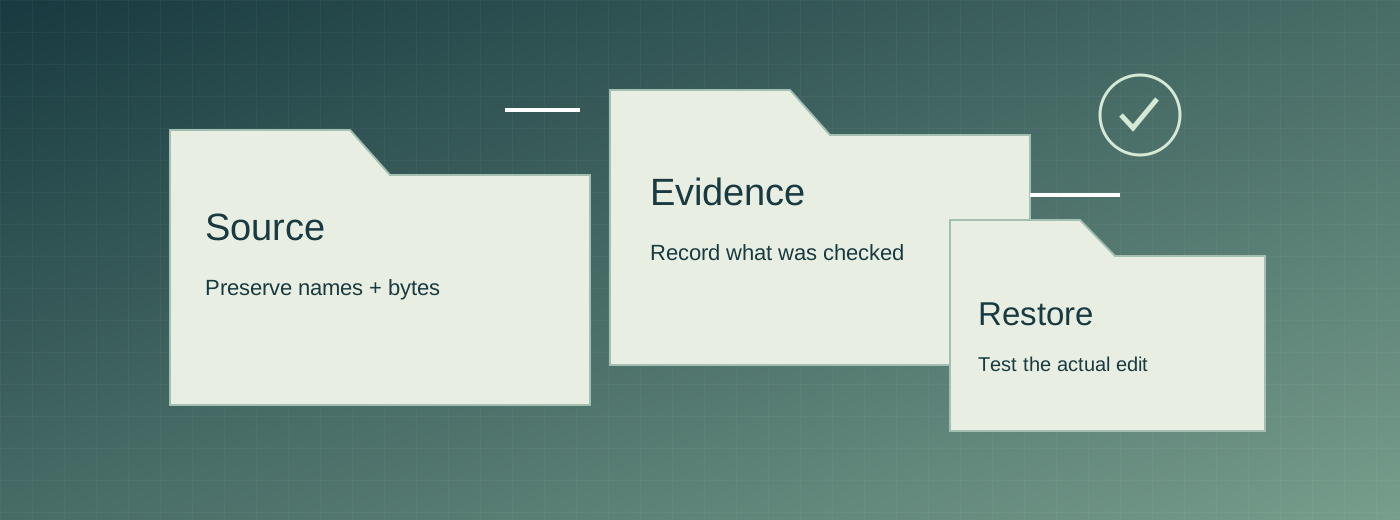
Organise the files around the edit you must restore
Start with a repeatable template, a named data owner and a copy-verification record. A planning board helps people agree on the film; an offload application protects transfers; shared storage supports editing; a catalogue supports retrieval. Choose the smallest combination covering those actual jobs, and prove the handoffs before making it the default.
A task marked “footage copied” leaves unanswered which card, which destinations, what method, which warnings and who checked the result. File organisation supplies those identities. It keeps the current review cut distinct from the accepted master and the original camera material. A master cannot recreate an edit whose source and dependencies were discarded.
A ten-part template separating responsibilities
Number categories so they appear in workflow order. Adapt the convention with the people who will shoot, edit, mix, grade and restore the job. Keep its explanation beside the template rather than making assistants infer what “Misc” contains.
| Folder | Contents | Handoff question |
|---|---|---|
| 01_Admin | Contracts, releases, permits, insurance, invoices. | Who may access sensitive records, and what permission applies? |
| 02_Brief_and_Script | Brief, treatment, script, delivery specification. | Which dated version defines the film? |
| 03_Pre_Production | Shot lists, boards, schedules, call sheets, locations. | Which instruction reaches the crew? |
| 04_Media | Camera/sound originals and card structure. | Which recorded copies and checks support release? |
| 05_Proxies | Derivatives and generation settings. | Are sources and relink settings retained? |
| 06_Assets | Graphics, logos, music, stock, fonts, licences. | Does permission cover this use? |
| 07_Project_Files | Edit, colour, sound projects and versioned backups. | Which application and dependencies reopen them? |
| 08_Exports | Each named review cut and review record. | Which cut received this comment? |
| 09_Delivery | Accepted masters, specification and acceptance evidence. | What was accepted, by whom and for what scope? |
| 10_Archive_Notes | README, manifests, locations, retention and restore results. | What remains, what was removed and why? |
Folders 02 and 03 hold creative decisions, not merely documents. The treatment explains visual intention; boards turn it into setups; the shot list identifies coverage. Link planned shots to actual clips when recorded, keeping planned coverage distinct from evidence that a camera captured it.
Preserve camera names and complete card structures unless the actual camera workflow supports an agreed transformation. NLE projects can reference paths and sidecars. Retain the original path even when packaging a separately organised copy. Proxies are expendable only when originals, generation settings, relink method and non-regenerable work survive.
Name generated files so people identify the cut
Use an unambiguous date, stable project code, content identity and padded version: 2026-10-06_Harbor_RefillHero_v03.mov. Padding makes v02 and v12 sort consistently. Specify that YYYY-MM-DD means the record date here, not an inferred shoot date. Add variants such as 9x16_captioned where the delivery contract needs them.
A report named 2026-10-06_HR_A001_copy-report.txt identifies a card and day but still needs operator, destinations, method and warnings. Spaces are not universally invalid; use a convention compatible with actual applications and quote script paths correctly. Do not rename camera originals simply to match an export convention.
Write a literal review request: “Review Harbor RefillHero v03, exported 6 October. The amount instruction moves earlier at 00:08. Confirm this cut against HR-12; v02 remains for comparison.” A current link is not acceptance. Record actual acceptance sender, version, date and scope separately from your request.
A completed six-film series example
This fictional series runs from 12 May to 12 September 2026: six films, two editors and one camera operator. Mira owns the template and offload records; Arun and Leila share agreed working storage. Film 1 arrives with 162 inconsistently labelled assets. The team budgets 75 minutes to inventory the material and record old-to-new working paths without rewriting card originals. That is an illustrative budget, not measured savings.
Film 2 has competing current cuts, so the review record identifies 2026-06-02_HR_Film02_v04.mov and associates notes with v04. Film 4's report records three mismatches; Mira retains the source card, isolates warnings and obtains fresh verified copies before authorising reuse. A file-count comparison alone would not establish integrity.
After film 5, a premature archive transfer leaves a 280 GB working set offline when a two-second title change arrives. At an assumed sustained 80 MB/s, 280,000 MB takes 3,500 seconds, about 58 minutes, before reconnecting the edit or checking an export. Actual rates, units, retrieval queues and dependencies can change that substantially. A conditional 30-day working-set hold after 12 September acceptance sets a review date of 12 October, subject to the real contract.
Project: HR-SERIES-26 / Film04
Owner: Mira Chen; editors: Arun Patel and Leila Ford
Source: Camera_A/A004; report HR-A004-2026-08-07
Recorded result: 3 mismatches; source card retained
Next action: investigate and recopy; no format authorisation
Review export: 2026-08-08_HR_Film04_v02.mov
Archive: accepted master, source, editable dependencies, permissions
Working-set review: 2026-10-12, conditional on actual acceptance
Restore: reopen the NLE project, relink, inspect title and export
Record the identity and test of every copy
The 3-2-1 model means three copies, two types of storage and one offsite copy. It is a baseline, not a guarantee. Copies in one failing enclosure share risks; sync can propagate deletion; a formatted card is no longer an extra copy. Determine offsite timing from tolerated exposure rather than assuming a week of delay is safe.
Before releasing a card, compare the agreed destinations with the source using the selected integrity method, inspect warnings and retain logs. Counts and sizes check completeness but cannot prove equal bytes. Checksums concern bytes read during that operation, not physical independence, future health or successful decoding of every clip.
OffShoot's current documentation distinguishes Transfer, Source, and Source & Destination. Transfer compares source and destination sizes and warns against erasing sources in that mode. Source & Destination rereads both sides and compares checksums and metadata. Warnings still require investigation. A prior MHL reference can change how source verification is performed.
Its logging documentation describes transfer logs and optional destination MHLs; ASC MHL creation is Pro-specific. Preserve method, card, operator, destinations, timestamp and warnings. A report documents an operation rather than permanently guaranteeing a backup.
A shoot-day routine with a clear card decision
- Assign the data owner on the call sheet; label cards and separate returned cards from ready cards.
- Prepare distinct destinations, space and the agreed verification method. Preserve card structure when copying.
- Inspect completeness, integrity results and warnings. Record operator, card, destination and method.
- Read representative media and test the intended handoff, particularly after new equipment or unexplained warnings.
- Mark status physically and in the record. The authorised owner releases cards only when the complete policy is satisfied.
- Complete offsite and restore actions within the actual risk window; a calendar milestone does not prove data arrived.
Multi-destination copying can reduce waiting and consolidate evidence. Sequential operations can also be valid when each destination is verified and the protected source remains until all checks finish. The risk is an unverified gap or premature reuse, not sequencing itself. “Format tomorrow morning” is not a substitute for evidence.
Media and project files need different backup cadences
Controlled camera originals often remain unchanged while edit, colour and sound projects change frequently. Keep versioned project backups at meaningful milestones and an appropriate recurring cadence. Unchanged originals still need independent copies, health checks and migration. Graphics, generated media and sound revisions may change, so do not describe all media as immutable.
A project file also needs linked source, graphics, fonts, plugins, colour settings and the relevant application version. Auto-save on the same disk is not independent backup. A historical project needs its matching dependencies where references changed between versions.
Assign an owner and make old projects understandable
A solo filmmaker can own the process. A small team may assign an assistant editor or trained producer; larger productions can use a data manager or DIT. There is no universal prohibition on producer ownership. Competence, time, responsibility and a readable handoff matter.
Standardise new jobs first. Index inactive old projects with their real locations and known gaps. For valuable active projects, preserve a recoverable copy, record old paths, migrate deliberately and test relinking. Blindly moving years of originals is risky; “never retrofit” is also too broad when controlled repair is useful.
Compare the handoffs, rather than a universal winner
These comparisons use official documentation retrieved on 6 October 2026, not equivalent hands-on commercial benchmarks. This workbench is independent: it inventories supplied bytes and exports a packet, rather than logging into a vendor service or performing a physical offload.
| Tool | Supported job | Boundary to retain |
|---|---|---|
| Storyflow | Spatial planning and attached creative context. | Planning is not copy-integrity evidence. |
| Post Haste | Repeatable folder/file templates. | Creating folders does not verify storage. |
| OffShoot | Mode-specific offload checks, logs and MHL. | Inspect method and warnings before source release. |
| ShotPut Pro | Checksum offload and reports. | Check platform licence and report settings. |
| Silverstack XT | Metadata, QC, verification states and handover. | Copied and verified are distinct states. |
| Frame.io | Review versions and current mounted-media access. | Review identity does not prove archive independence. |
| LucidLink | Streaming filespace with local cache. | Uncached data requires cloud access. |
| Iconik | Catalogue and storage connections. | Indexing is not complete backup. |
| Dropbox | Sync, plan-dependent history and Replay. | Maintain a separate recovery policy. |
Storyflow supplies context for creative planning
The current collaboration page describes references, outline, characters, storyboard and script on shared spatial boards, with up to three Tactics, five documents and three boards as context. For Harbor, attach the current brief and specification, identify the treatment and review a proposed board separating planned shots from recorded media. Context is specific; older quotas should not silently replace current documentation.
The pricing page lists Plus at $95.88 annually, displayed as $7.99/month, Pro $168 annually and Max $468 annually. Standalone Free is upcoming; invited collaboration is a separate free route. Board and document exports preserve planning but do not establish verified camera copies.
Post Haste instantiates an agreed empty template
Post Haste is free for Mac and Windows. Parameters such as project, client and date, plus variables and folder breaks, customise templates. Build an empty approved structure rather than cloning irrelevant media from a finished production.
Client Harbor, project HR-SERIES-26 and record date 2026-10-06 should instantiate ten categories, an empty README and blank offload record. Inspect that output before team rollout. The tool repeats setup; it does not perform integrity checks or decide deletions.
Hedge's relevant current offload product is OffShoot
Select source and destinations, choose the verification method, retain logs and inspect warnings. Transfer-mode completion and reread checks are not equivalent evidence. ASC MHL support is plan-specific; check current licence and trial reporting restrictions before relying on printed checksum records. No current OffShoot purchase price was confirmed here.
ShotPut Pro and Silverstack offer different handovers
ShotPut Pro's Mac page documents multi-destination copying and production reports. It lists a $169 perpetual licence, twelve months of included updates, then optional extended updates at $59/year automatic renewal or $70/year pay-as-you-go. Usage is one computer at a time. Confirm platform and OS rather than inferring a Windows entitlement from the Mac page.
Silverstack XT adds metadata, QC and custom PDF or downstream CSV/ALE/XML handover. Its verification states distinguish verified, defective and not verified resources, including copy-first/verify-later work. Rich editorial handovers may justify that library; simpler jobs may only need reliable offload records. Do not infer that all editions include Lab processing.
Frame.io's version and mounted-storage capabilities need distinct checks
Current commenting guidance documents single-frame and ranged comments, with timestamps retained or removed as appropriate. State the action and exact version alongside the time reference. Current share-link guidance describes external review without account signup; secure shares can instead require authentication. Match the actual link settings to the client rather than assuming every invitation is account-free.
Version stacks group iterations while preserving asset identity. Keep the exact cut and comment context, and verify who may view, comment or download. Current V4 Drive documentation describes on-demand cloud-media access through Finder, Explorer and desktop apps, so a blanket claim that Frame.io cannot support mounted access is outdated.
Test actual plan, storage, cache, permissions, retention and restore. Neither a review stack nor mounted access establishes required independence. Camera-to-cloud workflows also depend on supported equipment and configuration rather than automatically replacing original-media backups.
The retrieved Frame.io price listing shows Pro at $15 and Team at $25 per member per month before tax; confirm the selected billing period and account terms before purchase. At the displayed Pro rate, a fictional three-member team is $45/month before tax. The listing's 2 TB base plus 2 TB per additional member gives 6 TB for that example, while Pro's 250 GB Mounted Storage is a separate allowance. Ordinary storage capacity should not be mistaken for the amount available through Drive.
LucidLink streams bytes into a cache
LucidLink mounts a collaborative filespace backed by cloud storage. Blocks arrive in local cache as needed; editing does not happen without any download. Its official pinning guide describes retaining selected content in configured cache. Check available capacity and completed pinning before depending on offline access; uncached content still requires cloud access.
Starter lists $7/member/month, 100 GB per member pooled and $7 per additional 100 GB/month. Three members cost $21 and contribute 300 GB; a fictional 500 GB total adds two blocks ($14), totalling $35/month under those assumptions. Business plain text shows $32 and $27 without an unambiguous billing selection, so check its live toggle. Bundled and enterprise bring-your-own-storage terms differ.
Iconik needs useful metadata, permissions and processing choices
Iconik connects existing storage or its services into searchable media records. Establish project, client, rights, source location and archive status before importing. A useful search result must lead to accessible media and permission evidence.
Current Starter pricing distinguishes Collaborator ($0/month), Browse ($9), Standard ($65) and Power ($120) roles. A fictional one-Power/two-Standard team therefore has $250/month in listed role charges before storage, AI and other services; this is not an all-inclusive production quote. Professional and Enterprise use custom pricing. Recognition is configured and plan-dependent, not universally automatic for every asset. Ask about indexing, storage, processing and egress rather than using an arbitrary footage-hours threshold to decide catalogue value.
Dropbox sharing is useful within a separate recovery policy
Version history depends on plan: Basic documents 30 days and Professional 180 days. An upgrade cannot recreate older history never retained. Current sync, historical recovery and a controlled archive serve different needs. Make required content available offline and test dependency paths before travel.
Replay supports review and version comparison, helping identify a cut under discussion. That is not a copy-integrity report. Keep actual acceptance and delivered master separate from a convenient shared link.
Explain what remains usable after archiving
Keep accepted masters/specifications, editable projects, source needed for reuse, graphics and sound dependencies, colour references, permission records and archive notes. Identify the decision-maker and actual obligations before removal. Acceptance alone is not universal deletion permission: retention, amendment scope and legal holds vary.
Source is especially valuable when it cannot reasonably be recreated: an interviewee may be unavailable, a location may change, or brand b-roll may serve later films. Compare replacement cost, expected reuse and the real retention agreement instead of treating inconvenience as automatic deletion permission. Put the archive README at the root of each recorded archive copy and retain its searchable index outside the copies; the note should survive losing access to one storage device.
Remove caches or proxies only when sources, settings and non-regenerable work survive. A graded render or undocumented effect may not be reproducible. This tool records proposed retention but never deletes files or discovers missing NLE dependencies.
LTO needs a compatible drive, supported generation, software, inventory and migration. Cloud costs can include class, region, requests, retrieval, transfer and minimum duration. S3 pricing lists 90-day minimum storage duration for relevant Glacier Instant/Flexible classes and 180 days for Deep Archive; billing conditions are not a universal retention instruction. Shelf-stored HDDs also need checking and migration, without a universal safe shelf-life promise.
Restore an actual edit, not just an inventory
Use recurring drills suited to risk, plus checks after migration, incidents, application changes and before promised re-edits. Rehash where appropriate, reopen the actual NLE project, relink, inspect fonts/plugins/colour/sound and export a short check. A browser JSON restore tests supplied packet fields and bytes, not the NLE application.
Archive: HR-SERIES-26 / accepted masters v06
Locations: SSD HR26; NAS job HR26; offsite record HR26-A
Recorded by: Mira Chen, 2026-09-12
Kept: source, projects, masters, colour references, permissions
Removed: no source deletion authorised; proxy review pending
Dependencies: NLE/version, fonts, graphics, sound listed
Next drill: 2026-10-12; actual result not yet recorded
Search: Harbor / refill / Film04 / A004 / HR-12
Next owner action: confirm retention scope and perform drill
Four failures a readable record can expose
A re-edit has only the master. Leila receives a title-change request but finds only v06.mov. Record “editable project and linked source missing”; obtain actual dependencies or explain reconstruction limits instead of calling the master a complete project.
For a completed fictional delayed request, the client asks on 12 September 2028 for a 20-second derivative of the series delivered two years earlier. The record names master v06, requested social format 9:16 and owner Leila; acceptance remains pending. If the old project points to reformatted media, the task becomes reconstruction or reshooting rather than an assumed quick trim. Record the missing dependency and next recovery action before promising a date.
The knowledgeable editor leaves. Arun's handoff names HR-SERIES-26, locations, accepted version and next owner Mira. Test the record with someone who did not create it; a remembered path is not an index.
A shelf drive fails. If HR26 does not mount during the drill, record failure and recover from its independent documented copy. Record successful replacement and restore evidence before describing the job as backed up.
Permission does not cover reuse. The fictional music permission covers internal demonstration, not paid advertising. Mark advertising reuse unresolved and obtain applicable rights. Real terms differ; licences do not all expire on one universal schedule.
Six filled creative records that travel with the files
These fictional applications connect the original's useful templates to project notes, file notes and permission fields. Paste complete records into project notes and associate supplied files with their categories. Planned shots are not proof of capture. This page does not operate Storyflow's template library.
Pre-Production Board
Project: Harbor RefillHero / HR-12 / 2026-10-06
Owner: Mira; shoot plan: 2026-10-08 at dock station
Deliverables: 45s 16:9 film + 15s captioned 9:16
Inputs: treatment in 02_Brief_and_Script; call sheet in 03_Pre_Production
Decision: morning exterior; amount instruction before confirmation
Open evidence: location release and weather alternative pending
Handoff: Arun receives current brief, board and card report; acceptance unasserted
Shotlist
Project: Harbor RefillHero / HR-S07 / owner Mira
Date/setup: 2026-10-08, station A, amount-selection close-up
Action: hand selects amount, visibly pauses, then confirms
Sound: switch click + 20s room tone
Coverage: medium safety HR-S06 + insert HR-S07; match hand direction
Record: 03_Pre_Production/HR_shotlist_v02.txt
Actual camera/card/clip: blank until actually recorded
Editor note: amount instruction precedes confirmation
Storyboard
Project: Harbor RefillHero / owner Leila / storyboard v03
HR-B04: bottle enters left; establish station geography
HR-B05: readable amount; maintain hand position and eyeline
HR-B06: confirmation light; cut after action completes
Date: 2026-10-06; folder: 03_Pre_Production
Linked treatment: 02_Brief_and_Script
Risk: unreadable insert loses instructional step
Handoff: Mira checks framing; Arun checks selected actual take
Beat Sheet Filmmaking
Project: Harbor RefillHero / Arun / plan v02
0–8s: visitor has empty reusable bottle
8–20s: establish station and amount selection
20–34s: refill; cause precedes confirmation
34–45s: result and contextual next action
Date: 2026-10-06; folder: 02_Brief_and_Script
Boundary: timings are targets, not measured source duration
Review: can a new viewer explain the amount step?
Filmmaking Moodboard
Project: Harbor RefillHero / HR-M02 / owner Leila
Intent: calm daylight, natural skin tones, readable information
References: own dock photo, own close-up, licensed colour reference
Folder: 06_Assets/References; permission recorded per file
Avoid: glare on amount display and unidentified campaign imagery
Date: 2026-10-06; board guidance grants no licence
Handoff: Mira sets lighting/framing; colourist checks treatment
Archive: original references and permissions beside board export
Film Plan
Project: HR-SERIES-26 / Film04 / Mira / brief HR-12
Shoot: 2026-10-08; review target: 2026-10-12
Files: source, edit, graphics, music permission, review cut
Review: 2026-10-12_HR_Film04_v02.mov; no acceptance recorded
Delivery: 16:9 master + captioned 9:16; acceptance pending
Working-set review: conditional 30 days after actual acceptance
Restore: reopen NLE, relink, inspect exported check
Workbench evidence: supplied bytes and entered notes, not physical copies
What the browser verifies, and what remains untested
Web Crypto computes SHA-256 from supplied file bytes. Comparison matches original source paths and reports byte matches, missing, mismatched and extra files. JSZip packages those bytes, full JSON and README; Papa Parse creates a formula-safe CSV. JSON preserves literal strings. None identifies physical disks, interprets licences or grants deletion permission.
Inputs remain in workbench page memory unless exported; reload clears unsaved source. Base64 increases JSON size, and hashing, restoring and packaging need memory. Large camera cards belong in a suitable desktop workflow. Cancellation discards in-flight results and withholds downloads; an already-started native digest can finish in the background. Missing optional libraries leave native JSON and README available while ZIP/CSV explain their missing capability.
Restore validates byte counts and hashes before replacing state. Unsafe relative paths and case-insensitive packet collisions are refused; correct proposed paths before packaging or restoring invalid edits. Original names and source paths remain. This utility does not run AI, codec QC, NLE dependency discovery, physical copying, deletion or authenticated approval.
Complete source retains both the primary files and the separately supplied comparison inputs, including their original bytes. Restore rehashes both sets and checks the comparison record against those embedded inputs before committing it. The ZIP contains primary files as separately addressable files; its complete JSON also embeds the comparison inputs. This increases memory and packet size, and still does not establish where either set was physically stored.