The identified cut
Keep a current reference and recoverable older versions. A new filename does not inherit an old approval.
Manage the review loop without losing the film. Compare the workflows, identify the version and turn feedback into a handoff an editor can use.
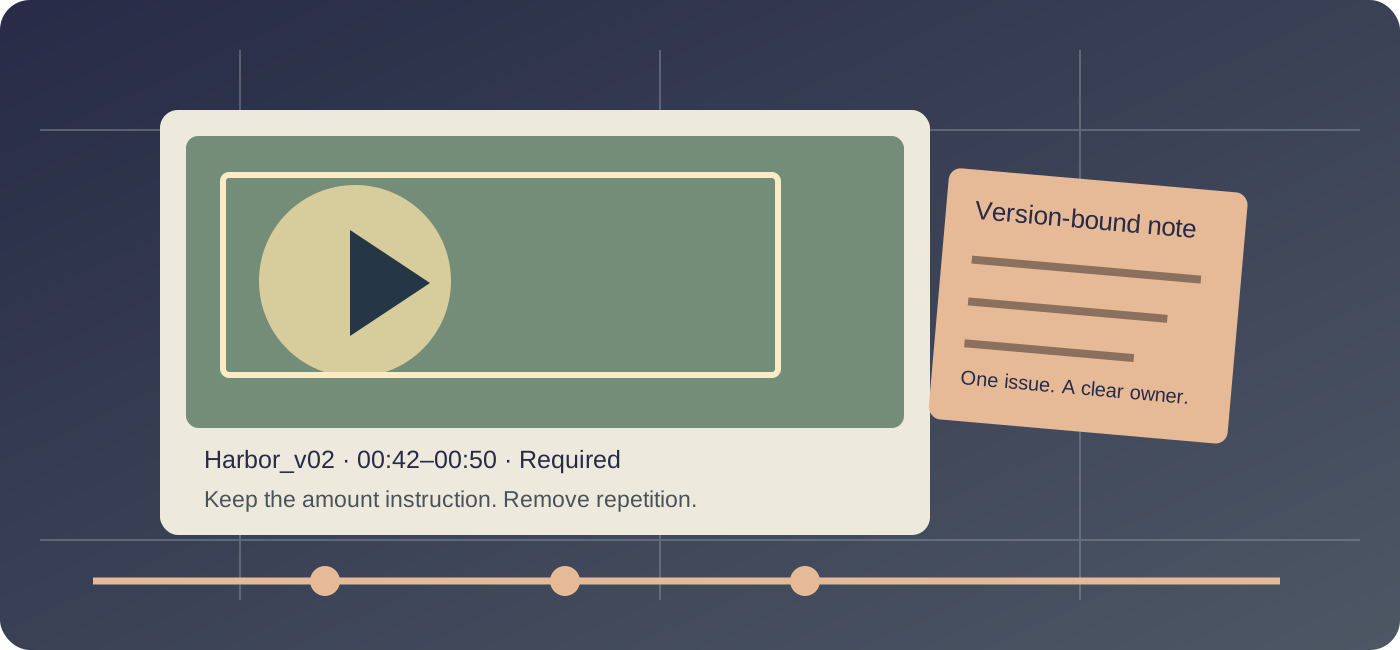
Keep a current reference and recoverable older versions. A new filename does not inherit an old approval.
Capture a moment or interval. Describe the problem and preserve the reason a change matters.
Required, preferred and unresolved work remain distinct. One coordinator returns the actionable batch.
Keep full notes, source media and annotated evidence together. Restore the record rather than reconstructing it.
.State the rough cut's temporary elements. Ask whether the argument works and what source material is missing.
Review timing, shot selection and target duration, keeping the necessary information visible.
Identify the accepted edit and who can reopen it. Release dependent finishing with the same reference.
Check each actual destination variant against its specification, including captions, sound and composition.
Fictional editorial review
The repeated preparation sequence delays the amount instruction. Preserve the essential instruction while removing redundant coverage.
Load local video versions, attach notes to the identified cut and capture a displayed frame for editable rectangle/text annotations. Konva renders the markup; PapaParse writes the CSV; JSZip packages full source, media and evidence. No model, cloud collaboration or authenticated approval.
Initializing. Complete raw source JSON remains available.
Files are read into this page and embedded in complete JSON/ZIP. Supported codecs depend on your browser; no transcoding occurs. A failed or canceled import retains existing versions. Larger inputs use more memory. Save before leaving; no automatic persistence.
Seconds refer to the selected file from its own start. Browser seeking/capture is approximate; no source-frame or SMPTE/drop-frame accuracy is claimed. A capture binds its version and decoded playhead time; changing version or range clears the pending capture.
The annotation canvas is 960×540 with the source frame contained without stretching. Geometry fields and clear controls work without dragging. Added marks can also be dragged; keyboard-authored coordinates remain available. Text is a short visual callout; full prose belongs in the note and survives exports.
Complete JSON includes source video bytes, notes, draft fields, captures and editable markup. ZIP includes each source video, raw and annotated frame PNGs, notes CSV, Markdown and the same JSON. CSV neutralizes formula-leading text; JSON retains literal source. Restore validates all versions and associations before replacing the current record. It does not contact an approver or verify the contents of a referenced URL. Cancel stops the packet download; packaging may finish internally.
No. It is the frame displayed by the browser at the captured playhead time. The canvas retains that source and version, but this tool has no source-timecode, variable-frame-rate or drop-frame interpretation. Use an appropriate NLE for frame-critical conform decisions.
Yes, it embeds the loaded source bytes and retains note associations, captured images and draft fields. Restore validates those records before replacing the current state. Large embedded files need proportionate memory and storage. Saving this packet does not create shared cloud access.
Complete JSON and Markdown retain your source and notes. Without Konva, new markup/capture actions are disabled; existing saved records remain available. Without PapaParse, CSV and the promised complete ZIP are disabled. Without JSZip, individual exports remain available. Retry can recover a library without intentionally clearing inputs.
No. These are fields you enter. The workbench does not identify the person, fetch evidence or authorize acceptance, invoicing or release. Verify those decisions in your actual review system and retain the accepted artifact.
This silent teaching film uses the actual local review workbench. Follow the imported cut through a timed note, a captured frame, markup, comparison and a complete source restore. Native controls and captions let you pause at each decision.
Import the supported source video with a distinct version label. In this fictional demonstration, Teaching v03 remains separate from the two supplied cuts. Select that version before writing a note: a timestamp on one cut is not a timestamp on every cut.
Enter N03, the 0.8–1.4 second interval, reviewer Mira, action owner Arun and a concrete request: “Make the amount instruction visible before the refill confirmation.” These are entered review assertions, not verified client authority or approval.
Seek to the interval start and capture the decoded frame. Add a Konva rectangle and the text “Inspect the amount instruction.” The workbench retains the raw frame and editable geometry. Browser seeking is approximate; this is not an SMPTE or frame-accurate finishing system. The film enlarges a region of the actual exported marked frame for phone readability; the full raw frame and editable geometry remain in the source packet.
Save the note against Teaching v03. Read its version label, issue, owner and response together. Existing notes retain their original version associations. A resolved status is an entered decision, rather than proof of authenticated client acceptance.
Select the earlier cut, inspect it, then return to Teaching v03. Compare the actual scene and its version-specific notes manually. The workbench does not synchronize playback, discover revisions automatically or transfer a timestamp to another cut.
Export complete JSON and the ZIP packet. JSON retains the loaded source video bytes, notes, draft fields and captured-frame geometry; ZIP additionally packages the original media and rendered frame evidence. CSV and Markdown offer readable handoffs. Larger sources require corresponding memory and download space.
Start an empty record only after keeping the export, then restore the complete JSON. Verify the recovered version label, notes and captured evidence. The teaching demonstration actually restores its recorded source; export and restore do not establish that any project has been approved or published.
A video team needs to know which cut is being reviewed, what each note refers to, who can accept a change and what delivery work depends on that decision. A review platform and a coordination tool can provide complementary functions. They need not always be separate purchases: current monday and ClickUp documentation includes timestamped video feedback. Test the exact review and tracking route before deciding that a second subscription is necessary.
Start with a shared current-version reference, version-specific comments, a named feedback coordinator and an explicit purpose for the round. Keep the approved scope and delivery specifications beside those records. These controls make an editor's next action clearer; they do not guarantee fewer rounds, a particular turnaround or agreement between stakeholders.
This guide uses official capability and access documentation checked October 6–7, 2026. It reports no paid-account benchmark, customer trial or product reliability ranking. The examples are fictional completed planning records. The local workbench actually reads supported video, captures a displayed frame, renders editable annotations with Konva and exports the entered records and media. It does not provide hosted team collaboration, authenticate approvals or perform AI inference.
Share the current version with the narrative objective, missing material and temporary elements stated explicitly. Ask whether the sequence communicates the intended idea and whether important coverage is absent. Do not ask a stakeholder to evaluate an unfinished mix as though it were the final sound. If a temporary element creates a real concern about rights, clarity or feasibility, retain the concern for the appropriate owner rather than discarding it automatically.
A ready-to-use fictional round message is: “Please review Harbor_v01_2026-11-09 for story order and missing information by November 10 at 16:00 UTC. The score is a temporary reference, color is an untreated preview and the logo animation is a placeholder. Mira consolidates notes; Theo decides product claims and Lena accepts the brand direction. Please identify the version and time range for each issue.” This is actual written copy, not a suggested field list.
After the structural decisions are accepted, review timing, transitions and the selected footage. Check the film against the agreed target without treating duration alone as success. A cut can reach its target and still omit necessary context. Identify a tradeoff when removing a sequence changes the argument, rather than presenting the shorter cut as an inevitable technical correction.
For Harbor_v02_2026-11-12, the fictional message reads: “Review pacing and product clarity in the 2:08 fine cut. Our accepted main-film target is 2:00, so eight seconds still need a decision. At 00:42–00:50 the second preparation demonstration repeats information already established. Please assess whether the repetition adds necessary understanding. Keep final color and mix notes for finishing unless an issue changes the current edit decision.”
Define what picture lock means for this job, who accepts it and which exceptions can reopen it. Record the actual version, date, approving people and outstanding finishing work. Color, sound and graphics teams need the same reference, including any handles or alternate deliverables. A “locked” task label without an identified file leaves the essential question unanswered.
The fictional record is: “Harbor_v03_2026-11-16, 2:00. Lena accepted brand direction and Theo accepted the stated product claims on November 16. Mira releases this edit to color and sound. Final caption rendering, mix and delivery encodes remain open. A changed product claim or replaced shot requires a written impact review and renewed acceptance of affected artifacts.” This is an entered example of an approval record, not evidence of real approval.
At delivery, inspect the actual exported files. Check captions, graphic spelling, approved claims, logos, audio, aspect ratio, duration and destination-specific requirements. A review proxy can show a composition error, but cannot establish every property of the master. Give technical verification to a person with the necessary tools and destination instructions.
Four purposes are a useful starting structure for a bounded branded project, not a universal healthy-round count. A documentary, VFX-heavy sequence or safety-sensitive factual film may need different gates. More rounds can reflect changed scope, a defect, legitimate exploration or a late decision. Diagnose the cause rather than labeling every fifth round a briefing failure.
Tie the issue to the version and a moment or interval. State the problem, its relevance to the accepted objective and whether it is required, a preference or an unresolved question. A useful response can be an edit, a clarification or a decision to retain the existing shot. Do not resolve a note merely because somebody acknowledged it.
| Complete fictional note | Why it is actionable |
|---|---|
| Harbor_v02 · 00:42–00:50 · Required · Theo: “The second preparation sequence repeats the action before the refill benefit is clear. Please preserve the amount instruction while removing redundant coverage. Mira confirms the wording before export.” | It identifies the artifact, range, actual problem, necessary information and decision route. |
| Harbor_v02 · 01:16–01:22 · Preference · Lena: “The held wide shot feels detached from the preceding close-up. Could a different transition make the relationship clearer? Retaining it is acceptable if the editor explains the continuity choice.” | It leaves room for the editor's craft and distinguishes preference from a mandate. |
| Harbor_v02 · 01:48–01:53 · Question · Mira: “Is the closing instruction the current approved wording? Theo to provide the accepted source sentence before this can close.” | It asks for missing evidence instead of prescribing an unsupported factual change. |
Watch the complete cut before writing the final list when practical. Then revisit relevant moments to make the note precise. First reactions can be useful, especially in audience testing, but they serve a different purpose from a consolidated production decision. Preserve them as observations rather than treating every immediate reaction as required work.
One named person collects the team's notes, removes genuine duplicates, distinguishes disagreements and returns a ranked handoff. If two people disagree, record both positions and ask the authorized decision-maker for a resolution. Do not silently choose the more senior-sounding comment or force the editor to infer organizational authority.
A batch should name its cutoff and what happens to late feedback. New factual, accessibility or legal issues may deserve an exception even after the cutoff. A preference can wait for a later review if that is the agreed process. The coordinator's job is to keep the decision visible, not to hide inconvenient feedback.
Use readable sequential labels such as Harbor_v03_2026-11-16.mp4, plus a stable version identifier in your records. Set one explicit current review location. Keep earlier cuts and their comments recoverable, with a visible superseded state. A “final” filename cannot identify which accepted artifact later changes replaced.
Do not overwrite the old version's approval when adding a new file. In the fictional record, v02 contains notes on the repeated preparation sequence; v03 contains the changed sequence and a separate acceptance entry. The older note remains attached to v02 even if its resolution cites v03. This avoids pretending that the timing of a comment survived a changed edit unchanged.
Moving a file into an archive is a storage policy, not the only valid form of version discipline. A review platform can retain a version stack under one asset. Check what reviewers see by default, whether old versions remain selectable and which links can reveal superseded material. Keep acceptance and distribution permissions with the actual version.
File hashes can help detect whether two local byte sequences differ. They do not establish a film's rights, creative correctness or human approval. The workbench retains source media in complete JSON and ZIP, so note-to-version association can be restored rather than reconstructed from a filename alone. Large embedded files consume memory and produce correspondingly large downloads.
The fictional Harbor refill demonstration is commissioned for November 2026. Its team uses four review purposes within a four-week production window, with one main film and four social deliverables. These dates and values are assumptions for the example, not promised outcomes or measured time savings.
| Deliverable | Accepted example specification | Verification owner |
|---|---|---|
| Main film | Harbor_main_v03_2026-11-16; 2:00; 1920×1080; 16:9; progressive 25 fps; H.264 MP4 review copy; separate ProRes 422 master requested by this fictional recipient | Arun verifies the actual master; Mira checks the review identity. |
| Social story A | 0:20; 1080×1920; 9:16; 25 fps; H.264 MP4; preparation and refill instruction | Lena checks the vertical crop and logo; Theo checks the claim. |
| Social story B | 0:20; 1080×1920; 9:16; 25 fps; H.264 MP4; closing benefit and next action | Lena checks composition; Mira checks caption placement. |
| Square cut A | 0:15; 1080×1080; 1:1; 25 fps; H.264 MP4; short demonstration | Arun verifies encode; Theo checks amount wording. |
| Square cut B | 0:15; 1080×1080; 1:1; 25 fps; H.264 MP4; product and next action | Mira verifies the package and destination. |
The example's online mix target is entered as −16 LUFS integrated with true peak no greater than −1 dBTP because that is the fictional recipient's written requirement; it is not a standard for every platform. An audio specialist measures the actual mix. Captions are supplied as UTF-8 SRT sidecars for the main film and reviewed burned-in captions for these social files. The recipient's caption, loudness, codec and naming instructions must replace these assumptions on a real job.
The example's brand instruction places the logo inside a reviewed 5% inset region, with no required information hidden by the recipient's interface overlay. Its accepted end card reads: “Refill with care. Follow the amount guide.” The factual reviewer checks that wording against the supplied product instructions. Rights and legal text remain identified checks; a logo that appears in the right place does not prove clearance.
| Date | Artifact or action | Owner and completed example record |
|---|---|---|
| November 2 | Brief, five deliverables and review roles agreed | Mira coordinates; Theo owns factual claims; Lena owns brand acceptance; Arun edits/finishes; Priya advises on rights and required text. |
| November 4 | Editor reviews coverage plan | Arun asks for a clear amount-guide close-up and the reverse angle needed for the refill action; Mira adds both to the shot list before filming. |
| November 6 | Shoot and media handoff | Camera and sound reports identify card groups, take names and sync information; two offloads are checked against the source inventory before media is released for reuse. |
| November 9–10 | v01 rough review | The shared message above restricts the round to story and coverage. Mira sends eight consolidated notes: three required, three preferences and two questions. No inferred saving is attached to this count. |
| November 12–13 | v02 fine review | The cut is 2:08 against 2:00. Removing a redundant eight-second sequence reaches the target while retaining the accepted amount instruction. Lena and Theo review that tradeoff. |
| November 16 | v03 lock candidate | The 2:00 identified edit is accepted by the stated fictional owners. Mira releases finishing and records the remaining delivery checks. |
| November 17–19 | Finishing and social variants | Arun supplies color and sound the same locked reference. Four adaptations use that basis, with their own crop, caption and end-card checks. |
| November 20 | Delivery review | A misspelled caption in story B and an overlarge logo in square A are corrected in newly identified outputs; the main-film acceptance is not silently reused as approval of all variants. |
| November 23–27 | Recipient receipt and retained record | Mira checks that the intended recipient can open the accepted package, records which exact files were delivered and retains sources, decisions and exceptions. |
The social duration total is 20 + 20 + 15 + 15 = 70 seconds across four outputs; it is not a 70-second fifth edit. The fine-cut adjustment is 128 − 8 = 120 seconds. The project record contains distinct acceptance for the main edit, finishing and destination variants. Meeting dates, delivered bytes and observed problems matter more than a declaration that “editing is 90% complete.”
“Harbor_v02_2026-11-12 · Fine-cut batch from Mira · Decision cutoff November 13, 16:00 UTC. Required: at 00:42–00:50, remove repeated preparation coverage while retaining the amount instruction approved by Theo. Question: at 01:48–01:53, Theo confirms the end-card wording before export. Preference: at 01:16–01:22, Lena invites an alternative continuity transition; the editor may retain the current choice with a reason. Music is still an indicative reference. This batch does not accept final mix, color or unreviewed social variants.”
This written packet includes the version, round, ranked issues, interval, reason, decision authority, cutoff and temporary exclusions. The workbench lets you retain the same distinctions with actual uploaded media, captured evidence and complete notes. It does not send the packet to a client or verify that the named people accepted it.
Frame.io's current V4 feature comparison documents range comments, annotations, version comparison and stacks. Its Premiere 25.6-and-later panel supports browsing/importing media, sequence uploads and comment markers. That route differs from the older comments-only panel; check the editor and panel version rather than assuming legacy behavior.
The roles and permissions guide distinguishes seats, resource access and share reviewers. A share can avoid a paid collaborator seat, but secure access may require authentication. Trial the actual client link and permission settings. Camera to Cloud uses supported cameras, encoders and other connections; it does not mean any camera uploads every original automatically. Test the media route and backup separately.
Final Cut Pro needs its own check. The current V4 migration guide states limitations on creating V4 projects from the Final Cut share destination and browsing the V4 account. The generic Final Cut integration page advertises sharing cuts and viewing feedback, while detailed legacy tours describe a comment-clip handoff. Do not present that old marker route as verified parity for a current V4 account. Trial your exact extension, share destination and comment import. This guide has not authenticated that route.
The official File annotations guide describes video annotations in the Files Column and timestamp-linked threads. It labels annotations a trial feature that may require payment in future. Therefore a blanket “monday has no timecoded review” claim is incorrect, and an account-specific eligibility check matters.
Use a trial to see whether its file/version organization, client access, comments and actual coordination process meet your requirements. A task board with video annotation is not automatically identical to a specialist's version comparison or permission workflow. Conversely, a second review service is not automatically necessary just because the project began in monday.
Asana's dependency date-shifting guide explains marked dependencies, date requirements and configured buffer behavior. A changed shoot date does not magically update every unconfigured task. Test whether the affected edit, finishing, caption and delivery work has the actual links and settings needed.
Treat the video-review requirement as a separate trial: the relevant reviewer must find the current cut, refer to a specific moment and recover the accepted version. This guide does not establish that Asana provides a complete specialist video-review replacement, nor claim that every client refuses its login. Evaluate the actual account and linked review route.
ClickUp's current Proofing guide documents comments on MP4, WebM and Ogg video, displayed timestamps, assignment and resolution. It would be false to mark all timestamped review absent simply because ClickUp also manages tasks.
Test the allowed file formats, plan eligibility, guest permissions, version association and export path in the account you would buy. A tool with many work types can be useful when someone maintains the configuration, but breadth does not establish that it is cheaper, more reliable or adequate for every large-file workflow.
Wipster's current review FAQ describes no-account external review, version-specific comments, side-by-side playback and comments becoming editable work items. Its integration page identifies Premiere Pro, After Effects and Final Cut Pro routes, with Slack notifications as a separate activity feature.
Verify your editor's installed extension and the precise behavior you need: navigating the note's moment, replying, resolving and sending the next version. An integration listing is not a test of your current NLE build. Its pricing page is the basis for an actual role/storage quote; this guide does not establish it is universally cheaper or simpler than Frame.io.
Dropbox's current Replay overview describes browser review without a Dropbox account, retained comments, live review and comment exports including XML, FCP XML, JSON and CSV. Its version-comparison guide explicitly requires the Replay Add-On for side-by-side comparison. Existing Dropbox storage does not establish that every review feature is included.
The current integration guide distinguishes Premiere, After Effects, Final Cut Pro, Pro Tools, Resolve and LumaFusion handoffs. Choose the route your editor actually needs. Its file/version guide describes retained previous-version comments and imports from more than Dropbox, so the service is not useful exclusively to teams already storing everything there.
For treatment, references and story planning, a visual workspace can keep the intended direction beside the material that explains it. Storyflow's current pricing page describes image and storyboard-related capabilities; its developer use case describes specs, tickets and planning artifacts. It is inaccurate to infer an absolute absence of every task-like record from an older article.
Those descriptions do not establish that it replaces dedicated video playback, time-bound review, version-specific approval or your whole production schedule. Inspect the exact board and referenced context the assistant can read. Paid early access, invited free collaboration and announced standalone free availability remain distinct in the explicit pricing description. Do not treat the listing of a future free tier as an authenticated current signup result.
| Requirement | Representative trial | Decision to record |
|---|---|---|
| A note belongs to a moment | A client comments on a short range and the editor navigates to it | Timestamp precision, supported media and actual NLE behavior |
| A note belongs to a cut | Add v02 without overwriting v01's comments | Version association, old/current visibility and export |
| Reviewers can participate | Open the intended link on the actual client device | Account/authentication needs, permissions and accessibility |
| A coordinator can consolidate | Rank, respond to and retain conflicting notes | Required versus preference; unresolved authority stays visible |
| Production dates can respond | Change one shoot prerequisite | Actual configured dependencies and owner's response |
| The full record can leave | Export versions, notes and acceptance references | Completeness, media access and useful restoration |
For costs, quote the intended paid members separately from occasional external reviewers. Include minimum seats, storage, transfer limits, secure sharing, retention, comparison add-ons and NLE access. Compare a solo editor, a three-person internal team and a larger five-person team using their actual roles. Existing Adobe or Dropbox entitlement may affect the incremental cost, but should be verified in the real account.
The current Frame.io pricing page lists member-based plans and distinct storage/share limits. A monthly-equivalent annual display is different from the cash paid for the year. Keep the billing interval, tax basis and needed feature eligibility with the quote. Record observed correction effort and actual adoption; no reputation claim in this guide substitutes for your representative trial.
Brief to planning: list every main and adapted deliverable with duration, format, accepted claim and actual decision owner. A promise of “social cuts” is insufficient if people disagree about how many, which ratios and whether captions are burned in. The filled example above gives all four variants their own identity.
Planning to shoot: let the editor inspect the shot list, intended sequence, sound needs and known finishing work. In Harbor, the amount-guide insert and reverse angle were added before filming. There is no guaranteed fifteen-minute review allowance; reserve enough time for the actual complexity and missing information.
Shoot to edit: retain camera and sound reports, card/take identifiers, checked offload records, sync information, source paths and exceptions. Verify the copies before treating media as safely reusable. A cloud proxy can enable earlier cutting, but does not replace the original-media inventory or a backup strategy. Rights, releases and transcript references also need recoverable identifiers.
Edit to review: identify the current version, scope of the round, temporary elements, deadline and coordinator. Batch the actionable notes and keep unresolved decisions distinct. An editor should not have to compare several contradictory email threads to discover what the accepted instruction is.
Review to delivery: release the identified edit to finishing, then check each rendered destination variant against its actual specification. If a late edit changes timing, review the affected sound, grade, graphics, captions and adaptations. Some departments can begin preparatory work before lock; control their dependencies and reconform risk rather than asserting that every pre-lock action is forbidden.
If notes keep returning to the video's purpose, revisit the accepted brief and the audience decision. If a late stakeholder reverses a settled direction, clarify the authority map and which acceptance has reopened. If contradictions arrive in one batch, ask the coordinator to resolve or escalate them before editing. If the client is using cuts to discover a direction, agree the exploration scope and commercial basis explicitly.
Round allowances and change requests can make costs visible, but a third round is not automatically billable. Use the actual agreement and distinguish correction of a defect from newly requested scope. An editor's hours, elapsed waiting time and finishing rework are different costs. Do not infer any of them from the number of comments alone.
Ask the editor what they would change and why, once there is enough shared context for the answer to be useful. Problem-based feedback preserves their expertise. Batched notes reduce repeated context switching, but emergencies, accessibility issues and material factual errors may justify a controlled exception. Keep the exception and its owner visible.
An internal documentary assembly can be an exploration of material rather than a client-ready cut. Agree who should see it and what question it serves instead of imposing a universal three-times-length or never-share rule. Structural feedback can remain appropriate much later than in a bounded commercial, and the expected review pattern should be discussed before pretending the story is already settled.
With many cuts, stable identifiers and version-bound comments become especially important. Preserve interview/transcript IDs and the relationship between selected excerpts and source recordings. Searchable transcripts can support organizing the edit; transcription is a capability to evaluate, not something universally absent from modern review platforms. Check accuracy, speaker attribution, consent, access and export before using a transcript as evidence for a quotation.
Social adaptations can be sketched or independently commissioned before the main edit locks. Where they depend directly on the same unlocked sequence, explain the recut risk and obtain a decision before doing substantial finishing. The right release gate depends on actual dependencies and deadline needs; “after lock, always” is too broad.
A mind map can explore the story's connections before a sequence is accepted. A story plan records the argument, audience and source material; a storyboard connects shots and intended transitions. A campaign record maps distinct destinations and approvals. Brand strategy can retain the claim and visual constraints, while a reference archive or second-brain document preserves sources and decisions. These are complementary record shapes, rather than evidence that one visual template performs timecoded review.
For any structure, retain the current artifact, source revision, owner, accepted constraints and unresolved questions. Use literal completed examples when handing it to a collaborator: a real end-card sentence is more useful than the field name “CTA,” and an identified social export is more useful than a blank list of desired formats.
An illustrative record reads: “Harbor refill · map R01 · 2 November 2026 · coordinator Mira. Audience question: how much refill should I use? That question depends on the amount-guide insert; the insert depends on Theo checking instructions revision B. The closing benefit depends on the same checked wording. Open issue: the current angle hides the amount marking. Next action: Arun tests a readable insert before the rough-cut review.” Paste this dependency record into the workbench's review scope; it records the argument behind a note without claiming the tool renders or verifies a mindmap.
The filled planning record says: “Harbor story plan R02 · 5 November 2026 · owner Mira. Opening: show the depleted container. Demonstration: show preparation, the amount guide and the refill action. Closing: retain ‘Refill with care. Follow the amount guide.’ Source: instructions revision B; Theo still needs to check the wording. Unresolved question: does the amount insert appear before the action that relies on it?” Keep the sequence in review scope and the literal end card in delivery requirements. These are intended scenes and entered requirements, not proof that the current cut contains them.
An illustrative campaign entry reads: “Harbor campaign R01 · planned release 20 November 2026, conditional on acceptance. Main film: two-minute 16:9 review and the requested master. Story A/B: separate twenty-second 9:16 exports with reviewed burned-in captions. Square A/B: separate fifteen-second 1:1 exports. Lena owns crop checks; Mira owns the package inventory. Release dependency: recipient review of the exact final files on 19 November. Open issue: confirm destination safe areas before finishing.” Copy the deliverables and conditional release dependency into delivery requirements; retain the file/version acceptance reference in evidence. A planned launch date is not publication proof.
The completed constraint record says: “Harbor brand constraints R03 · 9 November 2026 · wording reviewer Theo. Preserve the end-card sentence ‘Refill with care. Follow the amount guide.’ The fictional recipient requests a reviewed five-percent logo inset and an amount guide visible before the refill action. Source: supplied instructions revision B and the entered recipient specification. Open question: does the destination overlay cover either required element?” Keep the constraints in scope, the recipient specifications in delivery, and the source references in evidence. The entered reviewer role and requirement remain assertions until checked; the workbench does not authenticate authority.
One filled teaching record is: “Teaching v03 · illustrative six-second source, separate from the two-minute main film · shot S03 · N03 · 0.8–1.4 seconds · reviewer Mira · action owner Arun. Make the amount instruction visible before the refill confirmation. Capture the frame at 0.8 seconds; mark the relevant region and retain the note with this exact version. Response: proposed change; recipient acceptance remains unverified.” This maps directly to version selection, note ID, start/end, reviewer, owner, issue, response and captured evidence in the workbench. A planned time on another master must not be entered against a short clip whose actual duration does not cover it.
A completed reference record reads: “Harbor evidence index R01 · 12 November 2026 · coordinator Mira. Amount wording: instructions revision B, page 2. Delivery: recipient specification dated 9 November. Review: N03 on Teaching v03, with the captured raw frame and editable marks. Rights question: music clearance receipt still needs confirmation. Next action: Theo checks the amount wording; Mira obtains the missing rights reference before release.” Retain the references in the evidence field and the remaining question in response. These illustrative references are entered text, rather than documents fetched or authenticated by the local tool; the source JSON preserves that distinction.
Choose against version-bound review, actual client access, editing integration and coordination needs. Frame.io, Wipster and Replay are candidates for review; monday, Asana and ClickUp may serve coordination with different review capabilities. Test one complete client-to-editor-to-next-version route before assuming one or two subscriptions is best.
No. Current monday and ClickUp help documents describe timestamped video comments. Whether their exact workflow meets your version, permission, export and media needs requires a trial. A dedicated review product can be useful without making every combined alternative invalid.
Define their purpose and commercial basis around the actual scope. Rough, fine, lock candidate and delivery check are useful starting purposes for a bounded film. Documentary, evolving scope or complex finishing may need more. Investigate the reason for extra rounds instead of diagnosing the brief from a count alone.
The identified cut, time or range, actual issue, priority, author, decision owner and any required source or evidence. Describe why the problem matters while leaving the editor room to solve it. Record the response and which later version resolves it.
It is acceptance of an identified edit under an agreed change-control route, enabling dependent finishing. State what remains open and what reopens the decision. A task status or filename alone does not establish that authorized people accepted the actual cut.
Use sequential, readable labels with a date and retain a stable version identifier. Keep a specific current review reference and recoverable older versions. Avoid overwriting a prior version's comments or acceptance when the next file arrives.
It can, provided the coordinator preserves the exact version, time range, issue and decision. A suitable review link often makes those associations easier, but email is not inherently unusable. Consolidate the accepted instructions before asking the editor to act.
Name a coordinator who can collect, rank and de-duplicate feedback, resolve delegated choices and escalate remaining disagreements. They should return one actionable batch while preserving the underlying observations. Do not silently give the editor organizational decisions they lack authority to make.
It is a supported capture-to-cloud media route using compatible cameras, recorders, encoders or apps. Check the actual device, media type, connectivity, permissions and backup. A proxy arriving quickly does not prove the full original inventory was transferred and verified.
Its current Files Column annotation documentation describes video comments linked to timestamps. The document also labels the feature a trial with future payment possible. Verify eligibility and the precise version/client-access path in your account rather than relying on an old feature table.
Its current Proofing guide describes comments on supported video files, timestamp display, assignment and resolution. Check plan, guest and file eligibility, plus version handling and portability. This does not establish parity with every specialist review workflow.
Its documented dependency behavior can help maintain connected task dates when the actual prerequisites, dates and project settings are configured. Test a slipped shoot or lock date and inspect the downstream work. Media review should still be evaluated through the route your team will actually use.
Possible causes include an unsettled purpose, changed scope, late authority, conflicting notes, defects or legitimate exploration. Review the actual records and commercial agreement. Comment counts and round numbers do not establish either cause or billable work by themselves.
Each deliverable's identity, duration, dimensions, aspect ratio, frame rate, codec, caption treatment, recipient loudness requirements, approved wording, logo constraints and verification owner. Retain the actual destination instructions. A proxy or a field list alone is not proof the export meets them.
Plan original storage, checked copies, permissions and the review/proxy route separately. Test upload, supported playback, retention and restore in the actual product. The local workbench embeds loaded files in complete JSON and ZIP, so larger inputs need more memory and download space.
Give them the sequence and coverage plan early enough to identify missing shots, sound and transition needs. The example adds an amount-guide insert and reverse angle before filming. Reserve time for the actual job rather than claiming a fixed short meeting prevents every missing-shot problem.
Story discovery and structural feedback can continue across many cuts. Agree the intended audience and question for each assembly, keep source/transcript references and preserve version-specific notes. A commercial four-purpose pattern should not become an arbitrary creative limit.
Use their dependencies to decide. If they reuse an unlocked main sequence, make the recut risk explicit before substantial finishing. Independent concepts or preparatory crop tests can begin earlier when agreed. Review every final destination variant separately.
State the round's scope and placeholders in the sharing message. Route out-of-scope preferences to the relevant later check. Preserve material factual, rights, accessibility or feasibility concerns even when their trigger is a temporary element; do not automatically discard them.
Trust depends on the needed workflow and its evidence. Frame.io, Wipster and Dropbox Replay document specialist video review mechanics; monday.com, Asana and ClickUp document different coordination and feedback routes. Test the actual client permissions, version association, recoverable history and export in your account. A documented capability is useful support, but neither a reputation claim nor this guide establishes a universal most-trusted brand.
Compare the current member, reviewer, storage and feature quote for the work you need. Frame.io's and Wipster's official pricing pages support different role and capacity decisions; an annually billed monthly equivalent is not a month-to-month charge. monday's documented paid bucket pricing starts at three seats and then rises in multiples of five, so the purchased capacity can exceed the active team; check the applicable product and user roles. Separate existing Dropbox entitlement from any required Replay add-on. Keep tax, paid-editor count, client access and renewal terms with the quote instead of treating the lowest entry price as proof of fair total cost.
Run a representative test on the actual account, client phone and connection: upload a supported cut, seek to a note, compare retained versions, interrupt the transfer and inspect recovery. Test the relevant large-file and workspace conditions separately. Current feature documentation does not establish a reliability ranking, and an unsourced complaint about a competitor cannot substitute for observed errors or a support record from your own workflow.
Consider Frame.io, Wipster or Replay when the central requirement is version-specific media review and the documented client route fits. Consider monday.com or Asana for production dependencies and responsibility; test ClickUp's Proofing or monday's video annotations before assuming a second platform is necessary. Storyflow can support pre-production references and story context. Trial the actual handoff into your editor and compare an itemized quote; these are conditional candidates, rather than an objective purchase winner.
Replay deserves evaluation where media already lives in Dropbox, subject to current access and add-on conditions. Wipster merits a trial of its review and editing integration without assuming it is always cheaper. Existing timestamped annotations in a coordination product may cover a team's limited review need. A written delivery specification and a named note coordinator can also prevent an unnecessary purchase; neither is a substitute for testing the required version and source-media route.