Start with the change.
Name the objective and the audience situation. Separate current evidence from a useful hypothesis before drafting the promise.
Trace each asset back to a real audience need, a supported promise and the outcome you want to observe.
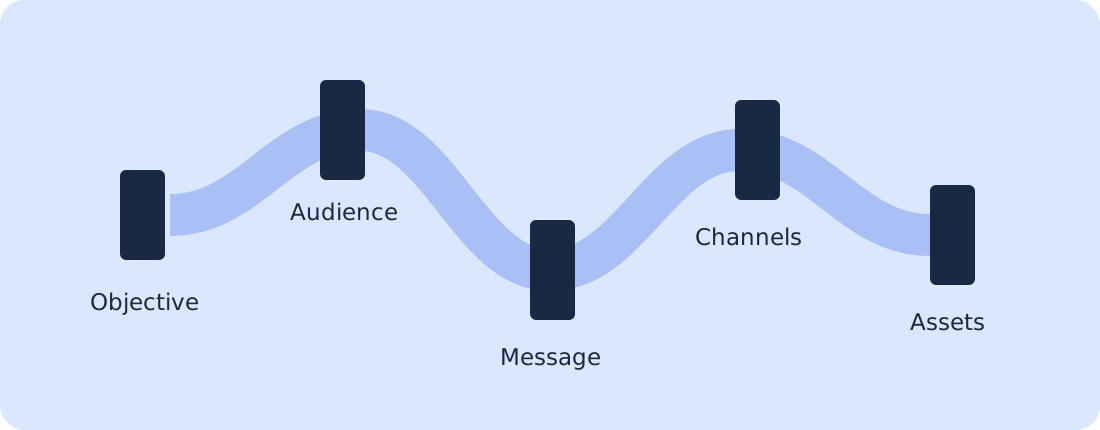
Which real situation makes this campaign relevant? Keep the evidence and the uncertainty visible.
What can you actually demonstrate? Link the claim to a current source and name the review owner.
What should this deliverable help someone understand or do? Trace it back through the other choices.
Name the objective and the audience situation. Separate current evidence from a useful hypothesis before drafting the promise.
Give the message a supported basis. Choose a route suited to the question someone is trying to answer.
Define the asset's job, owner and dependencies. Keep review authority and measurement visible as the plan changes.
A campaign map connects an intended outcome to the people, message, channels and assets chosen to pursue it. Its useful unit is a relationship: this audience needs this evidence, this channel can deliver it, and this asset has a defined job. The result is a reviewable argument for the campaign rather than a decorated list of deliverables.
Build the map in five layers: objective, audience, message, channels and assets. Add proof, ownership, timing and measurement as information attached to those decisions. These additions make the plan executable, but they do not replace the central question of why each element belongs. An attractive visual cannot resolve a vague objective or substantiate a promise that the product does not support.
A small campaign can fit on one page. A larger one may need a summary map with linked records for audiences, claims, production and approvals. Size the document around the decisions people must make, not the number of boxes a template offers. The map is finished enough for a review when another person can trace a planned asset back to a real audience need and the intended outcome without relying on its author's explanation.
The campaign brief establishes scope, business context and constraints. The map explains the relationships among strategic choices. The content calendar puts approved work onto dates. The project plan assigns people, dependencies and production tasks. A buyer journey describes a person's changing needs and encounters; the campaign map records the team's planned response to selected needs. These documents can share records without becoming interchangeable.
For example, “publish a comparison video on Tuesday” belongs in the calendar. “Use a comparison video to answer a buyer's concern about setup effort” belongs in the map. “The editor needs approved screen recordings before the cut” belongs in the production plan. Keeping these distinctions helps a late asset deadline trigger the right review: reschedule the deliverable, change the channel, or reconsider whether its purpose is still necessary.
An objective should name a relevant change, the population involved, the review window and the method of observing it. “Increase visibility” is a direction. “Help existing trial users complete their first shared project during the next launch cycle” is a more useful campaign objective because it identifies a behavior and a group. The measurement design still needs work, but the team can now ask whether its proposed assets contribute to that behavior.
Separate a business result from an intermediate signal. Revenue, activated accounts and renewals answer different questions from impressions, clicks and views. An intermediate signal can be valuable when it represents a necessary step, but it should not quietly become the definition of success because it is easy to collect. Record both the intended outcome and what the available evidence can actually establish.
Write the baseline as known, unknown or awaiting a named source. Record an aspirational target as an assumption until someone confirms its basis. A number copied from another campaign may describe a different audience, offer or attribution window. If there is no usable baseline, the first campaign can include a measurement task rather than pretending a precise improvement percentage is already justified.
A planning conversation becomes easier when the team names exclusions. A product launch might prioritize existing customers and defer cold acquisition. A local workshop might focus on qualified registration rather than selling a long-term membership. This choice does not deny the value of other outcomes; it prevents the asset list from expanding every time a stakeholder suggests another possibility.
Attach a decision owner and a review date to the objective. That owner should be able to resolve a conflict between a tempting new asset and the campaign's agreed purpose. If objectives genuinely conflict, map them separately and make the resource tradeoff visible. Combining them under “awareness and conversion” can conceal that one audience needs introductory material while another needs detailed implementation evidence.
A role label is a starting point, not a complete audience definition. Two operations managers may have different priorities because one is replacing a broken workflow and the other is exploring a future purchase. Record the task, trigger, current alternative, constraints and uncertainty that matter to this campaign. Include the people who influence or approve a decision when their concerns differ from those of the eventual user.
Use interviews, support conversations, product behavior, sales notes or other appropriate evidence to inform these records. Preserve the source and its limitations. A few conversations can reveal useful questions without proving how common they are. Analytics may show where people stop, while offering limited information about why. Treat hypotheses as hypotheses until the evidence supports a stronger statement.
Consider a team lead who wants a faster way to collect creative feedback. “Creative team lead” gives little guidance to a writer. “Has three reviewers in different time zones, loses decisions in chat and worries that a new tool will force clients to create accounts” identifies a practical task and an objection. It suggests that a campaign might need a review walkthrough, an access explanation and an example of a resolved decision.
Do not assume every audience needs a separate campaign. Split a group when the difference changes the promise, evidence, route or action. If two groups share those needs, a single clear message may serve both. If an internal buyer needs procurement documentation while a daily user needs a quick workflow demonstration, the difference is substantial enough to record rather than flatten into a generic persona.
Maintain an objection record beside the audience layer. Each objection needs a source, a proposed response and a way to check whether the response is accurate. “They probably think it is expensive” is a hypothesis. A documented comparison request is stronger evidence of an active decision question. The map should help the team distinguish those states instead of rewarding confident guesses.
The message layer connects a supported promise to an audience need. A useful message describes the change a person can expect and why the offer is credible in that situation. It can have different expressions across channels while retaining the same meaning. A headline, a demonstration and an email should not silently make three different promises about the same product.
Build a compact message record with the audience problem, proposed benefit, supporting evidence, boundary and intended next action. If the evidence is unfinished, mark the message as awaiting review. A polished draft can make an unverified claim harder to notice, so keep the claim and its source visible even when the final copy is short.
A claim about a feature can link to a current product demonstration or documentation. A claim about an outcome needs evidence relevant to that outcome and the conditions involved. A customer quotation should have appropriate permission and context. A comparison needs a defined basis and current information. The map does not establish legal approval or scientific validity; it identifies what must be checked and by whom before publication.
For a collaborative review product, “keep the approved decision attached to the current version” can be demonstrated with a real workflow if the product supports it. “Cut review time in half” needs a different kind of substantiation. Substituting the second claim because it sounds stronger introduces a research obligation rather than merely improving the writing.
Distinguish a proof gap from a wording issue. A copywriter can make an accurate promise clearer, but cannot manufacture product capability, customer permission or outcome evidence. When a claim lacks support, the options include collecting evidence, narrowing the claim, changing the asset's job or removing the promise. Add that choice to the review record so the issue is not passed repeatedly between designers and writers.
A channel belongs in the map when it provides a plausible way to reach the selected audience in a context suited to the message. Start with what the audience already does and what the team can operate. Owned email, product surfaces, search, events, community conversations and paid distribution have different requirements. A popular platform is not automatically a useful route for this campaign.
Record the channel's job, audience access, format requirements, owner and operational constraints. Search content may help someone investigating a problem over time. A product message can reach an existing user at a relevant moment. A live session offers questions and demonstrations, but also creates attendance and follow-up work. Paid distribution requires a funding and measurement decision that a free planning diagram cannot supply.
Estimate the work required to produce, publish, answer questions and maintain the campaign. A single webinar can require a script, registration page, reminders, technical rehearsal, presentation, recording, captions and follow-up. Treating it as one asset hides the dependency load. Record which parts are essential and which can be omitted without breaking its purpose.
Use a capacity overlay when several channels compete for the same people. List the actual available roles, expected commitments, review dependencies and known busy periods. A relative planning weight in a diagram is not an hours estimate or a media budget. Keep those meanings distinct. If the person producing the video is also needed for launch support, changing the release date may be more credible than adding an optimistic second channel.
Channel selection should include a reason to decline. If an audience cannot be reached reliably there, the evidence cannot fit the format or the team cannot follow up, record that constraint. The decision becomes reusable knowledge. It also gives reviewers a practical way to challenge a proposed channel without framing the discussion as a preference for or against a fashionable platform.
The asset layer contains the things people will encounter: an article, walkthrough, landing page, comparison, email, event or other deliverable. Trace each item through its channel and message to an audience and objective. If an asset cannot be traced, ask why it exists before assigning production. It may serve a valid purpose outside this campaign, but that purpose needs its own record.
A brief should specify the asset's audience situation, message, proof, required action, format, owner, dependencies and reviewer. Link the current source material rather than asking production to infer it from a meeting summary. Keep distribution and accessibility requirements visible. A recording intended for a landing page and a captioned social excerpt may share footage while requiring different editing and review decisions.
One verified workflow can support a full demonstration, a short excerpt, a written setup guide and a follow-up answer. This is useful reuse when each format has a defined job. Resizing a long explanation into a smaller frame without considering what a viewer needs may produce a technically valid file with little practical value.
Keep the claim connected to its proof across versions. If a feature or policy changes, the map should identify which assets relied on it. A reusable evidence record can make that review easier than searching through every caption manually. This requires maintaining explicit links; a diagram screenshot alone cannot update the assets or prove that all downstream copies have changed.
Assign status carefully. “Drafted,” “reviewed,” “approved” and “published” represent different events. Include the version and the person responsible when approval matters. A green card with no evidence of the underlying review is a design signal, not a verified decision. The tool below records human-entered status and ownership; it does not grant approval or check whether publication happened.
Google's consumer research describes purchase decision-making in terms of exploration and evaluation between a trigger and a purchase. Exploration broadens possibilities; evaluation narrows them. The research is a useful reason to examine return visits and comparison questions, rather than assuming everyone consumes a campaign in a single planned sequence. It does not prove that every customer or category follows an identical path. Read Google's account of the research.
A campaign map can respond by connecting the same message to several useful encounters. Someone may read an introductory article, return after an internal discussion and then need a setup explanation. A returning visitor should be able to find the practical answer without repeating the introduction. The map's five-layer planning structure records intended relationships, while a separate journey view can record observed or hypothesized encounter sequences.
An objection map connects decision concerns to supported responses. A proof map identifies the evidence behind consequential claims. A competitor comparison records defined alternatives and a current comparison basis rather than asserting that rivals lack features. A capacity view connects work to owners and production constraints. These views are useful when they change a decision, not merely because another diagram can be drawn.
Keep a distinction between planned and observed behavior. A link from a search article to a landing page is an intended route, not attribution evidence. An observed click is evidence of an event, not necessarily understanding or intent. Use appropriate measurement to investigate the route, then revisit the plan. Do not label manual association weights as traffic, revenue or conversion probabilities.
AI can help organize an already-grounded brief, draft alternative wording, identify missing fields or turn a review note into a proposed change. Supply the actual objective, audience evidence, supported claims, channel constraints and production capacity. Ask it to distinguish supplied facts from assumptions and unresolved questions. Preserve the source material so a reviewer can check whether an appealing draft stayed faithful to it.
A useful request is: “Propose two ways to connect these verified audience concerns to these supported product claims. For each, list the evidence used, the uncertainty and the assets our available team can actually produce.” This gives reviewers something concrete to assess. Asking for “a high-converting campaign” without evidence encourages a complete-looking plan whose audience, performance expectations and production capacity may be invented.
AI suggestions need the same claim, privacy, permission and practical review as human drafts. A plausible objection is not customer research. Generated copy is not an approved product claim. A formatted schedule is not a confirmed commitment from the people involved. Keep human decisions and current source evidence attached to the map instead of relying on the model's confidence.
The workbench on this page uses a local graph-layout library, not a generative model. It visualizes your explicit records and associations. It neither invents strategy nor forecasts performance. That boundary makes it useful for inspecting a plan without turning an attractive layout into evidence that the plan will work.
The right workspace depends on whether the team primarily needs visual discussion, designed presentation, generated assets, connected operational records or publication within an existing system. Test a real campaign and a real handoff before committing to migration. Review the current plan, access controls and integration requirements in the product's own documentation; the summaries here describe documented roles, not performance rankings.
Storyflow presents a visual workspace for creative teams with AI-assisted planning and creative material. Consider it when the review needs a shared visual context. Check how the campaign's records, evidence and handoff fit the current product rather than assuming a blog comparison is an exhaustive feature inventory. Its current pricing page describes early access and future plans, so do not reuse an old price as a stable purchasing fact. Product overview and current pricing.
Miro's marketing templates support campaign planning, calendars and visual collaboration. It can provide a flexible place to discuss relationships and retain workshop material. Decide how the team will identify the current approved map and move agreed work into its production system. A flexible board still needs conventions for evidence, ownership and version authority. Marketing templates.
Canva offers marketing campaign and presentation designs that can help communicate a plan. Its strength in this context is the designed presentation of reviewed information. Decide separately where the team's canonical claims, owners and task status will live. Exported slides or images are useful for communication but do not inherently synchronize the underlying operational records. This is a workflow consideration, not a claim that the product lacks every collaboration feature. Marketing designs.
HubSpot documents Campaign Assistant as a way to generate marketing asset content. It may fit a team already organizing execution in HubSpot. Evaluate the exact supported asset types and account requirements in the current documentation, and provide reviewed campaign information before asking for copy. Generated output still needs claim and audience review. A content-generation feature should not be mistaken for independent validation of the strategy it was given. Campaign Assistant documentation.
Jasper describes campaign workflows that turn briefs, brand information and channel requirements into content. Evaluate it when coordinated content production is the bottleneck. Test whether the brand knowledge and evidence supplied to the system are current, and whether reviewers can identify assumptions in its outputs. Product marketing statements about optimized content do not establish that a particular campaign will achieve its objective. Campaign workflows.
Notion's project and task databases can hold campaign decisions alongside operational work. This can suit a team that wants readable briefs and linked records in one workspace. Design properties and views around the decisions the team actually needs, and check sharing permissions before storing sensitive audience research. A database can record an owner or status, but people still need a clear agreement about what those fields mean. Projects and tasks guide.
Airtable's marketing guides describe organizing marketing work with connected records and workflows. Evaluate it when many assets, owners and campaigns need consistent fields and operational views. Decide which relationships deserve separate records and how the team will maintain them. A structured system can make inconsistencies visible, but its completeness depends on the data and workflow people maintain. Marketing workflow guide.
A simple shared document or spreadsheet can also work when the campaign is small and one owner maintains its structure. Preserve stable record identifiers, source links, clear status meanings and a reviewed current version. Move to a more elaborate system when an actual coordination problem justifies the migration work, rather than because a diagram has become visually crowded.
This fictional example concerns a studio running a practical workshop on reviewing video edits. Its objective is to attract registrations from creative team leads who need a repeatable way to consolidate feedback. The team has one facilitator, one producer and limited editing time. The example illustrates planning relationships; it supplies no forecast or promised conversion rate.
The audience record describes a lead managing feedback from several stakeholders. Interview notes, if actually collected, might reveal which parts of the process create difficulty. For this example, the team starts with an explicit hypothesis that conflicting notes and unclear approval authority are important concerns. It schedules a small research check rather than presenting those guesses as established customer facts.
The message is a supported description of the workshop: participants will work through a fictional edit review and practice consolidating decisions. The proof is the actual exercise outline and a preview of the materials. The team avoids promising a measured reduction in review time because it has not studied that outcome. A clear description of what participants will do is enough to form an honest offer.
The channel choices are the studio's existing email audience and a partner's relevant newsletter, subject to that partner's agreement. A search article can explain the review problem for people investigating it over time, but the team does not assume it will produce immediate registrations. A live question session is declined because the same facilitator is preparing the workshop and cannot add another event reliably.
The assets are a workshop page, a short sample exercise, an announcement email and a practical feedback-consolidation article. The page explains who the workshop serves, what participants need and what the session includes. The sample demonstrates the type of work involved. The email provides the relevant promise and next action. The article answers a useful problem even for someone who does not register.
A stakeholder requests a polished promotional video. The team traces the suggestion to the selected audience need. If the video would communicate exactly what the sample exercise already demonstrates, it may add production cost without answering a new question. If potential participants genuinely need to see the facilitator's approach, a short grounded introduction may have a distinct job. The map makes that discussion specific.
The producer records the decision and the evidence needed before producing the new asset. If the workshop format changes, the sample and page must be reviewed together. If the partner declines the newsletter placement, the campaign's distribution assumption changes even though the assets remain finished. The map is useful because it exposes those relationships, not because it removes uncertainty.
Conduct a first review for coherence: is the objective clear, is the audience grounded, does the message have support, can the channels reach that audience and does every asset have a purpose? Conduct a second review for execution: are the owners, dependencies, access, approvals and measurement arrangements plausible? These reviews can share a meeting, but separating their questions keeps production detail from concealing a weak strategy.
Walk backward from each asset. An isolated deliverable needs explanation. Then walk forward from each important audience concern. A concern with no supported response may require another evidence task rather than another piece of copy. Use the map to find these gaps while there is still time to revise the plan cheaply.
Identify the current reviewed version, its owner and the changes since the previous review. Retain consequential cuts with their reasons. This helps a new stakeholder understand why a channel was excluded and prevents previously rejected assumptions from returning as apparently new ideas. A version date is helpful, but it does not prove someone approved the contents.
Maintain an unresolved-questions list with owners. Separate “needs customer research,” “needs product confirmation,” “needs partner agreement” and “needs production capacity” because they call for different actions. Do not close these issues merely because an asset has been drafted. The person resolving each question should link the evidence or decision that changed its status.
After the campaign, compare the observed result with the recorded objective and assumptions. Review whether the team reached the intended audience, whether the evidence answered its questions and whether the operational plan was maintainable. Preserve the distinction between an observed event and an inferred explanation. If the measurement cannot isolate the campaign's effect, describe that limitation rather than assigning all changes to the assets.
Update the reusable records with what actually changed: a recurring objection, a channel constraint, a better proof source or a production bottleneck. Keep the original plan available so later reviewers can distinguish learning from hindsight. A smaller, maintained map is more useful than a comprehensive-looking board whose claims, ownership and links no longer match reality.
Use one objective, one well-defined audience, one supported message, a realistic delivery route and a few purposeful assets if that reflects the work. A smaller map is complete when it supports the necessary decisions. It does not need multiple channels to qualify as a campaign.
The time depends on unresolved decisions and evidence, not a universal template duration. A familiar campaign with current research may be mapped quickly. An unfamiliar audience or unsupported claim requires research and review. Track those dependencies rather than treating typing speed as planning readiness.
The five-layer map records planning relationships. A funnel summarizes stages or movement toward an action; a journey explores encounters and changing needs. Use a separate journey view when sequence matters, and distinguish a planned path from observed behavior.
Yes, if the supported promise and relevant evidence address their actual needs. Split the record when an audience needs a materially different claim, proof or action. Avoid creating variants solely because role names differ.
Attach budget and measurement records to the decisions they govern. Channel budgets, production estimates and objective evidence serve different purposes. The workbench's manually entered association weight is neither a budget nor an attribution model.
Investigate its purpose. It may have been added without a campaign reason, or the relationship may simply be undocumented. Record the real reason, assign it to another initiative or remove it. The structural warning is a review prompt, not an automatic quality verdict.
It can propose a structure or draft using supplied information, but its output does not verify audience evidence, product claims, permissions or available capacity. Have accountable people review those inputs and decisions before execution.
Choose by the work and handoff: visual review, designed communication, content generation, connected records or existing execution systems. Test a real workflow and current account requirements. There is no evidence-backed universal winner for every team.
Identify assets and messages connected to that claim, review the current evidence and record the revised wording and approval. A change in the map does not automatically revise published content or notify its owners.
No. Structural completeness means specified records can be traced through the model. It does not prove demand, accurate research, persuasive communication or execution quality. Use the map as one review aid alongside evidence and operational judgment.
Enter five-layer records and forward relationships. The real D3 Sankey layout uses manually entered positive relative association weights. Widths are not budgets, traffic or attribution. Diagram labels use record IDs; complete titles, evidence and notes stay in the editors and report.
Start with your own records or the clearly fictional example.
IDs connect the records. If you change an ID, update its relationships before reviewing. Removing a record does not silently delete references: review will ask you to resolve them.
Use existing IDs and forward layers. A skipped layer is accepted and flagged for review. Backward relationships, missing references and invalid weights are rejected.
This local editor does not send notifications, verify source links, provide AI recommendations, approve claims or predict results. Saved derived results are ignored on restore; review uses current source.