Know what is finished
Separate a dated idea from an approved piece that can actually fill the publishing slot.
A creator calendar that connects your publishing promise to finished work. Explore the tools, then test the week when production stops.
Separate a dated idea from an approved piece that can actually fill the publishing slot.
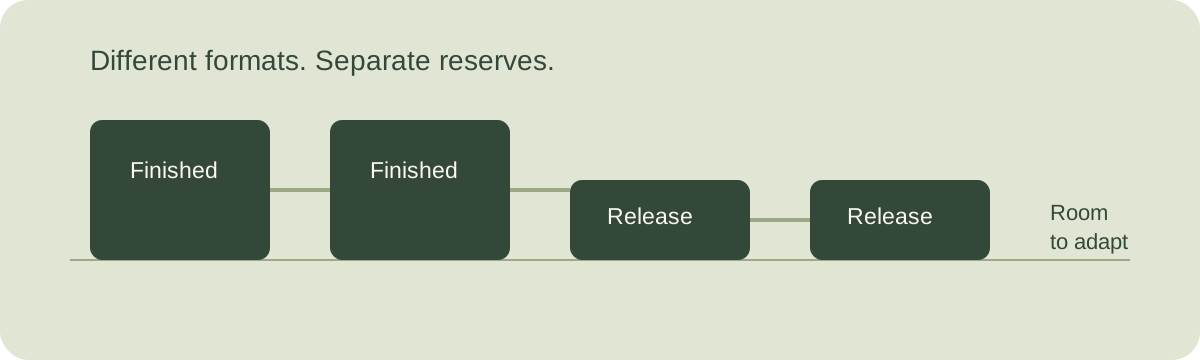
A newsletter reserve and a video reserve protect different promises. Their quantities stay separate.
Enter the hours you have each week and inspect which commitments remain covered.
A creator calendar is a shared view of commitments, production state and the work still required. Start by separating three questions: what should you make, what is actually finished, and when should it reach the audience? A dated idea answers only the last question. A maintainable system keeps the source, format, state, owner and publication decision connected so a disruption does not turn into a week of reconstructing context.
Choose a cadence from your recent working history, including ordinary busy periods. Count the hours available for research, creation, review, distribution and administration. A motivated launch week can reveal what is possible; it is weak evidence of what remains sustainable for months. Look for the stage that repeatedly stalls and change the promise, scope or process before adding another recurring slot.
The interactive simulator below helps examine that trade-off. Give each format its own finished inventory, publishing rhythm and production request. Enter available hours for every week, including a disruption. Decimal.js performs the shared-capacity arithmetic, while Luxon derives the week dates. The results show completed production, covered publication, missed slots and remaining inventory separately for each format. A reserve of newsletters cannot silently become a reserve of videos.
This is a scenario model, not a scheduling service or prediction of audience growth. Its assumptions are visible and its full record is exportable. Use it to choose which operational question to investigate, then compare the scenario with actual production and audience evidence.
The best tool depends on the record you maintain, the people involved and whether you need publishing automation. Test one representative piece from capture to release, then inspect the permission and export paths before moving your archive.
| Tool | Useful record | When it fits | Current boundary |
|---|---|---|---|
| Storyflow | Visual idea and series planning | Comparing themes and relationships before committing production | Its pricing FAQ describes paid standalone early access and free invited board collaboration. Confirm the actual workflow you need rather than treating a planning canvas as a publishing queue. |
| Notion | A database item that opens into a draft page | Writing-heavy work where the brief, draft and state belong together | Date properties support calendar views. Review any AI-created records and permissions; a date in the database does not publish the content. |
| Airtable | Related pieces, variants, assets and channels | A team maintaining several formats and versions | Current interfaces present the underlying records for different roles. Check actual mobile layouts, edit permissions and plan-specific timeline access. |
| Trello | Cards moving through production lists | A visible lightweight pipeline with drafts stored elsewhere | Native Calendar view is available in Premium and Enterprise workspaces; the Calendar Power-Up is a separate route. Review the native view and Power-Up access requirements separately. |
| Google Sheets | A flexible table with explicit fields and formulas | A creator comfortable maintaining consistent tabular records | Set validation and shared access intentionally. A spreadsheet can hold links and planning data, but a row does not replace media storage or platform publishing. |
| Buffer | Channel-agnostic Ideas, channel drafts and a publishing queue | Connecting social ideas to platform-specific posts | Current Create supports idea groups, tags and conversion into drafts or scheduled posts. Ideas can be organized before a destination channel is chosen. Confirm plan, network and media restrictions. |
| Later | Draft posts and social calendar records | Preparing and reviewing social posts before their scheduled release | Draft support exists in its documented workflow. Publishing options depend on the platform, media type and account; test the exact channel rather than assuming every post is automatic. |
Capability references: Storyflow current availability, Notion calendar databases, Airtable Interface Designer, Trello Calendar view, Google Sheets collaboration, Buffer Ideas and drafts, and Later draft posts.
A useful comparison does not require an unsupported “most trusted” ranking. Ask whether the relevant record is reliable, readable by the intended collaborator and recoverable outside the product. A tool is underrated for your workflow when it solves that job with less maintenance than the alternatives, regardless of how impressive its feature list appears.
Measure a few representative production cycles. Record setup time, time per piece, review, revisions and distribution. Separate fixed overhead from work that scales with quantity. The time saved by one recording setup may be real, while the research and editing decisions still need individual attention.
Use your recent constrained weeks to define a reasonable baseline and your upcoming commitments to define exceptions. If a launch, examination period or client deadline is already known, model it directly. The simulator accepts a different capacity for each week because an average can hide a predictable interruption. A hypothetical zero-hour week is useful for exploring resilience, not a claim that illness or disruption follows a regular schedule.
Define the audience promise in a form you can actually uphold. A tutorial every fortnight with a shorter check-in between releases can be a coherent rhythm, provided subscribers understand it. Alternating formats can reduce one production bottleneck while maintaining contact, but the audience may value a particular format; do not assume all publications are equivalent to them.
Increase cadence only after reviewing repeated delivery, quality and the time it takes from other responsibilities. No universal two-month waiting period or fixed reduction percentage proves sustainability. Your own history and the next season's constraints are better inputs than a rule copied from an unrelated creator.
A buffer is finished, suitable work available for future publication. “Finished” should have an explicit definition: complete draft or edit, necessary review, rights and source checks, final assets and any platform preparation required by that format. An unfinished outline, filmed footage and an approved newsletter represent different remaining work. Do not count them all as ready.
Size the reserve against the gap you want it to cover. With one video due every week, two finished videos can cover two no-production publication weeks if neither becomes obsolete. With a newsletter every fortnight, two ready newsletters cover four weeks of that particular rhythm. The same item count creates different time coverage. There is no universal minimum or maximum buffer appropriate to every format.
Include freshness and expiry in your real production record. A commentary piece may become unsuitable quickly; an evergreen demonstration may remain useful after a long lead time. The simulator does not model expiry or editorial quality. Review the actual pieces before treating its quantity as usable inventory.
Build a reserve through a limited production push, a slower cadence, a smaller scope or a naturally quiet season. Check the additional hours explicitly. When a healthy reserve appears, decide whether its purpose is protection, experimentation or a planned break. Publishing it faster creates a different commitment; make that choice deliberately rather than assuming spare stock is proof of spare ongoing capacity.
Batching is useful when a repeated stage has meaningful setup cost and consecutive work stays good. Examples include setting up lights for several recordings, preparing a consistent thumbnail system, reviewing several related outlines or scheduling already approved posts. Each has a different limit determined by concentration, topic complexity and the work environment.
Editing can also be batched for mechanical operations such as file organization, proxy creation, captions preparation or applying a consistent export preset. Editorial judgment may need shorter sessions, a fresh review or individual attention. “Editing never batches” is too broad to describe these distinct activities. Test the stage you actually mean and inspect the quality and revision burden.
The simulator models one setup cost for each format in each week that produces at least one completed piece. Per-piece hours are then charged for each completion. It does not claim that research, recording and editing happen in the same session or that an incomplete piece can be completed fractionally. Enter combined hours only when they represent a plausible route to finished inventory.
For a real workflow, retain a stage record such as captured, selected, researched, drafted or recorded, edited, reviewed, ready, scheduled and published. Merge states that do not create a meaningful handoff; add one where an approval or missing asset actually blocks publication. A scheduled post can still fail to publish, so keep the actual publication result distinct from the plan.
A spare slot can be a deliberate choice when timely work, collaborations or lessons from an earlier release matter. Define whether it is an optional publication or a committed audience expectation. In the simulator, a week with zero pieces due in a format represents no obligation for that format. A missed committed slot is a different result and remains visible in the ledger.
Choose spare capacity from the work and opportunities you expect; a fixed twenty-percent gap is not a validated universal requirement. Unused hours are not completed content, and an empty slot does not manufacture a reserve. The reserve grows only when suitable work is completed beyond the pieces actually published.
Repurposing connects a source idea to a new audience job. A tutorial can yield a concise answer, a checklist or a newsletter discussion, but the derivative still needs adaptation, source checks and format-specific finishing. A collection of shorter pieces can also inform a longer synthesis when you add a coherent argument and new connective work. Neither direction is automatically free or guaranteed to succeed.
Give each secondary channel a clear purpose, such as discovery, discussion or a durable reference. Link variants to their source without pooling their ready inventories. Check the opening, length, visual layout, accessibility and next action for the destination. Measure actual time spent and useful responses before adding another channel; a fixed derivative count or effort percentage cannot substitute for that evidence.
Imagine a creator producing practical videos and a newsletter. In this scenario, a video batch takes one setup hour plus five hours for each finished piece. A newsletter batch takes half an hour to set up plus two hours per completed issue. These are editable example assumptions, not production benchmarks.
The creator begins with two finished videos and one finished newsletter. A video is due every week, while a newsletter is due in weeks two, four, six and eight. Normal weekly production capacity is ten hours. The creator requests one video every week and one newsletter in each even week. Week three has zero production hours because of a hypothetical disruption.
In an ordinary odd week, the one video costs six hours. In an ordinary even week, the video and newsletter together cost eight and a half hours. The finished video reserve stays at two until the interruption. Week three completes no work, publishes one stored video and ends with one video. The newsletter is not due that week and remains at one. All eight video slots and four newsletter slots stay covered over the eight-week scenario, with one video and one newsletter left at the end.
Now enter zero hours for weeks three, four and five. The video reserve is consumed in weeks three and four; week five has a video due with nothing completed or stored, so the ledger records a miss. A newsletter is due in week four and consumes its stored issue. It cannot cover the missing video in week five. The first uncovered format is therefore explicit rather than hidden behind a total item count.
Try a different production order on a week with only six and a half hours. Producing the video first can consume six hours, leaving too little to complete a newsletter. Moving the newsletter earlier spends two and a half hours first, leaving too little to finish the video. This does not prove one priority is correct; it makes the competing audience commitments visible.
To rebuild the reserve, request an extra finished piece during a week with enough actual capacity or reduce a future obligation. The model carries finished stock, but it does not carry uncompleted requests or automatically backfill missed publication. Review the resulting work plan and quality before promising recovery publicly.
A theme organizes a group of pieces around an audience question. Keep a small set that the audience can recognize, then choose individual pieces by usefulness, evidence, relevance and effort. A recurring theme can reduce decision friction while still permitting an urgent or unusually valuable exception. A content calendar should not force publication of a weak piece merely because its date arrived.
For seasonal planning, distinguish recurring obligations from limited campaigns and planned breaks. A tutorial season can finish with a recap; a holiday period can use an explicitly announced lighter rhythm. Enter those weeks and format-specific requests in the model. Do not hide known interruptions behind an average or turn a recovery period into a permanent cadence increase.
A portable production record should include:
Keep long drafts and media where they are easiest to work on, with reliable links from the record. If the calendar item is also the draft, as in a document-centered database, verify that collaborators can navigate and review it. If assets live separately, naming and version links matter more than the elegance of the calendar view.
Export the simulator's complete JSON to restore all inputs. CSV contains the per-format weekly ledger, Markdown explains the scenario and arithmetic, and SVG shows the remaining inventories. Those presentation exports cannot substitute for the complete restorable record. Browser saving is specific to the current browser; keep a portable backup before changing a live production assumption.
Compare actual plan access, collaborator roles, scheduling limits, connected channels, records, media requirements and AI usage. Current free allowances can support a small workflow, but an announced future plan is not available access. Storyflow's FAQ separates current invited collaboration from future standalone free access. Trello's native Calendar view and its Power-Up also have different access paths.
Estimate the complete bill at your intended scale, then add the time to set up and maintain the system. A hypothetical three collaborators at a ten-dollar monthly seat price cost thirty dollars; that arithmetic is an illustration, not a vendor quote. Channel-based and usage-based charges need their own calculation. Test a representative busy month as well as the current quiet one.
Trial the same piece in the shortlist. Capture an idea, attach its draft, record a blocking stage, obtain review, inspect the ready count, prepare a platform-specific variant and export the record. If using publishing automation, test the exact supported account and media type, including any notification or manual step. A tool with fewer administrative steps can be more valuable than one with the most feature boxes.
Avoid fabricated performance comparisons, universal database-slowdown claims or predictions that calendars fail after a particular number of weeks. Useful failure evidence comes from your workflow: drafts without sources, confusing state names, inaccessible assets, duplicated updates, too much unfinished work, stale reserves or obligations that repeatedly exceed capacity. Preserve that evidence and correct the process before switching products again.
Choose the record you need to maintain. Notion can connect drafts and database views; Airtable can relate variants and assets; Trello offers a visible pipeline; a spreadsheet can be sufficient. Buffer and Later add documented social preparation and distribution workflows. Trial the actual job.
Separate a longer theme horizon from shorter committed production and release decisions. Review freshness, known busy periods and actual finished inventory. There is no fixed lead time appropriate to every topic or format.
Choose the no-production period you want to cover and translate it into each format's publishing obligations. Check the actual pieces remain usable. Two ready items do not mean the same coverage at weekly and fortnightly cadences.
Use measured capacity, smaller scope, a limited production push or a temporary lighter publishing commitment. Account for all finishing and review work. A reserve that requires indefinitely exceeding your available hours is not sustainable.
Batch mechanical steps when shared setup makes them efficient. Give judgment-intensive edits the attention and review they require. Inspect quality and revision time rather than asserting that an entire stage must always or never be batched.
The simulator allocates capacity in displayed format order and completes only whole pieces that fit setup plus per-piece costs. Uncompleted requests are reported and do not enter the buffer. Reorder formats to examine a different priority.
No. This simulator models quantities and time assumptions. The commercial tools have their own documented creation or AI capabilities, but generated text still needs research, editing and review before it counts as finished work.
Choose a promise that matches the audience and your demonstrated working capacity. Model the next season and known exceptions. More slots do not automatically create better work or better growth.
Possible causes include unrealistic commitments, duplicated data entry, unclear state transitions or missing asset links. Inspect the actual friction. Abandonment after a fixed number of weeks is not an established universal rule.
Use them when flexibility serves your editorial purpose. Distinguish an optional slot from a promised release. The model treats zero due pieces as no commitment; it still counts unfilled committed slots as misses.
Yes, when the new piece is adapted or synthesized for its audience and format. A shorter excerpt needs a suitable opening; a longer synthesis needs connective reasoning. Neither direction eliminates finishing work.
Choose states that reveal a real next action or handoff. Captured, selected, drafted or recorded, edited, reviewed, ready, scheduled and published are a starting vocabulary. Your finished definition determines what counts as reserve.
Enter reduced weekly hours, build only a usable reserve, simplify scope or announce a lighter rhythm. Review each format separately. A surplus in one does not cover an unrelated promise.
Use one when its supported accounts, preparation and publishing workflow solve a material distribution burden. Buffer already includes Ideas and drafts; Later documents drafts too. Check the actual account, media and manual steps.
It can if that makes writing and review easier. Otherwise link reliably to the working document or media asset. The important part is that production state, version and evidence remain easy to recover.
Give each one an audience purpose and retain a separate variant state. Budget adaptation and finishing time explicitly. Review actual outcomes and maintenance before adding another channel.
Change it when evidence, quality, opportunity or capacity justifies the change. Record what was displaced and whether the audience commitment changes. A plan should support a decision, not obscure it.
Review the current terms at your actual usage and record the results of the same-piece trial. Clear roles, limits, exports and an observed reliable workflow are more useful than unsourced category-wide trust rankings.
Confusing a planned slot with usable inventory. Count actual finished pieces by format, inspect the work remaining and compare commitments with available capacity before interpreting the calendar as ready.
Edit the formats and weekly production requests. Capacity is allocated in format order. Only whole finished pieces enter each format’s reserve, and completed work is available before that week’s publishing slot.
Enter measured or explicitly hypothetical hours. Setup is charged once in a week when that format completes at least one piece. Order controls which format receives scarce production hours first.
Requests are desired completions, not guaranteed output. Uncompleted requests do not carry forward. Unused hours do not create finished pieces.
Chart colors: green meets the desired reserve; gold is below reserve; rust has an uncovered publication. The complete numeric ledger follows.
Limits: this weekly scenario excludes partial work, content expiry, weekdays, actual publishing and demand prediction. Missed slots are not automatically backfilled. It assumes finished production is available before that week’s publication. Inspect actual quality, freshness and release dates separately.
A calendar is useful when it reveals a decision. Finished reserves protect a promise; spare hours create room to adapt the work.
Check the audience question, source and work still required. A planned date is not finished inventory.
Review the actual piece, its freshness, accessibility and intended platform. A modeled quantity cannot approve it.
Compare commitments, actual hours and audience value. Keep the rhythm that serves your work and readers.
Does this week contain finished work or only planned slots?