Tasks become decisions.
Development needs owners and a deadline. Transfer the reasoning, not just a completed checkbox.
Keep the slate small. Carry the decisions across phases. Estimate what a late change would ask completed work to repeat.
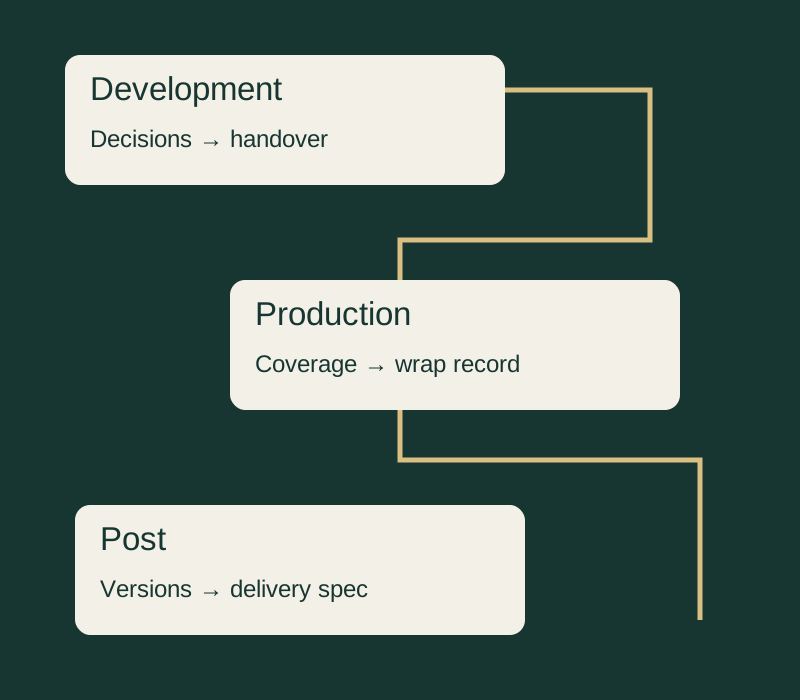
Development needs owners and a deadline. Transfer the reasoning, not just a completed checkbox.
A setup needs context. Give the editor preferred takes, gaps and the source record.
Review the actual cut. Scope a change before asking other departments to repeat completed work.
Fictional Harbour Memory records are filled in. Edit the five-field slate separately from its three handover documents and entered post-dependency estimates. No vendor sync, film analysis, calendar scheduling or approval verification runs here.
The handovers and change estimates form a separate record. They are not automatically linked to, or aggregated across, your slate rows. The filled example concerns Harbour Memory; identify your own film and version in the full work titles and handover messages.
Dependency direction: A feeds B. Enter the IDs of work feeding this item, separated by commas. Completed-work estimates are counted once, including when several paths reach an item. Pending work is shown separately.
Source exports retain every entered field, including handover text and assumptions. SVG is a diagram of entered relations. Save uses this browser only; JSON is the portable source. Delayed imports never replace intervening edits.
Carry the rejected location, contributor sensitivity and pending permission into the production handover.
Tell the editor what was covered, what was preferred and what remains missing.
Ask affected owners for the reversible work, estimate and deadline consequence. A graph cannot grant approval.
This original 32-second silent portrait animation teaches the fictional Harbour Memory workflow. The large record text is designed for phone viewing. Native controls let you start, pause, seek and use full screen; there is no autoplay.
Captions and the complete written lesson carry the same explanation. Entered estimates do not establish real completion, approval or a calendar delivery date.
Keep the slate small. Keep one overview row per film: project, active phase, external deadline, blocker and owner. Link the phase source instead of copying its whole schedule.
Carry the handover. The editor needs the source batch, preferred takes and actual coverage gaps. Send the completed handover, not a checkbox claiming everything was captured.
Estimate the reversal. The fictional owners enter eighteen completed-work person-hours at sixty dollars per hour. That is a 1,080-dollar estimate, not an invoice or approval.
Separate time and approval. The longest completed-work path is ten hours, or 1.25 equivalent workdays. It is not a new calendar deadline. Confirm availability, cost and human approval before changing the cut.
A film can carry one title while requiring several operating systems. Development organizes writing, research, access, finance and casting decisions. A shoot organizes scenes, setups, people, places and a live clock. Post organizes media, versions, review decisions and technical deliveries. A task application can support parts of all three, but a checkbox is not a substitute for a scene breakdown, an issued call sheet or a review of a particular cut.
The practical choice is a small overview linked to phase-specific sources, with written handovers when ownership changes. Use the generic project tool you already understand for actual development tasks. Use a production system or an appropriately maintained document set for the shoot. Use version-aware review for the edit. Keep the producer’s overview concerned with the next external deadline, its blocker and the person who can resolve it.
This is a fit assessment, not proof that every general tool fails or that a film must buy four subscriptions. Configurable tools can hold custom fields, files, dates, dependencies and estimated change costs. A one-location short might need only a spreadsheet, shared files and an agreed review route. A recurring series might justify an integrated production platform. The decision is whether the actual information and handoffs remain understandable and current for the people using them.
Before tasks, creative development also needs a place to arrange what the film might be: research fragments, character questions, visual references and a provisional structure. A board can support that work without becoming the production schedule. Keep creative exploration, operational tracking and signed approvals distinct.
The workbench above separates a five-field slate from three handover documents and a post-change estimate. Its example is fictional. Graph traversal finds the downstream work connected by your entered dependencies; it does not infer a real edit’s dependencies, predict artistic quality or verify a supplier quote. Written exports and the complete JSON keep your entered reasoning available even when a drawing cannot be calculated.
Months of development may involve a producer, director and writer working between other commitments. Production may bring a larger crew together for a concentrated block. Post can return to a small team working for months. The people, vocabulary and response times differ. Someone who understood the financing board is not automatically the person checking today’s equipment or tomorrow’s delivery encode.
Do not treat those phases as sealed boxes: documentary often shoots and edits concurrently, and pickups can happen after an initial assembly. Write the active phases explicitly, nominate the source for each, and transfer decisions at boundaries. A single login can make access simpler, but it does not establish common meaning or complete handovers.
“Send the treatment to the fund” is a task with an owner, a deadline and a definable submission. “Shoot scene 14” needs the location, six cast members in the illustrative scene, lighting, page count, weather and coverage choices. Marking it complete without knowing the usable coverage gives the editor little information. “Cut six is out for review” identifies a deliverable version; “editing is 60% done” needs a denominator before it conveys anything useful.
Keep scene identifiers stable when a screenplay changes: scene 14A can preserve references better than renumbering every downstream report. Let a shot or interview source remain identifiable when it enters a sequence. A task tool can store those identifiers, but assess whether the crew and editor can navigate the resulting representations without reconstructing them manually.
A fictional gaffer hired for three days may be serving four other productions that month. It is reasonable to send the relevant call sheet, contact and revision information through an agreed route instead of asking that person to learn another workspace. Some crews will use a portal; others need a downloaded document, text notification or printed copy. Decide from the actual crew and connectivity, rather than assuming nobody ever logs in.
Test the recipient experience before the first shoot: correct version, individual call, location and parking, emergency information, clear revision, and an acknowledgment route. Delivery, opened status, acknowledgment and comprehension are different states. An email open indicator does not prove the person has accepted the new call time. If a late change is important, use the agreed escalation method and record the response.
After picture lock, changing a cut can affect conform, grade, sound, captions and delivery. Replacing a shot can require a new VFX treatment; a timing change can require a remix. Some work may be reusable, so do not automatically describe every change as destroying an entire department’s week. Ask each affected owner what must be reviewed or repeated.
A sequence dependency says what normally follows what. A change-impact record adds the affected version, work state, reversible portion, person-hours, cash assumptions, required approvals and date consequence. Picture lock is an agreed boundary for limiting changes, not a software switch that makes further edits impossible. A custom system can record these costs; no official comparison reviewed here establishes that no software anywhere can express them.
An illustrative location is available on the 14th and not the 15th. An actor may be unavailable until March. A permit may have an estimated eleven-day lead time. Sunset gives a location-specific window that must be checked against the actual date and required light. Those constraints coexist with human capacity; workload leveling alone cannot create access or daylight.
Record the source and uncertainty of each window. “Permit requested” is different from “permit approved”; an estimated lead time is different from an authorization. Protect safety, breaks, contracts and required coverage when revising a schedule. The workbench does not calculate legal compliance, sunlight, permits or cast availability. Link the actual production source rather than manufacturing a second schedule in the slate.
| Question | Working source | What the overview should carry |
|---|---|---|
| What must happen before finance or access is decided? | Development task list, application pack and written decision notes | The next external deadline and the unresolved decision owner |
| Who needs to be where, with what, on the shoot day? | Current production schedule, call sheet, breakdown and contacts | Link to the issued source and the blocker threatening the next milestone |
| What version is being reviewed and what remains open? | Version-aware review, edit notes and a short delivery list | The next review/delivery deadline and the owner of the blocking decision |
| What changed when responsibility moved? | A dated handover by the outgoing owner | The person receiving it and whether the handover remains unresolved |
For development, Asana, Notion, monday, ClickUp or a spreadsheet may be suitable if the tasks are real, the owners understand the process and permissions are appropriate. The source article prefers Asana; that is a conditional workflow choice, not a measured market ranking. Storyflow can support earlier reference-led exploration, while a clear action list carries submissions, financing dependencies and access negotiations.
For a scripted shoot, StudioBinder or Celtx provides specific breakdown/schedule/call-sheet mechanisms. Yamdu can integrate additional departments and recurring work. For a very small shoot, manually maintained documents may be proportionate. Count the cost of keeping them accurate at night, not only the subscription amount. If an assistant director or coordinator owns the authoritative schedule, the producer’s summary should not override it.
For post, Frame.io can organize versions and timecoded review. A separate short list can hold grade, mix, captions, clearance and delivery actions. The review platform does not replace an editing application, storage strategy, release record or legal advice. If an existing general tool can hold this list without duplicate versions, keep it.
The top layer should be intentionally small: one row per project with project, active phase, next external deadline, blocker and blocker owner. Fifteen rows is a useful example cap for a small slate, not a universal technical maximum. One person can review it weekly in a planned ten-minute slot; fortnightly may suit a quieter development period. Those are maintenance choices to agree, not guaranteed update times or claims that every field drifts within two weeks.
An executive producer should be able to see the date risk and next decision without opening every source. Keep source links in the relevant handover or the linked source record; do not fill the slate with shot counts, crew contacts or copies of cut filenames. If more detail is needed for a decision, provide it deliberately with its source and version.
Fictional example: Harbour Memory runs from 1 January 2027 through 30 June 2028. Producer Mara coordinates access, director Ivo develops the argument and editor Jo receives the material. Two illustrative financiers receive a concise overview. These are invented people, deadlines and supplier assumptions to demonstrate a usable method, not a case study of a real production.
The illustrative stack is Asana for development actions, StudioBinder for scheduled shoot days, Frame.io for cut review, and one five-field monday row for the financiers. This is a proposed arrangement, not a claim that these services automatically integrate. The producer can maintain the summary by reading the current phase source and recording the next blocking decision.
| Period | Concrete work and source | Decision / handoff |
|---|---|---|
| Months 1–6: January–June 2027 | Development tasks: funding draft by 12 February, contributor introductions by 5 March, archive research by 16 April, access confirmation target 25 June | Producer keeps finance/access dependencies in the development tool; treatment and sensitive contributor notes have appropriate permissions |
| Month 7: July 2027 | First scheduled harbour filming on 14 July, with access limited to that day; production contacts, schedule and issued call sheet become the shoot source | “Shoot harbour” is removed from the ordinary task queue as a false description of access and coverage; development decisions are archived and handed over |
| Months 7–14: July 2027–February 2028 | Scheduled shoot days continue while Jo assembles material; production documents and review versions operate together | One source for planned shoot days, another for cuts; access changes are reflected in the producer’s blocker, without duplicating all detail |
| Month 11: November 2027 | Cut six enters review on 8 November; an illustrative reviewer is still looking at cut five | Jo stacks the uploaded versions, checks order and labels the review request with cut six; old comments remain attached to their source version |
| Month 14: February 2028 | Proposed picture lock on 23 February, subject to the named review authority and open issues | Any later timing change receives a written affected-work estimate before approval; no silent inference of lock |
| Months 14–18: March–June 2028 | Grade, mix, captions, clearances and delivery work through 30 June | Fifteen delivery items stay with the post owner; the slate carries the next external submission and its blocker |
The overview row on 10 November 2027 is filled as follows: Harbour Memory / Production + post / 15 November 2027 / Financier B has not confirmed comments on cut six / Mara. Jo first finishes uploading cut six in Frame.io, stacks it on cut five, checks the order, and chooses whether the intended share shows only the latest or retains earlier versions for comparison. The next request is: “Please confirm that your consolidated notes refer to cut six, shared 8 November, by 15 November. Cut five remains reference history; we will not combine comments from different versions without identifying them.” Link settings support the request; they do not prove the reviewer used the intended version or granted approval.
The source example describes a development board becoming unused within three weeks and abandoned unification attempts within a fortnight. Preserve the practical warning without treating those timings as an adoption benchmark. In this fictional version, Mara deliberately archives the completed development task view on 1 July, leaves research and continuing access work available, and records where each active responsibility now lives. An archived board does not mean destroying research or hiding unresolved financing work.
For the closing delivery list, these are fifteen illustrative items with meaningful outputs: picture-lock decision record; conform report; grade review master; sound-mix review master; music cue sheet; music clearance evidence; contributor release register; archive license register; chain-of-title pack; captions master; caption quality review; agreed festival master; agreed web master; technical QC report; and receipt of delivery. Availability, exact formats and legal requirements depend on the project. Each has an owner and source in the post tool, while the slate remains one row.
Handover D1, issued 30 June 2027 by Mara to production coordinator Sam. “Use treatment R4 dated 25 June as the current argument. The old west warehouse was rejected because the owner could not confirm the requested access window; do not rebook it without a fresh decision. Contributor Ada agreed to discuss working conditions, but has not agreed to public disclosure of her home address. The harbour quay access target is 14 July, with written confirmation still pending. Ivo needs wide working-environment coverage and an interview suitable for the opening sequence. The access emails and permission record are linked in the restricted production folder. Sam: acknowledge this handover by 2 July and name any unanswered logistical questions.”
This is an original completed one-page-style example. The source’s proposed twenty-minute preparation time can be a planning allowance; sensitive decisions and safety questions may require more. Restrict private details to the people who need them. An acknowledgment does not turn a pending access request into permission.
Handover P2, 15 July 2027, Ivo to Jo, covering the 14 July shoot. “Media batch HM_20270714_A uses the verified ingest record in the production folder. Interview Ada take A03 is the provisional preferred response about the early shift; verify wording against the transcript. Harbour wide H07 has the intended environment but a visible microphone edge, which requires an editorial decision. We did not obtain the west-gate transition because access was withdrawn at 16:10. Do not manufacture that coverage in the assembly; flag an alternate transition. Camera reports and continuity notes are attached to the source folder. Schedule a recorded wrap discussion on 16 July at 10:00, with consent and appropriate access, to explain remaining choices. Jo: confirm what is still missing after review.”
The source suggests about an hour for the wrap discussion. Treat that as an illustrative booking, not a guarantee that a conversation captures every uncertainty. A recording must have a clear owner, consent/access route and searchable notes. Camera reports and continuity records complement the director’s explanation; they do not establish a final edit decision.
Specification S1, drafted 3 July 2027, confirmed against recipient requirements before encoding. “Project: Harbour Memory. Delivery owner: Jo. Festival submission target: 30 June 2028. Proposed review file: HM_cut06_review_20271108.mp4, not a final festival master. Obtain the festival’s current specification before final encode: container/codec, resolution, frame rate, audio channel layout, loudness target, caption type, naming, size limit and transfer method. The internal working proposal is a 1920×1080, 25fps review MP4 with separate UTF-8 SRT and stereo review audio; this is a project example, not a festival requirement. Final mastering and loudness remain unconfirmed until the recipient specification is attached. Technical QC owner: Kai. Jo will return the filename, checksum, QC status and delivery receipt rather than an unchecked link alone.”
Write the specification at the start of post and update it when the actual recipient is known. Avoid adopting an invented loudness or codec requirement as universal. The workbench’s document exports teach this handover; they do not encode a film, verify a checksum or assess audio compliance.
Suppose the fictional cut-six picture decision has already fed a conform, a grade, a mix and captions. A new request changes the harbour sequence timing. The affected owners enter conform 4 hours, grade 6 hours, mix 5 hours and captions 3 hours. At the entered 60 USD per hour, that is 18 person-hours and 1,080 USD before tax, supplier minimums or other charges. This is an estimate, not a forecast or invoice.
If those four tasks can all restart independently after the cut is updated, their modeled elapsed work is governed by the longest entered path, not by summing all eighteen hours into eighteen elapsed hours. If conform must precede grade, the example path is four plus six, or ten work hours. At the entered eight work hours per day, that is 1.25 equivalent workdays. No date is automatically moved: crew availability, calendar working patterns, supplier queues and the external deadline still need a human decision.
Only count work already marked completed when reporting completed-work rework. A pending delivery encode may depend on the affected captions and grade, but it is not “destroyed completed work.” The workbench shows that distinction, deduplicates a node reached through several paths, and keeps each estimate’s owner, state, reason and raw notes. A disconnected music clearance is not included merely because it is important to the film.
The dependency direction means A feeds B. Selecting A asks which downstream entries could be affected by revising A. A cycle is a planning inconsistency to review, not a result to disguise as a finite completion date. Keep the current source when a dependency is invalid; written/JSON exports remain available where the source is valid but the graph runtime cannot load. The app’s numbers reflect entered relations and estimates, never automatic analysis of actual footage.
Before approving the request, send a literal decision note: “Change C7 proposes replacing the harbour transition after cut-six review. Affected owners estimate eighteen completed-work person-hours, 1,080 USD at the entered rate and a ten-hour longest dependency path. Availability and final supplier prices are unconfirmed. Mara will obtain the named approval, budget decision and revised delivery commitment before Jo changes the approved source. Until then, the change is Proposed.”
A real change may be cheaper: a color adjustment might be reusable, a caption timing patch may be short, or a supplier may include a revision. It may also be more expensive because of minimum bookings, additional review or remastering. Record these facts as they become known instead of turning a generic warning into a universal penalty.
Official public information was checked on 6 October 2026. Listed capabilities describe documented workflows, not independent uptime tests, client approval results or an objective ranking. Current editions, billing regions and permissions matter; check the actual recipient route before a high-stakes shoot or review.
| Tool | Useful operational mechanism | Decision to verify |
|---|---|---|
| Storyflow | Reference-led board exploration and AI-supported development context | Current board/document context and handoff; not an issued production schedule merely because a board has a film template |
| StudioBinder | Script/breakdown, stripboard/schedule, contacts and issued call sheets | Actual plan limits, individual calls, recipient states and revised-sheet process |
| Frame.io | Media versions, timecoded review, comparison and external shares | Correct version/order, latest/all-version visibility, public versus secure access and storage edition |
| Asana | Development tasks, owners, dated dependencies and project views | What updates automatically, what remains a human access/finance decision, and author versus viewer seats |
| monday | Five-field slate plus configurable project/date/dependency columns | Do not duplicate schedules; dependency modes and credit/seat billing vary by product and plan |
| Notion | Linked prose/research, database views, exports and downloaded offline pages | Which device/pages/rows are actually available offline and what permission the recipient has |
| Yamdu | Integrated departments, breakdown/scheduling, call sheets and crew communication | Scope, permissions, onboarding, edition and actual quote; not an automatic twenty-five-person threshold |
| Celtx | Script-linked breakdown, schedule, budget and call-sheet generation | Required scheduled scenes/start date, refresh behavior, exported copy and production add-ons |
| ClickUp / spreadsheet | A general coordination alternative or a deliberately small manual system | Clear units, source ownership and distribution; naming a platform does not prove native film representations |
The original recommends arranging references and fragments while the film is still taking shape, and explicitly distinguishes that from tracking production. Current Storyflow material describes a canvas with writing and reference images, board-aware AI and documents/boards supplied as context. Its current context limits differ from the original’s older one-Tactic/three-document wording; do not reuse stale counts as current specifications. A useful arrangement is a treatment document, visual-reference board and research/decision notes, with the named chosen material supplied to the conversation rather than assuming it has access to every project.
Keep the output as a creative handoff: the chosen direction, the unresolved story question, reference sources and rationale. A completed pre-production template is not proof that a call sheet was issued or that a schedule handles cast and daylight. Current pricing distinguishes paid standalone early access, free invited collaboration and a forthcoming standalone Free plan. Annual monthly equivalents retrieved are Plus7.99, Pro14 and Max39 USD; an announced future plan is not current free access. Workspace, pricing.
Its production mechanisms include scene elements, stripboard scheduling, breakdowns, contacts and call-sheet distribution. Check the actual call-sheet recipient record and individual instructions when issuing a revision. Open/confirmation indicators are coordination evidence with distinct meanings; they are not signed releases or proof of safety comprehension. Current StudioBinder also has screenwriting, documents and tasks, so the original’s blanket “nothing for development” claim is too broad.
The documented confirmation screen distinguishes viewed, confirmed and dropped messages. Its status help separately describes delivered, opened, bounced and deferred, with a timestamp for a confirmed call time. For the fictional 14 July sheet R2, Sam checks the recipient’s actual state: an opened email is still awaiting confirmation if the call time changed. Sam uses the agreed follow-up rather than declaring acknowledgment from the open indicator. Refreshing the status view after sending is a documented step. Confirmation workflow, status meanings.
The current Free plan is a limited trial: one project, ten contacts, five locations, ten shots/storyboards/moodboards, ten scenes or half a screenplay, ten breakdown elements, one screenplay, ten freeform documents, ten tasks and calendar-event limits. Sample call sheets can only be sent to yourself, so the headline “free one project” does not mean free crew delivery. Match the paid feature set and actual quote to the shoot; no unverified paid-price comparison with Yamdu is supplied. Free plan.
In the current V4 workflow, fully upload a new asset, place it onto the prior version to create a stack, then open the player and inspect the latest version. A version selector retains earlier cuts; ordering can be managed. Current help distinguishes ordinary version stacks from mounted-drive version saves, so do not equate every local save with an independent new cut. Shares can expose all versions or only the latest; use the actual setting and a version-specific request to avoid review ambiguity. Versioning, shares.
Ordinary external share links differ from restricted Secure Shares. Current V4 secure sharing is documented for Enterprise Prime; named secure reviewers authenticate, whereas ordinary share routes can allow external review without a workspace account, subject to their settings. Share permissions, expiration, passphrase and download controls should be tested in the intended route. Camera to Cloud can narrow the capture-to-edit handoff with compatible workflows; it does not eliminate ingest verification or make every camera connected. Secure sharing, roles.
Storage evidence needs edition-specific care. V4 help lists Free with two members, two projects and 2GB. Eligible Pro begins at 2TB plus 2TB per additional paid member; its five-member example is 2 + (4 × 2) = 10TB. Team begins at 3TB plus 2TB per additional paid member. Guests and reviewers do not add paid storage. The storage help quotes additional Pro members at 15USD/month and Team at 25USD/month, before tax; inspect the actual account, billing term and current allocation rather than importing an older edition’s limit. New versions consume capacity; mounted version saves have distinct handling. Plans, storage.
Use a development task such as “Submit access pack by25June” with an owner, the actual submission link and the preceding decisions that make it possible. A dependency can represent task order; that alone does not estimate grade or mix rework. Add a human-authored change-cost record if your configuration needs one rather than claiming such a field is impossible. The Asana help route returned an unusable minimal body in this retrieval, so no exact current lag/auto-shift behavior is asserted from it.
Current Starter lists Timeline/Gantt and annual-equivalent10.99USD per user per month, with13.49 monthly billing. Three paid authoring users would be32.97 per month equivalent or395.64 per year before tax, compared with485.64 for twelve monthly payments: a90 difference under those assumptions. Existing free access or different roles may make that purchase unnecessary. Pricing and included views, dependency help.
A board can carry one row per film and the five summary fields. Dependencies have documented Flexible, Strict and No action modes: these govern overlap or date shifting versus showing relationships without moving dates. The applicable Date/Timeline values must already be filled; dependencies do not manufacture every timeline. This is relevant when an external location window must not shift automatically. A custom estimated-cost column remains an entered estimate, not film analysis. Dependencies, project boards.
The current pricing page contains multiple products, seat configurations and AI-credit offers. The retrieved work-platform Standard example is12USD per seat/month billed annually for ten seats,120 per month before the offer details; that is1,440 per year at that displayed base. Do not turn a CRM price, promotional total or ten-seat example into a guarantee for a three-person film team. Inspect the actual product, minimum/seat bundle, credits and renewal checkout. The UI’s ease is not independent proof that a producer will maintain it. Pricing.
Treatment, director’s statement, production bible, research, contacts, finance notes, release register and decisions can live in linked pages/database records. A recurring project’s bible can identify agreed terminology, contributors, location context and continuing story questions, with sensitive material appropriately restricted. Notion also supports tasks and views; it is not inherently prohibited from development tracking. A database record is still not a native call-sheet delivery or media review just because it contains a link. Assign one current treatment source and link to it rather than maintaining four unlabeled copies.
Current offline use is available to workspace members on all plans in desktop/mobile apps, not browsers. Download needed pages; subpages do not automatically download. A database download initially includes the first50rows of its first view, so download additional essential rows. Paid plans can automatically download recents/favorites. Embeds, AI blocks, forms, buttons and sharing/permission changes have offline limits; non-text edit conflicts can still matter. Test the actual device before traveling. This is more precise than the original blanket “offline remains weak.” Offline help.
Current annual-selected Plus is10USD per member/month and Business20. Three Plus members would be360USD per year under that selection; free solo pages and guest roles are distinct choices. Free files have a5MB per-file limit, while paid uploads have different limits; it is not a sensible substitute for a footage archive merely because it supports attachments. Pricing.
Current Yamdu describes breakdowns, shooting schedules, call sheets, time cards, departmental coordination and an overview from prep through post. Call-sheet updates and distribution are specific mechanisms to trial alongside crew access and permission settings. It may reduce duplicate administration across recurring teams; it does not remove the need to explain rejected locations, preferred takes or agreed delivery specs.
Its cast-management help shows profiles, casting suggestions, DOODs, tasks/comments, contracts and attached documents, with rights controlling sensitive profile details. That supplies a concrete crew/cast information route beyond a generic shared board. A Yamdu-published customer account describes invited team members retrieving project documents and also needing directly distributed files; it explicitly discusses permission setup and adoption. Treat that as a vendor-hosted reported workflow, not independent proof everyone participates. Sam’s illustrative trial would invite the appropriate department, restrict contributor-sensitive material, and verify that it can retrieve the current permitted document while a temporary crew member receives the issued copy. Do not claim every portal route is account-free. Cast and access management, reported customer workflow.
Twenty-five crew is the original’s illustrative scale suggestion, not an official universal eligibility or value threshold. Estimate onboarding, departmental need, repeated projects and recipient participation instead. The current pricing page did not expose a usable numeric table in this retrieval, so exact amounts and a claim that it always costs more than StudioBinder remain unresolved. Obtain a scope-matched quote rather than inventing one. Current production features, call sheets, pricing.
Celtx connects a script and tagged elements to stripboard/calendar, budget and production reports. Call-sheet generation requires a shoot start date and scheduled scenes; Refresh pulls current project data into the sheet. An issued copy still needs explicit revision/distribution discipline. Planning features can be add-ons to writer plans, so a writing subscription does not automatically include everything. Production, schedule, call sheets, pricing.
ClickUp is a named general alternative in the original, not a researched claim of native film parity here. If you already use it, preserve task owners and source links, and test whatever custom dates/dependencies you rely on in the actual edition. A spreadsheet can be adequate for a small schedule or a five-column slate with a named maintainer. Account-free exported documents may solve a crew-recipient problem more simply than invitations; neither choice should be mistaken for automatic acknowledgment or synchronized versions.
Four common sources of wasted effort are an ordinary task list standing in for a shooting schedule; blanket invitations without a usable recipient route; a second schedule that drifts from the authoritative source; and percentages that conceal which version is actually being reviewed. The corrective action is a clear source and handoff, not merely fewer fields or a different brand.
The original names six useful filmmaking templates. Here are completed fictional examples that show what each carries and what it must hand off. They are practical structures, not copied vendor promotions or a claim that opening a template creates a finished film.
Pre-Production Board: Harbour Memory, revision PP3, owner Sam, next access decision 25 June 2027. Treatment R4 defines the harbour-access and contributor-interview plan; quay permission is Pending, and 14 July is the requested shoot day. Crew information stays in the production contact record; the current outline is linked. Sam owns the equipment request, while emergency and welfare planning require the qualified production lead. Handoff: “Sam will issue the approved 14 July call sheet from the current production source; this board remains planning references, not the issued sheet.”
Shotlist: HM_H07, harbour wide, planned 14 July 2027. The camera team chooses support and lens for the actual safe position. Required coverage: workers entering frame and a usable environmental transition. Constraint: the quay access window and safe position require confirmation. After the fictional shoot, the note reads “microphone edge visible; director requests editorial review.” Preferred take, timecode and camera report accompany the media source; no invented lens specification is imposed as a requirement.
Storyboard: Opening sequence SB2 has three panels: the harbour environment at dawn; Ada beginning her shift; tools and routine leading into her interview. Each carries its intended story function and matching shot/interview source where available. The west-gate transition is marked Missing, with a proposed alternate context shot rather than falsely marked captured. Jo receives the intended sequence alongside actual coverage. A storyboard is not proof of released assets or shoot completion.
Beat Sheet: “Who keeps the harbour working?” introduces Ada and the setting. “An access conflict changes the routine” contrasts policy and daily work. “Workers describe the adjustment” tests the developing argument against interviews. “An unresolved consequence remains” identifies a follow-up question instead of fabricating an ending. Ivo owns outline BS3, dated 25 June 2027; Jo may revise it after viewing material. The handoff distinguishes provisional narrative from verified events and explains any change.
Filmmaking Moodboard: Look MB2 uses muted dawn blues and practical warm light, with individually credited references and checked permissions. Its purpose is agreeing the opening’s tonal direction. Actual light and safety determine what can be captured. Ivo explains the discussion target; the cinematographer records real exposure and color decisions separately. A moodboard is not an image-generation or color-grade guarantee.
Film Plan: HM_PLAN4 covers 1 January 2027–30 June 2028: development January–June; scheduled production July 2027–February 2028; overlapping assembly from July; proposed picture lock 23 February 2028; final submission 30 June 2028. Mara owns access and finance, Sam production documents, Jo post and Kai technical QC. The open blocker is a financier’s cut-six comments. The five-field slate communicates that decision; full schedule, release and delivery detail remains in the authoritative sources.
The workbench’s restored demo includes the literal three handover records and separate post-change entries. The six template examples above remain readable prose even if you choose your existing applications. The purpose is to transfer the useful structure rather than reproduce the vendor’s invitation to start a board.
Documentary can organize by access, contributors, interviews, themes and material instead of screenplay scenes. Some projects have outlines, planned sequences or reenactments, so “there can never be a script or breakdown” is too absolute. Use the real source: contributor availability, location agreement, footage batch, transcript and editorial question.
Shooting and editing can overlap for months. A new assembly may expose a missing question and produce another interview request. Preserve the interview’s clip identifier, speaker, source batch, transcript version and timecode before attaching a theme. A useful index record is: Ada / HM_A03 / batchHM_20270714_A / transcriptT2 / 00:07:18–00:08:02 / earlyshift / wordingneedsverification / restrictedsourcefolder. This is fictional, not an exact quote or fact about a real contributor. The searchable index should point back to media and indicate transcript uncertainty.
Review tools and editing applications increasingly support transcripts or searchable metadata; this article does not claim none can help. The decision is whether the actual index retains source, permission, uncertainty and retrieval well enough for your project. Automatic transcription can mishear names or negate a sentence; verification belongs to the editorial process. This workbench exports written records; it performs no transcription, machine learning inference or footage search.
Scheduled days still benefit from issued call sheets and clear access ownership. Version discipline still matters when there are fifteen possible cuts rather than four. Archive completed development actions while retaining active research, open access and sensitive contributor decisions. Do not force an overlapping project into a fake single phase merely to make a chart tidy.
A more integrated film system could link task→scene/shot→sequence/version, preserve history, model estimated reversal consequences, send documents to transient participants and treat external windows as real constraints. These are design requirements, not proof the market cannot implement them or evidence that its economics caused a particular missing feature. Choose a workflow that works now and evaluate the missing continuity honestly.
For a separate fictional commercial, preserve the compressed phase assumptions with dates: brief/treatment during 4–15 January 2027, the two working weeks; scheduled shoot days 18–19 January; post rounds 20 January–9 February, a three-calendar-week window; then technical QC and delivery 10–12 February. The client’s round-one response, actual supplier availability and final specifications remain dependencies. A single job may need a brief and delivery list rather than a separate slate; several such jobs can share one concise company overview. These are proposed dates, not an observed completion record.
StudioBinder and Yamdu have documented production workflows; Frame.io has versioned review; Asana and monday have general coordination mechanisms. These facts do not measure trust across filmmakers. Test your representative script, actual crew recipient, review version and rollback/export route. A supplier reference or public customer story is a different kind of evidence from an independent reliability test.
Asana and Notion show public free/paid plans with role limits. StudioBinder’s Free trial restricts crew call-sheet delivery. Frame.io makes paid seats/storage important, and the current V4 storage wording needs an account-specific check. monday’s page includes different products, seat examples and credits. Yamdu/Celtx scope or add-ons may need a quote. Fairness is whether the actual needed roles, storage, support and term are clear for your project, not the lowest headline amount.
This research did not measure uptime, large-file transfer reliability or historical call-sheet delivery. Do not turn source endorsements into independent results. Run a representative transfer and reviewer test, inspect failed-upload/revision behavior, prepare a downloaded crew route and check support/access promises in the applicable plan. Notion’s current downloaded offline capability should be tested, not dismissed using an older blanket claim.
Consider a production platform when manual schedule/call-sheet assembly and version distribution genuinely consume scarce preparation time. Consider version-aware review when several people comment across revisions. Keep a familiar development tool if it supports the real tasks. Purchase decisions should follow a scoped trial with actual outputs; no universal eight- or twenty-five-person threshold substitutes for that assessment.
An existing task application can serve development well; a five-column table can answer a financier’s question; and a spreadsheet/shared-document stack can fit a small production. These are conditional overlooked choices, not an empirical popularity ranking. Their value depends on maintenance, access and clear source ownership. Avoid buying an additional overview application merely to display fifteen rows you already maintain correctly.
Choose by the next operational handoff. A development task tool, production schedule/call-sheet source and version-aware review may be a useful stack, with a small producer overview. A single small production may need fewer applications. No tested universal winner is established here.
Teams and rhythms change, tasks differ from setups/versions, transient participants need a usable recipient route, reversals can invalidate work, and external windows constrain dates. General tools can be configured, but verify that this preserves the actual film representations instead of reducing them to unexplained checkboxes.
It is a relationship where revising upstream work requires reviewing or repeating downstream completed work. A post-lock cut change may affect conform, grade, mix or captions. The actual amount varies; enter owner estimates and preserve the affected version rather than automatically assigning a week to every department.
Send the current document through their agreed route and make revision/acknowledgment clear. Some crew may prefer portals; others need email, text or print. Distinguish delivered, opened and acknowledged, and escalate important changes appropriately.
It can link the authoritative schedule or hold a carefully designed representation, but an ordinary task copy loses scene elements, cast/day relationships and time/location grouping. Keep one current schedule source; do not update a duplicate whenever the shoot changes.
One row per project: name, active phase, next external deadline, blocker and blocker owner. A fifteen-row cap, weekly ten-minute review and ninety-second reader test are useful illustrative discipline, not universal product requirements. Keep detail in linked phase sources.
Identify the exact cut/grade/mix version, its review state, open decisions and delivery action. A percentage needs a real denominator. Frame.io version stacks can group revisions, but people still need to check order, link settings and which version the request references.
It documents integrated preparation, scheduling, departments and post overview. Evaluate the actual scope, recipient route and handovers; integration does not automatically supply creative reasoning or a rework estimate. Twenty-five crew is not a verified threshold.
Use a familiar task tool or spreadsheet for concrete research, financing, contributor, casting and application actions. Keep reference exploration and the treatment nearby with source permissions. Distinguish an access negotiation from “shoot sequence” before transferring it into production planning.
Access, interview sources, themes and searchable transcripts can be more useful than screenplay scenes. Production and post often overlap. Preserve clip/timecode/transcript/source/permission details and scheduled-day documents without pretending an outline is a final story.
An integrated or configured system may cover much of it, especially with a recurring team. Test continuity of tasks, scenes and versions, external recipients, exports and handovers. “No tool can ever do it” is stronger than the reviewed evidence supports.
Maintaining a board that no longer describes the real work, or copying the schedule into another tracker. Identify the current source at the transition and nominate the person who maintains it. Invitations and more statuses do not repair an unclear handoff.
Not necessarily. A small crew/one-location shoot may use a spreadsheet, call-sheet document and shared folder effectively. Evaluate nightly preparation, revision risk and recipient needs; the original eight-person example is a planning illustration, not a buying rule.
In an agreed searchable place with access controls, versions and owners: for example linked Notion pages or a shared production folder. Keep treatment, director’s statement, research and meeting decisions identifiable. A link does not make a source current unless someone maintains it.
Keep the five-field row focused on the next external decision; review whether a new field duplicates a phase source. Name the updater and cadence. Use source links for detail rather than adding scene lists or every revision to the slate.
Often at responsibility boundaries: development rationale, actual coverage/preferred takes, and delivery specifications. An outgoing-owner handover, acknowledged by the receiver, can preserve that meaning. An integration is helpful only if the recipient can understand what transferred.
Archive completed tasks and identify the new production source deliberately. Keep ongoing financing, research or access work active, especially in documentary. Freezing is a maintenance choice; do not hide open work or destroy the history merely because one shoot day has started.
It must preserve different units and participant roles, model external constraints, explain change consequences and push information appropriately. Those requirements can be implemented; this research does not establish a single market-size explanation or prove they exist nowhere.
A spreadsheet and document set may be enough for a two-day short if ownership, versions and distribution are clear. Crew size alone does not establish adequacy. More locations, effects, review rounds or fragile permissions can change the decision even with a small team.
The concise overview plus the specific evidence needed for a decision. In the example: Production+post,15November deadline, cut-six comments unresolved, Mara owns the follow-up. A financier may also need budget, rights or delivery evidence; do not impose “nothing else” as a universal rule.
Yes, with compressed timing: an illustrative two-week brief/treatment, one or two shoot days and three weeks of post rounds still needs version-specific review, external windows and scoped changes. A single job may not need a slate; a company running several benefits from a concise overview.