Write and find
Keep complete prose and its evidence. Documents are more than status fields.
Choose a Notion alternative by what your people actually do. Make maintenance, ownership and migration costs visible before moving anything.
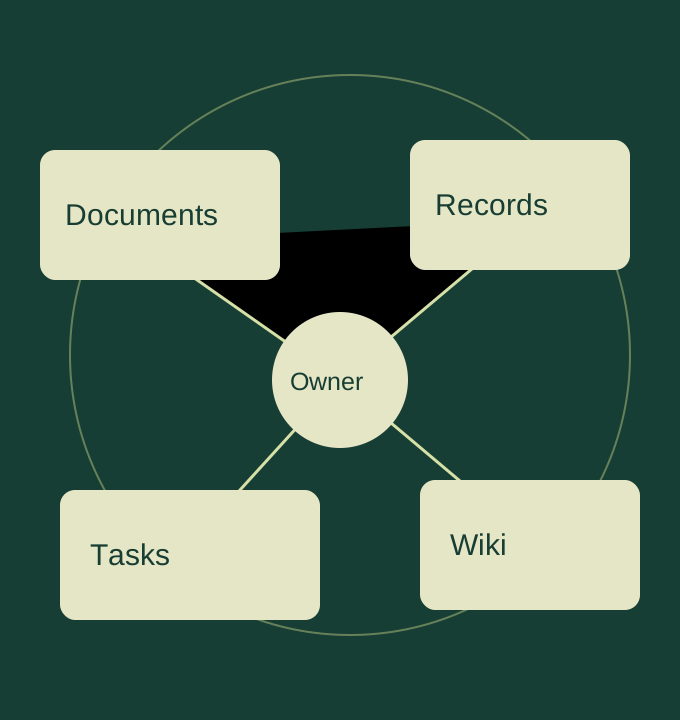
Keep complete prose and its evidence. Documents are more than status fields.
Required properties and relationships need an accountable source.
Separate assigned action, blockers and actual completion.
Readers need a trusted version, review date and permission route.
This local worksheet uses your entered evidence. It does not scan a vendor workspace, enforce permissions, or make an AI recommendation.
Dependencies use the visible structure IDs, separated by commas. Archive proposals with retained dependents need review. Missing owners and dependency cycles remain explicit.
Filled counts cannot exceed expected records. Required incomplete fields stay visible as repair work; optional values remain separate.
A missing value is not a negative answer. A finished task is not overdue. A portable file is not a restored workflow.
0–8 seconds: Begin with actual weekly activity. Harbor's fictional 210 document, 60 database, 90 task and 40 wiki minutes total 400. Documents are 52.5% of this observed example; the result guides a pilot, not an automatic vendor recommendation.
8–16 seconds: Inspect required property completeness. A segment filled for 60 of 100 records is 60% complete. Forty values are unknown. Keep the unknown bucket visible and decide whether to repair the required data.
16–24 seconds: Review authority and dependencies. The retained dashboard depends on the client register. A proposed archive of the register needs human review; a missing owner or a dependency cycle is not resolved by exporting it.
24–32 seconds: Write the pilot and preserve the source. Name an owner, date, acceptance tests and fallback. Export complete JSON, all CSV records, review Markdown and the ZIP packet. Restore JSON in this worksheet and inspect it; this does not prove vendor import or organizational approval.
Keep the four-field register when it still meets the actual job, with a named owner and complete notes.
A useful Notion alternative solves a particular repeated piece of work. That might be writing and finding documents, keeping structured records accurate, assigning and finishing tasks, or maintaining shared knowledge. An attractive new interface does not establish that it will do any of those jobs better for your people. Start with a week of actual work and one representative handoff, then compare products against that evidence.
There is a separate problem that a feature comparison often misses. A workspace can have enough capability and still become unreliable because nobody owns its structure. An old client list, three overlapping task lists and a dashboard that reports finished work as overdue are symptoms of a broken maintenance process. Changing products may help if it removes unnecessary choices or makes the required updates easier. It does not establish a new owner, fund their time or determine which source is authoritative.
This guide distinguishes a capability limit from maintenance debt, keeps the useful option of staying in Notion, and compares eight named destinations by their actual role. Asana is included as an additional task specialist. Product mechanisms were checked against current official documentation on October 7, 2026; documented features and illustrative examples are not independent performance benchmarks. The workbench records your own assumptions and calculates their consequences. It does not connect to your workspace or pretend to inspect its contents automatically.
Documents means writing, linking, retrieving and reviewing prose. Meeting records, a research journal, a client update and a draft story belong here when the text itself is the deliverable. Test whether a person can find the source, understand its context and continue editing after an export. Obsidian and Craft deserve document trials; Google Docs can be an adequate shared-writing baseline. A visual board can support discovery before a document exists without replacing its final authoritative copy.
Databases means reliable records, relationships, consistent fields and repeatable views. A client register, asset matrix or multi-year content catalog may genuinely need this. Decide which properties answer a real question and which values must be complete. Airtable and Coda are candidates when structured operations dominate. Notion may be sufficient, and current Obsidian Bases, Craft Collections and Google Sheets tables make older yes/no comparisons misleading. Test your required relationship and editing process instead of equating a table-shaped view with a full database workflow.
Tasks means clear responsibility, sequence, status and completion. An issue list is valuable because it changes action, not because its cards are attractive. Linear is particularly relevant to teams using issues, projects and cycles. Asana is another named option when broader project coordination, dependencies and handoffs are the job. Notion, Craft and Coda can also represent tasks. The deciding question is whether the team updates the necessary state without duplicating the reasoning or losing a blocker.
Team knowledge means durable answers people can find, read and trust. A policy, onboarding guide, service runbook and decision record are different from today's task list. Notion can remain a useful home when page context and structured records need to coexist. Confluence merits a trial when permission layers, review and organization governance are actual requirements. A wiki still needs review: an infrequently edited page may be critical precisely because readers assume it is correct.
Record the minutes spent on those jobs across one ordinary week. Include finding and fixing work, not only creating it. If documents consume 210 minutes, databases 60, tasks 90 and wiki reading 40, the measured total is 400 minutes and documents account for 52.5%. Those invented values do not prove that any software is best. They identify where a pilot would address the most observed activity. Keep unusual weeks separate; a launch week can temporarily make tasks dominate a normally document-heavy practice.
Maintenance is the recurring work that keeps your system usable: correcting statuses, resolving duplicates, reviewing permissions, retiring redundant views, teaching conventions and changing structures as real work changes. A flexible product gives you choices, including choices that somebody must keep coherent. A more constrained product can reduce the surface area. It cannot remove the responsibility to decide what is correct.
Look for specific evidence. People save useful pages outside the expected hierarchy because the official route takes too long. Two databases contain the same clients and neither has a declared authority. New starters need a tour because labels do not explain where work belongs. An important view has no known user. A template is copied twice and then abandoned. The workspace owner has left a role without handing over its rules. Record these as distinct structures and observed failures, rather than using an arbitrary count as a diagnosis.
An unused view can be harmless; an unused approval record can carry a retention obligation. Seven abandoned structures can be a helpful case description, but three is not a universal failure threshold. Add purpose, dependency, owner, last review and the evidence for a proposed action. The tool flags unassigned ownership and an unresolved dependency; it cannot know whether deletion is legally or operationally safe. Archive decisions remain human decisions informed by the source and your organization's requirements.
A property used in reporting has a different risk from an optional personal note. Suppose a fictional client segment is filled for 60 of 100 records. A view filtered to that segment can appear complete while silently excluding the other 40. The measured completeness is 60%, not evidence that the missing records belong to another segment. Show the unknown bucket and name the limits of the report. If the property is necessary, assign someone to repair it; if it has no actual purpose, simplify after checking what depends on it.
Do not confuse a smaller schema with automatically better information. Removing a required consent field would reduce maintenance and destroy an important control. A practical property review asks which question the field supports, what completeness is required, who updates it and whether its values can be checked. Preserve essential-but-incomplete fields as repair work. Retire decorative or duplicated fields only after confirming that they are not carrying a hidden handoff.
An owner is a person with authority and scheduled capacity, not a name placed beside a database. Write down which sources they govern, which changes need review, how people report a problem and who takes over when they are away. A half-day per month might suit a small stable workspace; a busy regulated operation may need much more. Treat the amount as an estimate and inspect whether the work fits it.
For the fictional Harbor studio, a useful ownership note is: “Maya owns the client register and its four required fields. Eli is backup. On the first Wednesday of each month, Maya compares active projects against the register, resolves duplicate clients and records exceptions. Anyone may propose a field; Maya approves changes after identifying the question it answers. Project notes stay in the named project folder. The register links to that folder and does not duplicate its prose.” This is more actionable than promising that a new platform will stay tidy.
The sequence below follows work from exploration through documents and records to action and shared knowledge. It is not an overall ranking. A tool near the end may be the correct purchase for a team whose decisions are already made. The useful comparison is the specific mechanism, the handoff and the continuing cost.
| Destination | Trial when this is the job | Prove before relying on it | Responsibility that remains |
|---|---|---|---|
| Storyflow | Arrange early research and creative relationships on a canvas | Board context, actual AI edit mode, collaborator route and portable output | Turn approved outcomes into a maintained source of record |
| Obsidian | Keep linked writing in local files | Markdown recovery, needed Bases view and sharing process | File conventions, plugin restraint, backup and team edit ownership |
| Craft | Write presentable documents with embedded structured items | Required Collection fields, task behavior, device editing and export | Review documents, identify authoritative records and test recipients |
| Coda | Combine prose with formulas and structured operational tables | Exact formula, automation, editor action and Maker role | Formula owner, update rules and paid role governance |
| Airtable | Maintain related records and useful role-specific interfaces | Actual record volume, links, permissions and unfiltered recovery | Data quality, interface ownership and writing handoff |
| Linear | Track issues, projects and cycles in a defined workflow | Status semantics, blocker handling, required documents and adoption | Triage, accepted scope and truthful completion |
| Confluence | Maintain governed knowledge pages | Space/content permissions, approval plan and recovery | Review dates, approved version and accountable authors |
| Google Docs and Sheets | Use shared prose plus a relatively simple register | Folder access, table views, offline setup and owner handoff | Consistent IDs, shared source boundaries and required updates |
Storyflow can be a useful trial when research fragments and possible relationships need arranging before their categories are stable. A canvas can represent provisional proximity without asking you to define a database relation first. That is a difference in working method; Notion prose, links and documents can also express relationships that are not schema fields.
The current pricing page describes proposed AI board edits, canvas context, document and board exports, invited collaborators and Max workspace roles. That differs from the source article's blanket absence of permissions or task-like objects. These descriptions do not establish equivalent relational-database behavior. Early access remains paid: Plus lists $95.88/year, Pro $168/year and Max $468/year; the advertised Free launch is future, while invitations can allow no-charge collaboration. Test actual access and accepted outputs before buying.
Use the boundary explicitly: visual research proposes a direction; the reviewed brief, task tracker or client register carries the agreed state. For a documentary team, “three possible opening sequences” belongs on the exploratory board, while “opening sequence B approved for draft v3, owner Eli, November 12” belongs in the project source. A pretty exported image is useful for presentation and is not automatically a restorable structured project.
The article describes active-board context with one Tactic and up to three mentioned Documents. The current AI board-editing help instead describes attachments of up to five documents, three tactics and three boards. It also says board changes occur directly with turn-level undo, whereas pricing describes proposals to accept or discard. Verify the actual edition and edit behavior before relying on a review gate. Bring the relevant board into focus, supply a named framework and source documents, then inspect the complete changed content; do not assume all unseen workspace knowledge is included.
The brainstorming help offers a practical conversion from a prompt to working board elements: walls per theme, notes per idea or a mind map from the conversation. Attach the brief or research and a relevant Tactic to constrain the request. For Alder, ask for three opening directions and then a map of their evidence and consent issues. Inspect the original notes after grouping, retain meaningful alternatives and use undo/manual edits when a relationship is wrong. This worksheet provides an audit ledger and performs no AI board generation.
Obsidian stores notes as local Markdown files. That makes independent text access a meaningful advantage when you want control over where writing lives. The official work-license announcement says the app is free for work as well as personal use; optional paid services have separate costs. A claim that commercial teams must buy the old mandatory commercial license is outdated.
Bases provides structured views over local notes and their properties. Consider it for a book list, project notes or a reading queue where each record is also a file. Evaluate the required view, filters, formulas and property-editing workflow. Do not dismiss it as having no databases, and do not assume it reproduces every hosted relational workflow or team permission model.
The maintenance risk moves to conventions, backup, file synchronization and extensions. Start with a folder, a few useful properties and a recovery test. Add a plugin only when it solves a repeated problem with a known owner. A graph can reveal a possible connection; an attractive network does not verify that an assertion is supported. For a team, test simultaneous edits and the actual handoff rather than assuming local files make collaboration either impossible or effortless.
Craft deserves a document-centered trial, especially when readable shared pages matter. Its Craft 3 documentation describes Collections with item content and task capture, a global task view and scheduling. The article's description of no meaningful databases and almost no tasks misses these mechanisms.
Test a real client note with an embedded Collection, required status values and the next action. Ask a recipient to find the authoritative version and update the necessary item. For complex relations or automations, prove the exact behavior you need. Offline capability should be checked on your actual device and edition, including the item that will matter on location; native, web and other platform behavior should not be conflated.
A more opinionated document interface may reduce your design work. It does not eliminate review dates, duplication or permission decisions. Avoid calling Craft universally lowest-maintenance or objectively underrated. It is a specific candidate worth a measured trial when writing and presentation dominate.
Coda is relevant when a table, formula or automation is the actual capability requirement. Write the desired behavior as a small acceptance test: changing the delivery date must alter a dependent view, and the editor must understand what happens. Keep the formula's explanation beside its owner. Complexity that is useful and maintained is different from complexity copied from an impressive template.
The official billing guide distinguishes paid Doc Makers and admins from free editors and viewers. Creating docs or pages requires the appropriate role. Consequently, a 15-person workspace is not automatically 15 paid Makers. Check actual needed actions and role-upgrade settings. Bundled accounts can have different administration. This role distinction matters more than an inaccurate generic “per editor” price claim.
For a document-and-data practice, test whether Coda reduces a real limitation while retaining understandable prose. If the main problem was nobody reviewing a schema, moving to more powerful formulas can expand the unowned surface area. Assign the owner before introducing the automation; a failed calculation should have an understandable recovery path.
Airtable is a sensible candidate for an asset matrix, customer pipeline or related catalog. Its linked-record documentation explains actual linked fields, and its view guide explains how views expose records. Trial the relationships, record counts, editing roles and interface your team needs. A general claim that one product is fast at a particular row count is not a substitute for that trial.
Long-form reasoning needs a deliberate home. An interface can make a record understandable, but the team may prefer a dedicated document for a substantial brief. Define the record ID, its document link and which values can change in each place. A second tool is helpful only when the boundary prevents contradictory edits.
The official plan comparison should be checked for the required roles and features. Model three paid collaborators and five separately when that is the actual choice. Export all necessary records rather than relying on a filtered view that excludes information. CSV is portable table text; it is not proof that permissions, automations, attachments and working linked behavior will reconstruct in the next product.
Linear offers issues, projects and cycles with defined workflow concepts. That can reduce the number of decisions a team must make about its tracker. Cycles provide repeated planning intervals, while current documents attach written context to several working objects. Calling it a product with poor or absent documentation features misses that useful handoff.
A software team can trial an issue with a blocker, a responsible person, a project and a written decision. A marketing or operations team should test whether the vocabulary and process fit rather than accepting an engineering recommendation by reputation. The team still needs triage, meaningful statuses and an owner for stale work. Constraints reduce configuration; they do not prevent neglected issues.
Asana remains a useful named task alternative. Its dependency documentation identifies blocking relationships and availability on Starter and higher eligible tiers; timeline features also depend on plan. For a cross-functional launch, test an approval task that blocks publication and inspect what a date change actually does. The existence of a line between tasks is different from automatic recovery of the schedule or evidence that an approver has accepted the work.
Confluence can be appropriate when the job is a governed knowledge base. Its permission model distinguishes global, space and content levels. Test the actual reader, editor and restricted-content routes before declaring it safer or more suitable for a larger organization.
The native approval feature is currently documented for Premium and Enterprise pages, not live docs or blog posts, and approvers need appropriate editing access. That is a meaningful plan and object distinction. Do not substitute a generic statement that every wiki includes approval, or assume a Marketplace workflow has the same cost and behavior as a native feature.
A fictional policy packet can say “Travel policy v4, author Noor, review November 18, finance approver Maya; page approval requested; publishing pending.” This is a proposed record, not actual signoff. An attractive page hierarchy still requires current owners, clear review dates and tests that readers can locate the approved version.
For shared prose and a relatively simple register, a folder of documents plus a spreadsheet can be enough. Not everyone already has the same paid plan or access rights; confirm your account and recipient route. Sheets tables have column types and views, so the source's categorical claim that there are no views is outdated. A spreadsheet still is not automatically a relational application with governed cross-record behavior.
Offline use requires preparation on the relevant device and browser. Try the actual file while disconnected and reconcile a changed value afterward. “Works offline” does not mean every linked asset or fresh permission change is available.
Keep one authoritative client ID, a known folder and a named register owner. Put narrative decisions in the project document and the limited operational values in the sheet. A useful handoff is “HBR-017 in Clients is the authority for project owner and stage; November brief v2 is the authority for the approved narrative.” A shared folder with no review rule can become just as confusing as a sophisticated workspace.
The original agency example is useful because it distinguishes an initially working system from a later ownership failure. The replacement below is fictional and dated so readers can inspect the sequence and adapt its records. The figures retain the source's practical situations; they are not observations of a real client or a prediction that every workspace decays on this schedule.
Harbor is a fifteen-person agency. From January 6–17, operations lead Maya spends a fortnight creating a project database related to clients, a people list, meeting-note templates and an owner-filtered dashboard. The first client is Alder Museum, project HBR-017. Eli owns the film project; the client source links to the project folder and current brief. The useful question is “Who owns active work for this client, and where is the current reasoning?”
Between February and June, the structure helps. Two new hires, Noor and Jules, each spend an hour learning the route from the client list to the project, its meeting notes and responsible person. That is two hours of person-time, not a one-hour whole-company delay. Record the onboarding cost even when the system is worthwhile; it makes later comparisons fairer.
In month nine, Maya takes a client-facing role. No backup receives the convention note, and nobody reserves time for structure review. There is no immediate software failure. The absence of an accountable owner gradually leaves questions unanswered: can a project add a new status, where do duplicate clients merge, and who corrects a dashboard when the underlying record is wrong?
The useful warning is the missing handover, not September itself. If Maya had transferred authority and funded the review work, the same product might have remained sufficient. Record an owner transition as an event with source rules and backup, rather than a claim that a specific application causes decay after nine months.
By month fourteen, three of eleven properties are inconsistently filled. Two colleagues keep project notes in Google Docs because that is easier than locating the right template. The dashboard displays six overdue items, although four are already finished. Only two are actually overdue in this fictional reconciliation. The apparent count exaggerates the outstanding work by four items; it does not measure faster or slower software.
Ask Eli to confirm completion against the actual deliverable, and write the correction time and authority. Then inspect every field separately. “Three inconsistently filled” does not prove that the other eight are all necessary. The team chooses four required properties for its client register after reviewing use: client ID, current project folder, accountable owner and active/paused/closed state. Eight reliably populated fields and four necessary retained fields would be different statements; avoid silently conflating them.
In month twenty, a new starter asks for the client list and receives three different answers. A colleague proposes moving everything to Coda. The audit records seven structures needing a decision: the main client register, a duplicate sales list, an old people table, an unused dashboard view, a copied meeting template, an abandoned campaign tracker and a private project-note collection. Their proposed actions differ. The client register is retained and repaired; the sales duplicate needs reconciliation; the personnel table requires access review; the private notes need explicit sharing consent.
The observed dominant job is documents: meeting records and client updates are read and written, while many database views are rarely consulted. The October 6 review therefore pilots a simple shared-document route and retains one small Notion client register with four required properties. Maya resumes named ownership, with Eli as backup and an estimated half-day per month. They do not delete essential historical material solely because nobody opened it recently.
Record: HBR-017, Alder Museum, project folder “Alder Museum / Film 2026,” accountable owner Eli, state active. Current narrative source: “Alder opening film brief v2, October 6.” Four finished items have their completion evidence linked; two remaining actions stay open. Register owner Maya; backup Eli; next reconciliation November 4. Proposed pilot acceptance: a new starter can find HBR-017, its current brief and owner without a tour, and Eli can correctly change the state without editing two sources.
Message draft: “Please use the Clients register for client ID, active state, responsible owner and the project-folder link. Put meeting notes and narrative changes in the named project folder. For Alder, HBR-017 and opening-film brief v2 are the current sources. The dashboard's six overdue count included four finished items; two remain open after today's reconciliation. Maya owns register changes and Eli covers absences. Reply with any missing client or conflicting owner before October 9. This message proposes the new route; please confirm acceptance before we make the old duplicate read-only.”
The team can still migrate if the trial reveals a capability limit. A hypothetical Coda migration taking a quarter and eventually producing similar confusion is a warning scenario, not an established inevitable outcome. The useful lesson is to settle ownership and source boundaries before investing in reconstruction.
Start simplification with inspection, not deletion. Find views with no identified purpose, properties whose values are not trusted, duplicate sources and prose forced into an inappropriate operational structure. Preserve a recoverable copy and note dependencies. A property whose values are absent needs an explicit choice: repair, show unknown, or retire after checking its purpose. Changing a page arrangement cannot make missing information exist.
A database row opening into a full page can be a genuine strength of Notion. The reasoning behind an item and its operational fields can stay together. Other products can also combine written context with records in different ways; treat this as a useful fit advantage rather than an exclusive feature nobody else replicates. Test whether the actual team can find the reasoning and safely update the value.
Stay when several jobs share useful context, the current workspace works at representative size, readers understand it and a responsible owner can maintain it. A genuine team wiki need not be moved merely because a specialist has stronger features elsewhere. A solo user who remembers the conventions may find maintenance manageable, while still needing offline access or local-file control. Conversely, small record counts do not guarantee good performance or adequate permissions.
Split tools only with an explicit boundary. For a database-heavy practice, Airtable may carry operational state and a document app may carry long-form reasoning. For a document-heavy practice, a local writing home might carry prose and a small shared register might track clients. State the authority for each field, the stable identifier that joins the sources and the person who resolves conflicts. Two capable specialists can lose information between them if both appear to own the same decision.
Keep the onboarding test honest. Ask a new person to find the active client, locate the approved brief and update one required value. Measure the completed task, access delay and correction separately. Nontechnical familiarity is personal and team-specific; do not turn a pleasant interface into a guarantee that everybody can adopt it without support.
Spend the first five minutes listing recent activity under the four jobs. Use actual minutes or event counts and state which unit you used. The workbench uses minutes, so a one-minute event and a fifty-minute research session are not accidentally counted as equal. Record one ordinary week and an exceptional week separately if their patterns differ.
Use the next five minutes to identify structures that require decisions. Write the real owner, purpose, last review and source. Note duplicates and dependencies. A row titled “Old client list” with no link or decision is insufficient evidence for archiving; a row with its authority, replacement ID and recovery check is actionable.
Include retrieval and mobile editing in the capability trial. Ask someone to find a page whose title they know, then find an observation they only partly remember, including a relevant second workspace if that is the real route. Record the query, time and correct source rather than declaring search universally weak. On the actual phone, read the brief, change a required property and inspect the linked context. A good reading experience and a good structured-editing experience are separate results. Test the offline packet on the train, plane, archive or location device you actually use, before losing connectivity.
In the third five minutes, name the capability that actually fails. Offline editing on your train device, finding a specific record among representative data, allowing a recipient to read a brief, or calculating a required formula are concrete tests. Write what passed, what failed and what you did not test. Product reputation is not an observation of your workflow.
Use the final five minutes to choose a small reversible next action. That might be simplifying one register, testing one specialist with a real packet, or keeping the current tool while assigning an owner. Write a pilot date, success criteria, source boundaries and a fallback. Twenty minutes can create a decision brief; it cannot complete a safe migration of an unknown workspace.
Filled diagnosis: October 6, Harbor, owner Maya. Observed week: documents 210, databases 60, tasks 90, wiki 40 minutes. Seven structures need review, including one duplicate authority and one unassigned owner. Need: Noor must find Alder's current brief without a tour. Proposal: retain the four-field client register and pilot a shared-document route for one client by October 13. Acceptance: correct current source found, complete narrative preserved, required edits reconcile and a recovery packet opens on a fresh device. Fallback: keep the original source available while the team resolves disagreements. This is a proposal awaiting acceptance, not a completed organizational change.
The Notion export guide documents HTML and Markdown/CSV routes, associated page content and uploaded files. Access restrictions can omit content, and a workspace export cannot simply be reuploaded to recreate the original working system. Verify the scope, attachments and subpages before treating the export as complete. A readable archive and an operationally reconstructed workspace are separate outcomes.
Create a checklist around behaviors: links that resolve, properties and relations that matter, views and filters people use, required permissions, formulas, automation and final decision context. CSV values do not by themselves establish restored relations, role restrictions or working formulas. Keep record IDs and complete prose while documenting what must be rebuilt or verified.
Recent usage helps prioritize a pilot. It is not a retention policy. A document unread for three months might be an evergreen procedure, an old approval or a record that must be retained. Classify current work, reference material, historical records and restricted content before choosing what moves first. Keep a reviewed archive with a known retrieval method; do not call an export useful while promising nobody will ever open it.
For the Harbor pilot, October 7 is the export and inventory day; October 8–9 rebuilds the client register and document route; October 12 tests access, status and recovery; October 13 is the proposed go/no-go review. Those dates and effort estimates are fictional. The original source remains available during the pilot. Any read-only period depends on the plan, retention requirements, team acceptance and recovery confidence, rather than an automatic six-month rule.
A source file can retain the words while losing a linked relation. A destination can display a relation while exposing sensitive content to the wrong reader. Ask different people to perform the actual actions. The export checklist should note expected and observed results, not only a green “migrated” badge.
For HBR-017, test that Noor can read the correct brief, Eli can change the active state, and a restricted personnel record is unavailable to the client. Confirm the six-item dashboard reconciliation still reports two genuinely open actions. Restore the review packet on a fresh browser and inspect complete notes. The workbench's JSON restoration proves its own source recovery; it does not establish successful import into any vendor or enforce that vendor's permissions.
Write the source rules and assign review capacity before launch. If nobody accepts the role, narrow the system or choose a workflow with fewer required conventions. A migration can be reversible when snapshots, cutover boundaries and a fallback are preserved. It can also create costly dependencies. “One day to simplify” and “a quarter to migrate” are useful planning prompts only when converted into scoped, entered estimates for your own situation.
The lowest sticker price may not produce the lowest cost for your workflow. A paid Maker, paid editor, invited collaborator, viewer and workspace admin can have different billing consequences. Confirm needed actions before counting licenses. Use an existing paid account only when its actual permissions and feature edition fit; an already paid bill does not make additional work or risk disappear.
Here is a fictional monthly-equivalent estimate, in an entered currency: three required paid roles at 20 each cost 60. Maintenance takes four hours at 45 per hour, adding 180. Cross-tool handoffs take two hours at the same rate, adding 90. The ongoing total is 330 per month. A one-time pilot estimate of twelve hours at 45 adds 540. Spreading that estimate over six months adds 90 per month, for a 420 comparison. These are assumptions for arithmetic, not vendor quotes, guaranteed savings or a recommendation to commit to an annual contract.
Now compare a second scenario with five paid roles, two maintenance hours, four handoff hours and an eighteen-hour pilot. At the same entered 20 and 45 rates, seats cost 100; maintenance 90; handoffs 180; pilot 810 or 135/month over six months. The modeled comparison is 505/month. The second scenario reduces maintenance and still costs more overall because it adds handoff and pilot work. Inspect which assumptions you can measure; a scenario is not evidence of future outcomes.
For Coda, map paid roles to actual Makers/admins rather than all fifteen people. For Airtable, inspect the required collaborator and plan rules. For Storyflow, distinguish an annually billed monthly equivalent from a monthly charge and a future Free plan from current paid access. For Obsidian, distinguish the free app from paid synchronization or publishing. For Confluence, include the plan required for native approvals if those are in scope. Preserve currency, tax assumptions, billing term and role action alongside the arithmetic.
These six named applications preserve useful template ideas without copying a decorative workspace wholesale. Each example is fictional and includes a source boundary, accountable person, review date and useful output. They can be adapted into the workbench's structure and pilot ledgers; a template name alone is not a migration or a verified permission setting.
Structure SB-01 is “Museum visitor research,” job documents, owner Noor, review November 2, source “Alder / Research / visitor-interviews-v1.md.” Its purpose is to retrieve observations for the opening-film brief. Required fields are source ID, observation date, participant consent reference and note owner; an optional inspiration tag is not used for reporting. The note separates direct observations, interpretation and open questions. Pilot action: open the complete note and consent reference on the actual offline device, then reconnect and verify the edit. Decision draft: retain the writing source and link it from HBR-017; do not duplicate interview text in a task status.
Structure MM-01 is “Alder opening possibilities,” job documents/exploration, owner Eli, review November 3, source “Alder / Exploration / opening-map-v2.” Nodes are “arrival,” “object repair” and “visitor voice.” Edge text records “possible contrast,” not a proven causal relationship. A new link can be made before a database relation is defined. The handoff is a written choice: “Try the object-repair opening in draft v3; visitor voice remains an alternative pending consent review.” Pilot action: export a readable map and preserve the written reasoning. That visual choice does not update the client register or establish approval.
Structure ST-01 is “Opening film v3,” job documents, owner Eli, review November 5, source “Alder / Film / story-plan-v3.md.” Opening: a repairer reveals the object; middle: a visitor notices its trace of use; ending: the museum invitation connects preservation to participation. Constraint: no visitor identity before consent check. The decision record says “proposed for client review,” with Maya sending the brief on November 4 and a response due November 6. Pilot action: preserve the full prose, alternatives and open consent issue through export. A row saying “approved” is not a substitute for the actual accepted version and source response.
Structure MK-01 is “Museum film release,” job tasks plus documents, owner Jules, review November 9, source “Alder / Launch / release-plan-v1.md.” Fictional budget: 2400 units, 50% production materials 1200, 30% paid distribution 720, 20% access/caption checks 480. Deliverables: one captioned film, two short cuts and one accessible landing-page draft. Target: 500 qualified visits in a stated fourteen-day November 16–29 window; baseline is 400 in a comparable prior fourteen days, so the proposed increase is 100 or 25%, not an observed result. Pilot action: keep budget assumptions and brief in the document, and task responsibility in the tracker. Check which channel results are actually measurable before promising the target.
Structure CP-01 is “First-time museum visitor hypothesis,” job documents, owner Noor, review November 10, source “Alder / Research / persona-hypothesis-v1.md.” Proposed audience: local adults considering a short visit, with uncertainty about admission and accessibility. Evidence: interview notes R-03 and R-07; unresolved: whether opening hours or transport is the larger barrier. Excluded assertion: “all local visitors value restoration stories.” Pilot action: preserve the evidence links, consent boundary and uncertainty in the exported note. Literal review request: “Please challenge this hypothesis against R-03/R-07 before we use it to choose the film opening; it is a planning draft, not a verified population description.”
Structure TD-01 is “Harbor weekly client view,” job databases/tasks, owner Maya, review November 4, source “Clients / HBR active view.” It displays client ID, accountable owner, state and project-folder link. HBR-017 is active, Eli owns the work, and two actions remain open after reconciliation. The view does not claim four finished tasks are overdue. Dependency: the Clients register must stay authoritative, and the project-folder links must resolve. Pilot action: check the display against three real project sources and have Noor find the current brief. If the view adds no distinct decision, simplify it after preserving its source and confirming dependencies.
Enter actual four-job minutes, then edit structures with purpose, owner, review date, dependency IDs, source link and complete note. Add a property with expected and filled record counts; the output exposes incomplete required data and keeps optional fields separate. The dependency graph uses the entered IDs to find cycles and dependent structures. A proposal to archive a node remains visible beside its blockers. The tool does not decide what your organization is allowed to delete.
Use the scenario fields to model paid role counts, entered price, maintenance, handoff hours and one-time pilot effort. The totals are arithmetic over your inputs, with units and assumptions retained. A graph and calculated cost do not establish which vendor performs best or whether a workspace has truly been migrated. Keep an observation note for the actual pilot and mark proposal, trial and acceptance as different states.
Export JSON for exact restoration of this tool's source, CSV for a complete flat ledger, Markdown for a human-readable review, and a ZIP packet for the individual structure notes and full source. Inspect the downloaded files before relying on them. JSON restoration validates the format and relationships before replacing current work; an invalid or incomplete source should leave the current record intact. The packet is a review artifact, not a vendor-native project or a permissions backup. Browser memory is not a durable storage guarantee; export meaningful work before closing the session.
If a visualization library fails, use the textual ledger and source exports while the chart is unavailable. If a ZIP library fails, individual JSON, CSV and Markdown downloads remain the recovery path. Full-note preservation is more important than a decorative summary. The teaching video demonstrates the fictional agency's input, dependency review, property completeness and pilot packet; its transcript contains the same complete method for readers who prefer text.
This guide establishes no independent trust ranking. Compare the control that matters: local source access in Obsidian, required sharing and administration in a document app, record ownership and permissions in Airtable or Coda, accountable workflow in Linear or Asana, and governed page access in Notion or Confluence. Inspect the actual plan, privacy/security documentation and deletion/recovery process. A recognizable brand or long history does not verify that your recipient can safely use a particular workspace.
Fairness depends on the needed action and bill. Obsidian's app is free for commercial as well as personal use; optional services are separate. Coda charges Makers/admins in paid workspaces rather than every editor. Airtable role and plan rules must be checked against the actual collaborators. Notion and Google have distinct editions and existing-account constraints. Storyflow currently advertises paid early access and future Free availability, with no-charge invited collaboration. Compare the complete role/term/currency assumptions before declaring a product cheap or expensive.
No longitudinal uptime or large-workspace benchmark was run here. Local Markdown supports independent text access; it does not guarantee immunity to lost files or synchronization conflicts. A hosted product's incident history and status page can inform a review but cannot promise your next session. Test representative data, important views, search, mobile edits and recovery on your actual device. Keep measured response times separate from general claims about scale and check the exact workload before attributing a failure to row count.
Begin with the official plan page for a product that passed the primary-job pilot. Documents may lead to Obsidian or Craft; structured operations to Airtable or Coda; tasks to Linear or Asana; governed wiki pages to Notion or Confluence. Google Docs and Sheets may be enough when the source boundary is simple. Storyflow is a separate exploration trial. Verify the required role and feature edition, renewal term, export route and consent to organizational spending. This page does not sell subscriptions or represent an authorized reseller.
“Underrated” here means worth testing for an overlooked fit, not a measured popularity ranking. Craft Collections/tasks, Obsidian Bases, Google Sheets tables and current Linear documents can change an outdated comparison. A smaller retained Notion workspace with a named keeper can also be overlooked when the conversation assumes everyone must migrate. The concrete trial is more useful than a universal winner: ask whether one real source, edit and handoff become easier without creating a new authority conflict.
Choose candidates by the job you actually do. Document-centered work merits Obsidian, Craft or Google Docs trials; structured operations merit Airtable or Coda; tasks merit Linear or Asana; a wiki may stay in Notion or move to Confluence when specific governance needs justify it. Current hybrid features blur old categories, so the table is a trial map rather than a capability ranking.
Possible reasons include capability fit, performance on a particular workload, offline preparation, mobile use, search, export concerns and unowned maintenance. This guide has not measured which reason is most common. Diagnose the observed failure: a slow view, a missing source, an incomplete required field and a departed workspace keeper require different remedies.
It can help when the destination removes unnecessary complexity or meets a genuine missing capability. It cannot automatically reconcile duplicate authorities, supply missing data or fund an owner. Test a simplified current route and one destination pilot, preserve a fallback and compare actual handoff costs. A predicted recurrence after nine months is a warning scenario, not an established rule.
For local linked writing it is a strong candidate. Bases adds structured views over note properties, so “no databases” is outdated. Test required relation behavior, extensions, synchronization and team edit conventions. Local Markdown reduces dependence on one editor for basic text access but does not mean every plugin-based workflow reconstructs automatically in another app.
The workflow with the least unnecessary structure for your required job. Linear's issue/cycle model, Craft's document route or a small Docs/Sheets arrangement may reduce choices. Each still needs an authority and review rule. Measure maintenance and handoff together; fewer configurable options are useful only if the remaining process fits.
There is no row-count performance threshold established by this page. Properties, views, content, devices and network conditions can affect the experience. Use representative records and the actual operations your team performs. A few hundred items do not guarantee speed, and several thousand do not by themselves prove that another vendor is the correct destination.
Current desktop/mobile support allows downloaded-page work, including editing and new pages. Database downloads initially include the first fifty rows of the first view, with additional important rows downloaded separately. Downloads are device-specific; some advanced blocks and permission actions need connectivity. Perform the real trip-packet test and reconcile changes rather than treating offline as a binary product badge. See the official offline documentation linked above.
It can fit when readers find useful pages, editors maintain them and the actual permission/review requirements are satisfied. Confluence is worth testing for its documented governance mechanisms, including plan-specific page approvals. Organization size alone does not choose a winner. A small critical policy can need tighter control than a large informal knowledge collection.
Inventory and export early, scope one pilot, preserve source IDs and full prose, and test actual behavior plus access. Prioritize current work while retaining historical and evergreen obligations appropriately. Assign ownership before cutover and set a documented fallback. Estimate the work instead of promising a fixed duration or a universally irreversible migration.
The official export route provides readable page/table content in formats including HTML and Markdown/CSV, with relevant page files and uploaded assets depending on scope and access. It is not an instant reconstruction of the working workspace. Inspect relationships, views, permissions and automation separately in the destination; the export's existence is not proof that all content or behavior survived.
It may suit a particular table/formula/automation requirement. Prove the exact behavior, editing route and Maker role before declaring an upgrade. If nobody maintains the current schema, more powerful formulas can increase debt. A document-heavy or comfortably mixed workspace may gain little from a move.
Keeping both in one workspace may be valuable. If one job strongly dominates, a specialist and a small secondary source can work with a declared boundary. Define which source owns each field, how records link and who resolves disagreements. The cost model includes handoff hours because a second tool is not free merely because its subscription is already paid.
Record real evidence: ownerless sources, duplicate authority, stale statuses, missing required values, unused structures and difficult onboarding. Count structures as an inventory, not a universal diagnostic cutoff. Compare observed capability failures separately. The agency case's seven review items help explain its decision but cannot classify an unknown organization automatically.
Only if the actual need justifies the move. Local-file control, writing preference, offline-device behavior or a specific capability can favor Obsidian or another route. A solo system can still become complex, and a solo user can still have a demanding dataset. Test the individual workload and recovery requirement rather than applying a team or personal stereotype.
A named person with authority, capacity, a backup and written source rules. Assign that role before the move. If nobody can accept it, reduce required conventions and scope the workflow honestly. The half-day-per-month Harbor example is an estimate for a fictional small practice, not a universal staffing recommendation.
Usually it is worth a small tested attempt when maintenance is the issue. Review unused views, duplicated sources and field purpose; repair important missing data and preserve recovery copies. Do not delete solely by last-opened date. A scoped simplification can be easier to reverse than a broad cutover, but effort and reversibility depend on the actual work.
An incomplete field used as an authoritative filter can create false confidence. Show missing values, record completeness and decide whether to repair or retire the field. A necessary-but-incomplete consent property cannot safely be removed just to make a table smaller. Optional fields and required reporting fields have different consequences.
A template may offer a useful starting method, but it brings assumptions that somebody must review. Start from the real question and required handoff, adapt the six filled examples above, and add fields when repeated work justifies them. Screenshot density is not a maintenance strategy. A template can help only if its behavior and source boundaries match your process.
It can keep operational fields beside a full page of reasoning and combine several jobs with one understandable route. That can reduce cross-tool handoffs and help shared context. Other products also combine prose and records in different ways, so the advantage is actual fit rather than exclusive ownership of a feature. Test new-person adoption, recipient access and total cost with your own people.
This original guide draws the topic and useful decision coverage from Storyflow's Notion-alternative article, then checks current mechanisms against the official vendor links beside each claim. The fifteen-person agency, dates, budgets, costs and template records are explicitly fictional worked examples. Product documentation supports the described mechanism; it does not establish a comparative speed, trust, satisfaction or ease ranking.
The ledger keeps a portable planning record; it does not inspect live vendor data or synchronize collaborators. Export the complete source before relying on it as your review packet. Keep the proposal, actual trial evidence and accepted cutover decision separate so the next person can see what was checked and what still needs their action.