Choose Milanote when the creative board is your main workspace; choose Notion when owners, dates and dependencies need a structured record; consider Storyflow when you want AI-assisted production drafts beside the visual plan. Keep your actual editor and review process in the workflow. This is a documentation-based comparison, checked October 5, 2026, rather than an account trial or performance benchmark.
Milanote
A visual home for the treatment and shoot plan.
Its filmmaker workspace brings notes, research and references together with moodboards, storyboards and shot-list templates. The visual sequence is useful when a director needs to communicate the look before discussing tasks. Official filmmaking overview.
Board sharing distinguishes viewing, commenting and editing. A shared board also exposes its subboards, so inspect the full hierarchy before sending a client link. Read-only access does not require an account; commenting and editing do. Sharing documentation.
Our recommendation: keep the approved treatment prominent, then maintain a separate, explicit delivery checklist. A beautiful board alone does not establish whether a final file matches the brief.
Notion
A structured record for recurring production work.
Sub-items split a task into smaller pieces. Dependencies connect tasks, with choices to shift dates only on overlap, maintain the gap between tasks, or leave dates unchanged. Weekend avoidance is a separate setting. These documented controls suit a repeatable production database. Sub-items and dependencies.
Sharing permissions include viewing, commenting and editing, with permissions inherited from parent pages. Design the client-facing page deliberately rather than assuming every internal record is safe to share. Notion sharing documentation.
Our recommendation: use linked records for deliverables, tasks and decisions; put the approved creative reference inside the record that owns the work. This needs an intentional setup rather than a production-specific default.
Storyflow
A board for AI-assisted production documents.
The current production page documents briefs, scripts, storyboards, shot lists, schedules, call-sheet PDFs, edit tickets and deliverable tables together. Its AI drafts from board context; the human producer still checks the output. View-only links require no account. Current production overview.
It organizes work around the footage; it does not edit footage, run payroll or send call sheets by text. Keep editing and frame-accurate cut review in their appropriate tools.
Availability matters: standalone access is paid-only during early access; invited collaboration is free today. A standalone Free plan is announced for before the end of 2026, not currently available. This follows the explicit pricing availability statement checked October 5. Older indexed marketing describes free access more broadly; this was a public-source check, not a signup test.
The shared discipline
Give every stage an owner and a real artifact.
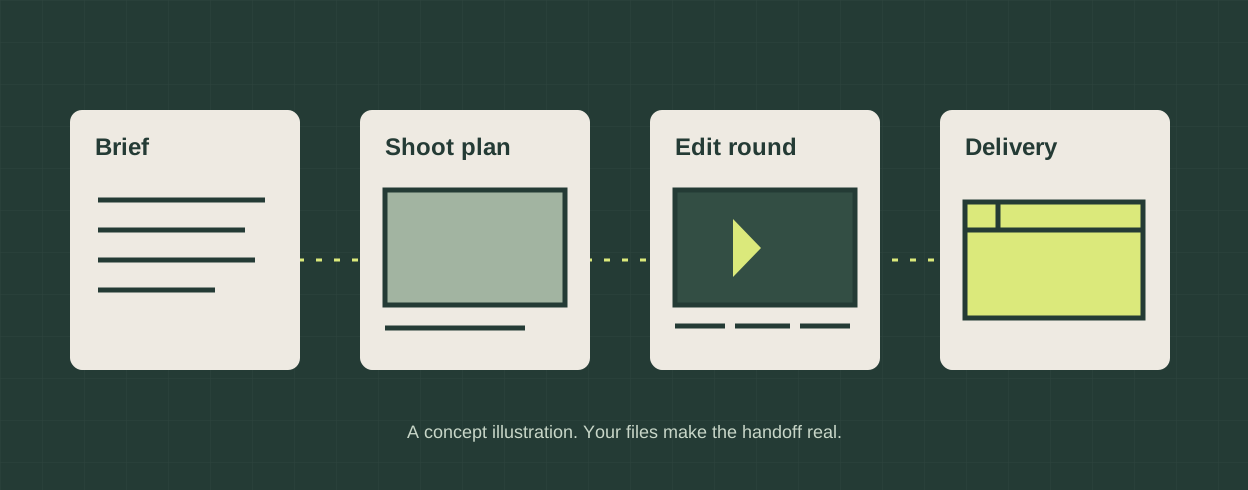
Record the approved brief and version. Connect each shoot requirement to that brief. Record edit decisions against a named cut. Before delivery, list each promised format and attach the corresponding file.
A board, a database and an AI draft can all support this discipline. None substitutes for checking permissions, consent, actual media content or the recipient’s technical specification.
The packager below makes the last handoff concrete: it collects your selected files, computes their SHA-256 digests, and exports a manifest that says exactly what is included.