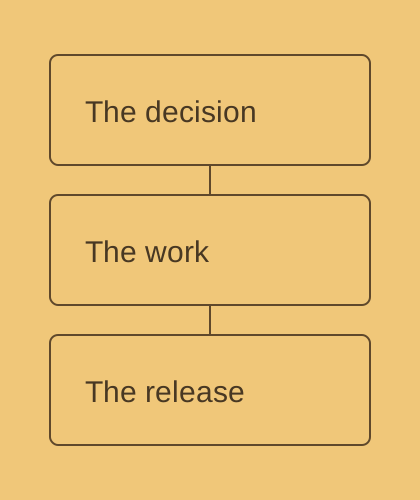
A brand launch needs shared decisions more than a folder full of polished blanks. Our practical six-document set connects the audience and promise to the work, release plan and learning questions.
This is our recommended working structure, not a universal rule that every launch requires six separate files. A small team can combine documents, while a complex launch may need more. Preserve the decisions and owners rather than defending a file count.
Positioning and audience
State who the launch serves, what situation they face, the alternative they use today and the distinctive value you can support. Separate researched observations from assumptions. Shopify’s positioning guide connects the target audience, category, differentiation and reason to believe; use it to make the premise explicit.
Write a primary message, supporting claims, evidence and language boundaries. Each substantive claim needs an identifiable source or an explicit unresolved status. This document carries the promise from strategy into pages, emails and creative work.
Creative production brief
Define the actual deliverables, formats, audience, acceptance criteria, inputs and reviewers. Include unresolved dependencies rather than allowing a polished mockup to hide them. A useful brief tells the next owner what is needed to begin.
Channel and launch plan
Choose the destination and purpose of each channel, the owner, release condition and required asset. Asana’s launch guidance describes organizing responsibilities and timelines; its launch template offers a project structure. Our document supplies portable source text rather than creating an Asana project.
List the actual release actions, person responsible, prerequisite, verification and fallback. Keep a draft release decision separate from the act of publishing. The runbook is for a person following the sequence; it is not proof that a system has executed it.
Measurement and learning
Define the question, observation, source of data, review owner and decision the result could change. Google Analytics documents campaign URL parameters such as source, medium and campaign. Consistent tagging supports measurement, but adding parameters does not itself install analytics or prove an outcome.
These are original writing prompts informed by the cited primary guidance. They are not copied templates or a compliance checklist. No customer outcomes, commercial account tests or current prices are claimed.
What changes when a brand launches?
A product launch introduces an offer. A brand launch changes the identity and expectations through which people understand an organization. They can happen together, but the work is not identical. A new product may need product-specific sales material while the existing identity remains useful. A rebrand may leave the product unchanged while replacing the name, positioning, visual system and language across many existing touchpoints.
Begin by naming the change. Is the organization entering a category, changing its audience, combining businesses, introducing a new name or clarifying an existing promise? Write what remains true as well as what changes. That boundary prevents a visual redesign from silently becoming a new product proposition, and prevents a campaign headline from making a promise the organization cannot deliver.
Make the launch brief a decision record
The brief should answer who the launch serves, why the change is happening, what response is wanted and which evidence supports the promise. Add scope, constraints, an accountable owner, decision-makers and unresolved questions. A useful objective describes an observable response, such as an existing customer understanding a name change, rather than simply “build awareness.” Record the baseline and the observation you will review; do not invent a target because a template contains an empty number.
For example, a small software team renaming an established service could write: “Existing customers should recognize the service after the change and find the same support route.” That is a different job from convincing a new market to try an unfamiliar product. The former needs continuity and clear migration communication; the latter may need evidence of relevance, accessible trial information and a stronger explanation of the offer. The same design assets will not necessarily answer both questions.
A messaging house is a claim structure
Use a primary message, a few supporting messages and the evidence behind each one. Under the statement “a simpler way to organize field work,” supporting messages might explain where work is captured, how a team finds the current task and which handoff the product actually supports. Each message needs its own proof and boundary. A screenshot can illustrate a feature; it cannot establish an unmeasured percentage improvement.
The structure helps a writer choose the appropriate message for a landing page, customer email or sales conversation without changing the promise each time. Keep language that is not yet supported in a separate questions area. Treat positioning as the premise and messaging as its expression, rather than using both terms for a collection of slogans.
Turn the asset list into a launch system.
An asset matrix connects a deliverable to its audience, destination, format, owner, reviewer, current version and release condition. The point is not the spreadsheet itself. The point is being able to answer “What exactly is this row, who owns it and what must be true before it can go live?” without searching several conversations.
Example deliverable
Purpose
Owner and review
Release condition
Customer continuity email
Explain the changed name and unchanged support route
Lifecycle owner; support lead reviews accuracy
Destination and support links verified; final copy accepted
Website identity update
Present the current name and promise
Web owner; brand and product owners review
Approved asset version, tested navigation and agreed release window
Sales explanation sheet
Help staff explain the change consistently
Enablement owner; commercial owner reviews
Internal briefing complete and current file distributed
Social announcement
Introduce the change to the selected audience
Channel owner; named reviewer decides
Destination live and the publication step authorized
This is a hypothetical four-row example, not a complete campaign inventory. Add the real format, language, accessibility requirements and dependencies for your launch. A deliverable called “social” is too vague when it represents several channels, formats and localized versions. Separate the records when their production or release conditions differ.
Keep the calendar and matrix connected
Give each asset a stable identifier and use it in the launch plan. The calendar answers when something is intended to happen; the matrix answers whether the actual item is ready. A calendar date alone should not imply approval or completed production. When an asset moves, update the linked launch action and tell the owner of any dependent action.
Choose an authoritative place for readiness and an authoritative place for timing. They may be views of one dataset or separate documents linked by identifiers. Avoid two independently maintained status columns that both claim to be final. Define which field is a plan and which is an observed result; record a publication only after the real destination is verified.
Audit migration work before creative scope is final
A rebrand can leave old material in support articles, login screens, invoices, email signatures, app listings, downloadable PDFs, partner pages, packaging and sales material. Inventory the touchpoints you actually control, name their owners and distinguish public, internal, transactional and archived items. Ask partners what they can change rather than assuming access.
For a site or domain change, put the existing URLs, intended destinations, navigation links and verification owner into the migration workstream. Use the actual platform’s documentation and test the resulting behavior. This article does not prescribe redirect rules for every deployment. The important planning decision is that migration has an owner, explicit scope and verification, rather than being an unnamed task beneath “launch website.”
Keep a reasoned exception list. Some historical material may remain as an archive, while a document sent daily to customers may need immediate replacement. Record the decision so the team can explain an intentional exception instead of repeatedly treating it as unfinished work.
Prepare the people who carry the new promise.
The internal launch pack
An internal pack should explain what changed, why it changed, what stayed the same and how staff should use the new materials. Include the current message, approved assets, answers to predictable customer questions and the owner of unresolved issues. A sales or support person should be able to find the current answer without deciding which of several announcement drafts is authoritative.
Use actual scenarios in the briefing: a customer asking whether their account changes, a partner requesting a logo, a staff member updating a presentation and a prospect comparing the new offer with an existing alternative. Where an answer is unknown, name the owner and response path. Do not turn an announcement into an unsupported guarantee about contracts, accounts or products.
Internal timing is a dependency decision. The people answering customer questions usually need the current explanation before those questions arrive. Some information may require coordinated access or a particular release window. Choose the real timing with the people responsible rather than adopting a fixed “internal launch day” from a generic template.
The sustain plan
After the announcement, assign ownership for follow-up content, customer questions, outdated material and measurement review. Sustain is not a universal budget percentage. Estimate the actual work and channels you intend to maintain. Decide which observations will justify more explanation, another asset, a corrected link or a change to the next campaign.
A launch-week runbook can hold the first actions, but ongoing work needs a continuing owner and review rhythm. If you combine the sustain plan with the measurement document, keep actions and observations distinct. “Customers asked about the old name” is an observation; “update the support article and recheck customer responses” is a proposed action.
A worked example: a service rebrand with an existing audience.
The following is a fictional planning example, not a customer case study or an empirically validated schedule. A small software team intends to rename its field-service product while preserving existing accounts and support routes. It has a web owner, a brand designer, a lifecycle marketer, a support lead and a product owner. The timing below represents chosen planning buckets; actual duration depends on capacity, decisions and dependencies.
Discovery and the change boundary
The team first lists the current customer touchpoints and writes the boundary: the name and presentation change, while the product and support route remain as they are unless a separate verified product decision says otherwise. Its brief names existing customers as the primary audience for continuity communication. New prospects remain a second audience with a different explanatory need.
The positioning document records why the new name is being considered and what evidence supports the promise. The messaging document separates the customer continuity message from the prospect introduction. One unresolved question concerns a partner page whose update timing is controlled by another organization; it becomes an explicit dependency instead of a presumed launch-day change.
Scope and production
The asset matrix includes the website update, customer email, support explanation, sales sheet and selected channel announcements. Each row points to the relevant message and names its production owner and reviewer. The team removes an optional launch video from the initial scope when its production estimate does not fit available capacity. That is an explicit scope choice, not evidence that video is ineffective.
The creative brief describes the required formats and acceptance questions. For the website, those include legibility, current links and continuity of the support route. For the customer email, the main question is whether the explanation is accurate and actionable. Review focuses on the deliverable’s job rather than collecting general preferences about the entire brand.
Rehearsal, release and learning
Before the selected release window, staff use the internal pack to answer example customer questions. The web owner rehearses the deployment and verification path in the actual environment. The channel owner confirms what is permitted to publish, the lifecycle owner checks the intended audience and the support lead verifies the current answer.
The runbook orders actions around real dependencies: verify the destination, release the approved customer communication, perform authorized channel publication and inspect the user-facing result. An unavailable partner update remains on the exception list with its owner. After release, the team reviews incoming questions, navigation problems and the planned campaign observations. It separates a corrected issue from a claim that the rebrand caused a business result.
The decision trail
The useful record is not “launch complete.” It is the chosen boundary, the current approved assets, the observed release state, the unresolved exceptions and the next review owner. Copy this reasoning into your own documents with your actual evidence, capacity and people. Keep the example’s fictional assumptions out of the final plan.
Where should the launch documents live?
Pick storage and workflow tools according to what changes most often. Narrative decisions benefit from readable documents. A growing list of assets benefits from structured records. Exploration benefits from a visual workspace. Production timing benefits from task ownership. Campaign reporting benefits from a system that actually contains the relevant channel data. These are workflow recommendations, not a tested ranking.
Tool
Documented capability relevant here
Practical fit and decision to check
Storyflow
Visual boards and creative templates; current pricing distinguishes paid early access from forthcoming standalone free access
Creative context and reference relationships. Check the current plan and invitation route rather than assuming a free owner account.
Notion
Related Projects and Tasks databases with properties and multiple views
Narrative source plus project context. Keep the required fields and ownership convention small enough to maintain.
Airtable
Linked records can represent relationships between separate lists of entities
Asset-to-channel and asset-to-owner relationships. Define identifiers and status meanings before building views.
Miro
Board access can be view, comment or edit
Exploring direction with collaborators. Choose permissions deliberately; a shared board is not a release decision by itself.
Asana
Launch templates organize a repeatable launch process
Owners, actions and timing. Link the actual creative reference to the task instead of duplicating its status in several places.
monday.com
External guests can collaborate on Shareable boards subject to permissions and plan conditions
Structured client-facing coordination. Check what the guest can actually see and do in the selected board.
ClickUp
List, Board, Calendar, Timeline and Workload views have distinct purposes
Several views of a task dataset. Verify feature availability for the plan and role you intend to use.
HubSpot
Campaigns can hold details, goals and associated assets; its current guide identifies Marketing Hub Professional or Enterprise access
Connecting campaign assets and reporting in an existing HubSpot operation. It does not automatically replace creative review.
For a small team with a modest asset list, keep a readable brief and message document, one authoritative asset list and the production board the team already reviews. The workspace below can produce the source pack without requiring another account. Add a separate system only when the current one cannot represent the actual work.
For a launch with many formats or languages, a structured asset dataset can reduce confusion about relationships. Keep the approved narrative as a linked source, and use the dataset for identifiers, versions, owners and destinations. A table containing only filenames and dates is still missing the decision structure.
For an organization already operating campaigns in HubSpot, associate the relevant campaign assets there while retaining the creative brief and review source in the place the team actually uses. Decide which system owns release readiness and which system owns reporting. An integration is useful only when the resulting field meanings are clear.
Evaluate cost without pretending to know your quote
Compare the actual seats, guest permissions, storage, required views, review capabilities and existing subscriptions for your team. A headline price does not answer whether a client can review, whether an advanced view is included or whether another paid seat is required. This guide verifies capability sources rather than asserting current monthly prices or ranking vendors by fairness.
Measure the response without inventing causality.
Choose a question for each audience and connect it to an actual observation. For existing customers, the question might be whether they can identify the renamed service and find the support route. For new prospects, it might be whether the proposition is understood well enough to take the next intended step. These questions can lead to different observations; one dashboard number will not necessarily answer both.
Record the source, baseline, observation period, owner and decision that could change. Google Analytics’ campaign URL guidance supports consistent source, medium and campaign labels. A tagged URL is part of a measurement setup, not evidence that tracking is installed correctly or that a later conversion was caused by the rebrand. Verify the actual analytics behavior and state the scope of what the data can support.
Separate operational completion from market response. A verified landing page and sent announcement establish release events. They do not establish understanding, preference, retention or revenue impact. Likewise, a rise in traffic may have several causes. Keep the observation and interpretation in separate fields so the learning document remains useful when the campaign changes.
Common problems and the next useful action
Positioning changes during asset production: identify the affected claims and assets, stop treating earlier approval as current, and agree the change boundary before commissioning more work.
Internal teams use old material: identify the authoritative source, distribute the current pack and remove or label superseded daily-use files.
The calendar says ready but the asset is not: inspect the current asset reference and actual release condition, then update the dependent action.
Everything is planned for the same moment: order actions around real dependencies and audience needs rather than an aesthetic preference for one date.
Follow-up ownership disappears: assign the sustain and measurement owners before the initial announcement, with explicit unresolved work.
Questions that change the launch plan.
How long should a brand launch take?
Estimate the actual decisions, production, migration, review and external dependencies. The worked example uses planning stages rather than a universal duration. A small identity update and a multi-market rebrand are different jobs.
How much budget should go to sustain?
Scope the real follow-up work, channels and uncertainty. No universal percentage is established here. Make the chosen budget assumption explicit and revise it when the actual work changes.
Should every asset launch on the same day?
Only when the dependencies and audience needs support that sequence. Staff guidance may be needed earlier; a public announcement may depend on a verified destination. Use release conditions rather than treating simultaneity as success.
What belongs in the internal launch pack?
The current explanation, what changed and stayed the same, usable assets, answers to predictable questions and an owner for open issues. Keep it clear enough for the people answering customers.
Does HubSpot replace the launch brief?
Its campaigns system can connect details and assets for an existing marketing operation. The brief still needs to state the audience, promise, scope and decisions. Decide where that narrative remains authoritative.
How do I keep an asset matrix and calendar consistent?
Use stable asset identifiers, explicit status meanings and one authoritative field for each decision. A planned date and a verified release are different fields, even when they appear in the same view.
What is the most useful migration audit?
One that identifies the touchpoints you actually control, their current state, intended change, owner, verification and deliberate exceptions. A long list without ownership is not an executable plan.
Write a pack someone can act on.
Make the unknown visible
Write “Open” beside unresolved information. A document with an explicit question is more useful than a confident invented answer.
Keep the version clear
Name the current draft and owner in the source. Include the asset or document version in the release decision.
Connect the handoff
Carry the accepted positioning into the creative brief, and carry the deliverable list into the runbook. Reconcile conflicting assumptions before release.
A launch packis a shared source.Its value is the decisionsomeone can use.
Your editable launch workspace.
Edit all six complete source documents below. Markdown-it renders real document previews and JSZip creates a portable pack containing each original Markdown file, its readable offline HTML version, the complete source JSON and a README. No strategy is inferred or generated from these inputs.
Raw HTML is shown as text rather than executed. Image references appear as text and are not fetched; ordinary Markdown links remain clickable after you review them. Headings in the live preview are nested beneath this workspace; offline documents have their own title. Any change invalidates the reviewed ZIP state. If a ZIP finishes after inputs change, the old result is discarded rather than downloaded. Source JSON remains available if a rendering or ZIP library is unavailable.
The worksheet keeps inputs in memory and clears them on reload. Save a source file to keep your work. The pack includes every entered document and workspace note; review it before sharing. It does not create hosted pages, invite collaborators, establish approval or schedule a launch.
Review the pack before sharing the promise.
Which launch statement still lacks supporting evidence?
Do all six files have to be complete to export?
No. Blank or unresolved sections are retained exactly as entered. A portable export is not a completeness or approval certificate. Review the unknowns before using the pack.
Can I restore a ZIP directly?
Extract its source.json and restore that JSON file. The worksheet validates the complete source structure. Saved rendered previews or cached results are not treated as source.
Does the measurement document collect analytics?
No. It records the intended questions and measurement setup. Implement and verify any analytics or publishing step separately in your real systems.