Keep the brief.
Trace every delivery.

Asana coordinates campaign projects and reviews. Monday.com makes dependency behavior explicit. Notion keeps structured brief records. Storyflow describes an AI-assisted campaign canvas. The useful distinction is how a goal becomes owned work, approval and a delivery record.

Campaign goals linked to individual delivery records

Choose the coordination you actually need.

These are documented capabilities, not hands-on performance tests. Recommendations are workflow reasoning. Current prices, feature eligibility and integrations should be confirmed in the account you will use.

Asana: campaign work and reviews

Asana’s campaign page describes dedicated creative projects, portfolios, timelines and rules that route reviews or approvals. Assets can remain connected to the campaign work.

Use when: several teams need one accountable work record. Keep review requests attached to an exact deliverable version.

Check: confirm access to the specific portfolio, rules and approval workflow you need; the general campaign page does not prove every feature is included in every plan.

Official campaign management page

Monday.com: explicit dependency behavior

The current Dependency Column guide describes Flexible, Strict and No action modes. Dependencies adjust existing dates rather than automatically creating every missing timeline; the guide identifies Pro and Enterprise access.

Use when: changing one delivery date should have a defined effect on related work.

Check: choose the mode deliberately and populate dates. A displayed relationship does not necessarily shift downstream work.

Official dependency documentation

Notion: the campaign’s structured brief

Notion boards group database pages by status, assignee and other properties. Filters and custom properties can keep brief context, owners and stages visible together.

Use when: the brief and source evidence are repeatedly lost during handoffs. One page per deliverable can carry its context.

Check: define approval and delivery meanings. An entered database status is not independent proof of either event.

Official board documentation

Storyflow: brief and planning on a canvas

Storyflow describes AI-drafted campaign briefs and marketing plans, with a table on the same board tracking each deliverable’s status, owner and due date.

Use when: the team needs a first planning structure to refine while keeping the brief nearby.

Check: these are vendor-described planning features. A drafted plan and tracking table do not establish automated approvals, verified results or connected distribution.

Official campaign workflow description
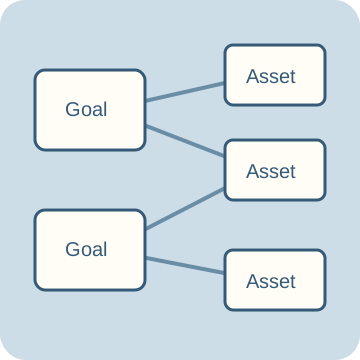
Campaign goal-to-delivery map

Enter your goals and deliverables as CSV. PapaParse preserves quoted fields; Graphlib builds the goal/deliverable graph and identifies disconnected workstreams; Decimal sums your entered planned costs. The fictional demo has one uncovered goal and no fabricated outcome forecast.

Headers: id,goal,measurement. Measurement is your stated method, not a generated target or forecast.

Headers: id,title,goal_ids,owner,due,stage,asset,approver,evidence,planned_cost. Separate multiple goal IDs with semicolons. Stages: Planning, Review, Approved, Delivered. Approved/Delivered require approver and evidence; Delivered also requires an asset reference. All costs must use the entered common basis/currency. Due dates use YYYY-MM-DD.

Inputs stay in this browser; saving is opt-in. The map reflects your entered links only, not causal attribution or campaign effectiveness. Costs are summed estimates on one common basis; no taxes, currency conversion, realized spending or ROI calculation is inferred. Due dates are records, not a dependency schedule. Review/delivery evidence is text we do not fetch or authenticate. CSV exports protect formula-leading values. The SVG uses shortened labels for readability; full text remains in JSON, CSV and the handoff. Library licenses ship with this page.

Keep the brief
through the last handoff.

Start with a measurable task

Write the audience and the action the campaign should support. Define where actual results will be measured. A goal label alone is not evidence of impact.

Assign a deliverable, not an aspiration

Connect each asset to a goal and an owner. If one goal has no supporting work, make that gap explicit. If an asset serves several goals, link those goals rather than duplicating its cost.

Specify the approval record

Keep the version, reviewer and decision reference together. In this workbench, approved status requires a record; it cannot check whether that record is authentic or whether the reviewer had authority.

Close with delivery evidence

Record the actual destination or final artifact, then inspect it in your real workflow. The exported handoff is a reviewable record of what you entered; it does not perform the delivery.

Resolve the gap you can see.

Uncovered goal

Decide whether to add a useful deliverable, narrow the goal or remove it from this campaign. Avoid leaving a promise in the brief with no owned work behind it.

Over budget

Review the entered estimates and scope. A negative balance is a planning warning, not an automatic reason to assume extra funds or fabricated savings.

Disconnected workstream

Separate graph components can be legitimate. Check whether each group has the right coordination and measurement rather than assuming every asset must connect to every goal.

Does goal coverage prove campaign effectiveness?

No. Coverage means you linked a deliverable to a stated goal. It does not prove audience response, attribution or results. Measure the real campaign separately.

Does Delivered verify a public asset?

No. It is an entered record requiring a reference and approval evidence. The workbench does not fetch the asset, verify a reviewer or publish anything.

Make the next delivery
traceable to the brief.

Build and export the campaign handoff
Organize your campaign goals and delivery handoffs with Super