One current answer
Compare boards with the same purpose, choose a canonical version and retain its predecessor and reason.
Make visual collaboration recoverable: a clear owner, the right access, one current answer and a real way back to its evidence.
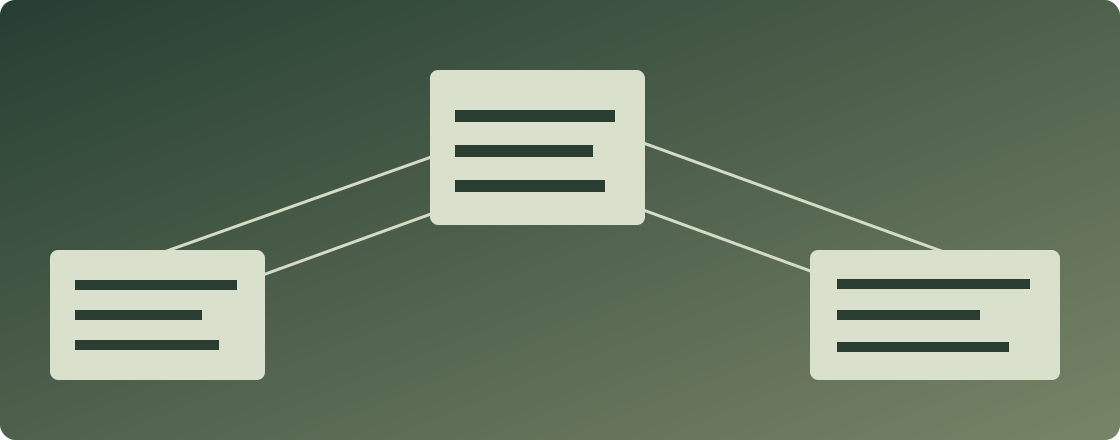
Compare boards with the same purpose, choose a canonical version and retain its predecessor and reason.
Separate the model you entered from a dated recipient test. Missing evidence stays unknown.
Keep literal notes, extra columns and graph positions in a full backup, alongside the vendor's real source.
Headcount is a prompt to inspect the work, not a fixed failure threshold. A small confidential project can need access controls before a larger public workshop.
Findability, competing versions, departed owners and invoice pressure deserve separate decisions. The complete guide retains concrete examples, current vendor mechanics and the exceptions.
Compare actual purpose and evidence before calling two boards duplicates.
Use the actual platform to test the intended role; record the result here.
Count paid roles and overlap, keep currencies separate and label assumptions.
This is an entered-source model, not a remote account audit. No file, permission, approval or saving is externally verified. Download your full JSON before closing.
Loading local libraries.
Required headers: id,title,project,purpose_key,owner,last_activity,state,classification,indexed,canonical_id,decision_ref,source_ref,notes. Extra columns are preserved.
Required headers: id,name,groups,notes. Extra columns are preserved.
Required headers: id,scope_kind,scope_id,principal_kind,principal_id,access,evidence,review_date. Extra columns are preserved.
Required headers: id,board_id,person_id,expected,observed,checked_on,evidence. Extra columns are preserved.
Required headers: id,option,role,quantity,unit_price,currency,term,notes. Extra columns are preserved.
Required headers: id,currency,amount,kind,notes. Extra columns are preserved.
Required headers: id,board_id,owner,due,state,instruction,evidence. Extra columns are preserved.
Required headers: id,date,people,active_boards,archived_boards,notes. Extra columns are preserved.
Each node is a board. An arrow points from a superseded board to its entered canonical replacement. Drag positions are retained in the full JSON. The list below remains usable without the graph.
The model chooses the most permissive matching explicit workspace, project or board grant for each entered person, including entered group memberships and public grants. It has no deny rules, vendor inheritance engine or account lookup. No matching grant means no entered grant, not verified denial. Observations are separate dated assertions.
Recurring rows are monthly or annual totals for the quantity and unit price entered. Transition rows are one-time costs. No currency conversion, productivity multiplier or automatic tax is assumed.
These are separately entered counts, not figures inferred from a twelve-board teaching sample.
Four concrete steps in the fictional Northwind review: identify competing boards, retain the canonical rationale, distinguish access model from observation and archive reversibly.
Use native playback or choose a teaching stage.
At0–8seconds, compare B02 and B03, which share the entered Northwind Q2 positioning purpose. A shared purpose is a review candidate, not proof that both artifacts should be merged.
At8–16seconds, retain B03 as the entered canonical decision and D-Q2-02 as its written rationale. B02 remains superseded history. Amira owns the next review on October23.
At16–24seconds, inspect B04's entered public view grant. The model predicts access, while C01 separately records a fictional recipient test. Changing this local grant does not revoke a remote link; test and fix access in the real platform.
At24–32seconds, archive B11 reversibly, download all source and positions in JSON and restore it. An inactivity flag does not authorize deletion. The aggregate140-to96 snapshot is entered case data, not a count calculated from the twelve example boards.
A visual collaboration tool earns its place when arrangement carries meaning: evidence beside a hypothesis, alternatives beside a decision, or dependencies between pieces of work. Choose a product that also lets the next person find the right board, understand its authority, and receive the intended access. A pleasant workshop canvas alone does not establish those properties.
Miro is a candidate for teams needing project spaces and increasingly formal administration. FigJam is a candidate when a Figma team already organizes its work in that ecosystem. Mural adds specific facilitation and room choices. Lucidspark fits work moving between visual exploration and Lucid diagrams. Canva fits teams turning ideas into designs. Microsoft Whiteboard requires particular attention to account type, storage and the current retirement schedule. Storyflow offers board-context AI and creative project continuity, with current plan distinctions that differ from older articles. Notion is useful when the lasting artifact is a searchable decision document rather than a spatial board.
There is no independently established universal winner here. Nor is there evidence that every team breaks at exactly five, fifteen or fifty people. Those numbers are useful planning bands, not limits built into human collaboration. A two-person studio with confidential client work can need restricted access immediately. An eighty-person organization with a maintained index and clear ownership can be easier to navigate than a disorganized eight-person team.
This guide rewrites and expands the useful decisions in Storyflow's original team-size article. Prices and mechanics were checked against current primary pages on October 7, 2026. Examples below are fictional teaching records, not measured vendor performance or reported customer outcomes.
| Candidate | First useful trial | Organization and access question | Recovery question |
|---|---|---|---|
| Miro | Run a workshop, then find its decision from a project space | Which boards are private, which guests are signed in, and which public links remain usable? | Can the responsible owner download and restore the native backup on the intended plan? |
| FigJam | Review a product decision beside the relevant Figma project | Which collaborators need Collab rather than Full seats; what access comes through the team or project? | Does a local .jam copy retain the content you need, with comments and history handled separately? |
| Mural | Facilitate a session with timer, voting and attention controls | Do open, private or confidential rooms match the actual client boundary? | What does the recipient receive after a session, and what remains only in the live mural? |
| Lucidspark | Turn a board discussion into a more formal diagram handoff | Is each contributor licensed for the product being edited? | Can another person recover both the exploratory board and its linked diagram? |
| Canva Whiteboards | Move from campaign discussion to actual design assets | Are designs and folders shared with the intended members or groups? | Does the exported deliverable retain the meaning of the board, and where is its source? |
| Microsoft Whiteboard | Continue a Teams meeting using an eligible work or school account | Who owns the OneDrive-backed file, and what happens when that person leaves? | Is this a current OneDrive board or a legacy Azure board approaching deletion? |
| Storyflow | Keep research, decisions and board-context AI together | Does the current shared workspace and role setup cover the team, rather than assuming one account buys every role? | Recover the important documents, board content and decisions through the actual supported exports. |
| Notion | Write a decision with searchable evidence and an owner | Which teamspace, group, guest and page permissions apply? | Recover the document and its relationships; do not pretend it is a freeform canvas. |
Use four evaluation dimensions: structure above individual boards; the smallest meaningful permission boundary; the bill for the actual roles; and the cost of leaving. Test each with your own ordinary work plus one uncomfortable case, such as a contractor needing one client board without the rest of the workspace. A polished demonstration with everyone logged in as an administrator is a poor permission trial.
For organization, ask a newcomer to find a named decision without chat assistance. For access, open the real share link as its intended recipient and record the result. For cost, count paid editing roles, viewers, guests, inactive accounts and the actual billing term. For exit, export, import and review the recovered artifact. Image and PDF exports can preserve the visible arrangement while losing editability or embedded detail; native backups can preserve editable content within the original product without making it interoperable with another canvas.
Small teams often remember which board contains a decision because the same people were present when it was made. That familiarity can postpone a formal directory. It cannot substitute for a recovery file, client confidentiality or a successor owner.
Start with a clear title, owner, purpose and decision location. For a two-person studio, “Northwind / campaign direction / 2026-10” is more recoverable than “ideas final.” Keep an index link in a place both people can reach. Store the final client approval separately from the board's exploratory notes so an old sketch is not mistaken for approved copy.
A free tier can be sufficient when its editable-file allowance and sharing model match the work. Miro currently keeps three boards editable; Mural Free also has three editable murals and open rooms. These are product limits, not evidence that a fifth person causes a failure. A small team handling multiple confidential clients may need a paid permission capability before it reaches a board cap. Conversely, a larger group using one occasional workshop board may not need every attendee to hold a paid authoring role.
Before adding enterprise administration, identify the requirement it solves. “We have five people” is less useful than “a departing contractor must lose access while our producer retains the archive.” Small businesses can have real procurement or identity requirements; they can also waste money buying controls nobody will configure.
As more people create boards, memory stops being a reliable directory. Watch for repeated requests for a link, new starters receiving a canvas without a path to it, two partly current references to the same project, important links trapped in private chat, or people rebuilding a board because searching costs more effort.
Give each board a project, purpose and date. Place it in the product's actual organizational layer: a Miro space, Mural room, Figma project, Lucid folder, Canva folder, or a maintained linked index where the product does not provide the same hierarchy. Those structures are different; naming all of them “folders” conceals important access behavior.
An index should say more than where a board lives. Record whether it is active, superseded or archived; who owns it; what decision it serves; and where the approved outcome lives. Include a replacement link when a board is superseded. Archive recoverably after an explicit review, not because a fixed age has passed. A six-month-old reference board can still be authoritative; yesterday's duplicate can already be misleading.
Assign modest real maintenance time. In the fictional Northwind case, Jo reserves twenty minutes each month to review new links and unresolved owners. That is an entered allocation, not a demonstrated benchmark for every organization. If the index is out of date after the first cycle, change the ownership or process rather than displaying a decorative directory that nobody trusts.
Duplication is often a consequence of local convenience. Two teams each make a competitor grid, both remain partly correct, and neither knows the other exists. The failure is not simply two files. It is two files both being treated as the current decision source.
Choose a canonical board for each specific purpose. Retain the superseded board and the reason for the choice. “B03 replaces B02 for the Northwind Q2 positioning decision; B02 remains historical evidence” is a usable handoff. “Use the new board” leaves the version, scope and lost material unclear. Different purposes can justify parallel boards: a workshop sketch and an approved decision record are not automatically duplicates.
Access becomes more varied as clients, specialists and contractors participate. Compare a product's board, file, room, space and workspace controls at the actual plan level. A public editing link is different from an invited signed-in guest; a viewer is different from a paid editor. Review inherited and direct access together. Restricting one visible share dialog may not remove an access path through a team or group.
The workbench lets you model explicit grants and record a separate actual recipient test. It does not connect to any vendor or reproduce every vendor's inheritance, denial, invitation or licence engine. A predicted grant is an entered model result; an observed test is a person's dated assertion with evidence. If no test is entered, actual access is unknown. Use that distinction before telling a client that a board is private.
At larger scale, the question becomes who has authority and time to maintain the system. Name the person responsible for workspace structure, departed-user handoffs, access reviews, retention decisions and the canonical index. Give that person an escalation path. An informal volunteer cannot enforce a rule the organization has never agreed to.
SSO, SCIM, audit logs, centralized content inventory and retention controls can support that work, but they are specific features on specific plans. They do not automatically establish clean titles or correct decisions. Conversely, careful naming cannot substitute for a required identity control, data boundary or legal retention requirement.
Review ownership before deleting or deactivating an account. Retain links and decision context alongside the source. Measure actual large-board behavior on the devices and browsers people use; performance can depend on content, assets, network and implementation. This guide has not benchmarked eight vendors or established a universal object threshold. A giant board can be both cognitively confusing and technically slow, and those are separate diagnoses.
The original illustrates a creative team growing from nine to nineteen inside a sixty-person organization over eleven months. Its useful lesson is the relationship between creation, discoverability and maintenance, not an inevitable headcount law. Here is a new fictional case with explicit assumptions and worked numbers.
Northwind's creative team uses an annually billed plan assumed at USD8 per paid member per month. All nine initial members are assumed paid; all nineteen final members are also assumed paid. That is a case assumption, not a licensing recommendation. Nine members cost USD72 monthly equivalent or USD864 for a full year. Nineteen cost USD152 monthly equivalent or USD1,824 for a full year. The annualized difference is USD960. Actual mid-term invoices, taxes, discounts, guests and prorating may change the bill.
| Snapshot | Team members | Entered active boards | What the team notices | Specific next decision |
|---|---|---|---|---|
| 2025-11-03 | 9 | 34 | Four frequent authors; links still familiar | Jo owns the project index rather than relying on one author's bookmarks. |
| 2026-04-03 | 13 | 71 | Two partly current Q2 planning links | Label their purposes and record which one owns the launch decision. |
| 2026-07-03 | 16 | 118 | Two competitor grids created nine days apart; a search returns eleven plausible boards | Compare the evidence and choose a canonical decision source, retaining the other. |
| 2026-08-03 | 18 | 140 | New boards keep arriving without owners | Name board owners; review the six-month inactivity candidates before archiving. |
| 2026-10-03 | 19 | 96 | Forty-four boards have been moved to a recoverable archive | Test that an older decision can still be recovered and that replacements are indexed. |
The arithmetic is 140 minus 44 equals 96 active boards. It does not mean forty-four boards were deleted, or that duplication inevitably stopped. These five snapshots are entered aggregate teaching figures. The downloadable example contains twelve complete board records, not a fabricated claim to list all 140 historical boards. Its snapshot CSV explicitly preserves that scope distinction.
Those twelve records form a usable small audit: B01 is the index; B02 and B03 share a Q2-positioning purpose; B03 is the nominated canonical version; B04 is confidential partner research; B05–B10 implement the six templates below; B11 is a superseded workshop; B12 is an older retained reference. All have actual example ownership, state, dates, sources and notes. The full backup preserves every record, original CSV string, additional columns and graph positions. You can replace the examples with your own complete inventory.
Jo writes this literal fictional handoff: “Use B03 for Northwind's Q2 positioning decision. B02 preserves the earlier workshop and is superseded, not deleted. The approved rationale is D-Q2-02. Amira owns the next evidence review on 2026-10-23. Please test the intended client link before sharing it.” This sentence distinguishes a chosen version, retained history, written outcome, accountable person and access action.
Miro's current pricing lists Starter at USD8 and Business at USD20 per member per month billed yearly. Starter includes unlimited private boards and project spaces. Business adds separate workspaces and unlimited signed-in guests. Free keeps three boards editable. Public visitor editing and signed-in guest collaboration are different access choices, so do not price or approve them interchangeably. See current Miro pricing.
Miro's feature matrix and role documentation should be checked for the actual team role, not inferred from a broad paid-plan label. Enterprise Content Admin is different from merely being an ordinary board editor. If centralized inventory is essential, demonstrate that administrator's view in the plan you intend to buy.
For recovery, Miro documents .rtb backups on Starter, Business, Enterprise and Education. Owners/co-owners or the relevant Enterprise administrator can download; paid-team users can restore. The current documented download limit is 1GB, and bulk backup is unavailable. This is more useful than claiming every canvas export loses its arrangement. It still does not promise editable import into a different vendor.
Try Miro when project hierarchy and different client workspaces matter. Preserve Jira or Slack handoffs as real linked decisions rather than assuming an integration makes the board the system of record for delivery. Start with a smaller plan only if its actual guest, workspace and administrative controls meet the requirement.
Figma's current pricing distinguishes Collab, Dev and Full seats. Professional displays Collab at USD3 and Full at USD16 per month; Organization and Enterprise have different rates and billing terms. A colleague editing FigJam does not automatically require the Full role used for Figma Design. View and comment access to products outside a seat's editing entitlement is another distinction. Confirm the selected billing interval before using a displayed rate in a quote.
File and project permissions depend on where the file lives and the access it receives. Keep the FigJam outcome in its relevant project and check the newcomer or contractor's actual path. File access and paid product entitlement answer different questions.
Current documentation also uses a folder structure: Starter allows one folder and three FigJam files within it, with unlimited drafts. Do not describe its free team workspace as simply unlimited because private drafts exist. The file browser guide notes that mobile web does not support that browser and recommends the mobile app for phone viewing. A desktop-only findability trial can miss a real phone handoff limitation.
A local .jam copy can be saved on any plan when access and owner restrictions permit. It omits comments and version history; reimport creates a new file disconnected from the original. Retain important decisions and review context separately. FigJam is attractive for an existing Figma workflow, but that fit is not evidence that it is universally cheaper or equally governed for every twenty-person team.
Mural's current pricing lists Team+ at USD9.99 per member monthly equivalent billed annually, with private rooms and editing visitors. Business is USD17.99 annually billed monthly equivalent and adds SAML SSO and external guests. Confidential rooms, SCIM and audit logs are listed under Enterprise. Free has open rooms, three editable murals and view-only visitors. Its facilitation tools are not evidence that Free has the same client boundary as a paid private or confidential room.
The concrete trial is a facilitated meeting followed by a recoverable result. Mural's facilitation features include summon/follow controls, a timer, locking and voting. Use a specific method: allow five illustrative minutes for silent evidence notes, compare competing claims, vote to select a question for discussion, then write the actual decision and owner. Voting is an input to the discussion, not client approval. Ask whether the next reviewer needs to edit, comment or only read. Match those roles to the actual room and visitor model before inviting them. Do not pay for a room tier merely because a team passed fifteen people; pay for the boundary and control it actually needs.
Lucidspark can connect exploratory visual work with a Lucid diagram workflow. Organization and source ownership still need a real folder and handoff trial. Lucid's plan documentation distinguishes individual and Team product subscriptions from Enterprise's suite. Team multi-product licensing makes the important exception explicit: a Lucidchart licence does not automatically provide full Lucidspark editing.
Record which product each author actually edits. A viewer, a guest collaborator and a fully licensed author are different cases. Recover the exploratory board, the final diagram and the decision linking them. The public pricing view was not reliably extractable in this audit, so the workbench takes an actual entered quote instead of embedding an invented current rate.
Lucid's current home-page help describes folder creation, keyword search by title/tags/status and list columns such as location and owner. Enterprise team folders are a distinct case. Its Trash can restore a document to its prior folder until the user permanently deletes it. Use those concrete paths in a findability and recovery trial, rather than assuming every subscription includes the same enterprise inventory.
Canva is a practical candidate when the team already creates the campaign deck, social assets or presentation there. Its whiteboard is then close to the material that must be delivered. That proximity can reduce copying, but it does not decide who owns the approval or which draft is authoritative.
Canva's sharing help describes sharing designs with a team, selected members or groups and the applicable view/comment/edit choices. Check designs and folders separately; do not describe Canva as having no access controls merely because it is not your preferred administration interface. Current plans use Free, Pro, Business and Enterprise labels, so older generic “Teams” seat prices should not be copied into a new comparison without checking the account's actual offer.
Try a complete campaign path: sketch the concept, retain the brief, create the actual design, and record an approval message for its exact version. An exported PNG is a deliverable, not a recovery of every editable source or comment. The current localized price was not established here; enter the real currency and billing term from your account quote.
Microsoft's storage documentation says new organizational boards are stored in the creator's OneDrive, with relevant OneDrive controls and file audit activities. It specifically says SharePoint is not yet supported as the Whiteboard storage destination. Do not blur the wider Microsoft 365 ecosystem into a claim that every board lives in SharePoint or automatically has every desired retention behavior. Check account departure and ownership before disabling the creator.
The current standalone-app retirement page states October 16, 2026 for Windows, iOS and Android standalone apps. Work or school users can continue in Teams and on the web. This is not retirement of Whiteboard for those accounts.
The legacy Azure schedule states migration ended September 25, remaining legacy boards are view/export-only through October 16 and then permanently deleted; Azure service shutdown is November 30. That page also contains older embedded standalone-app wording that conflicts with the dedicated current retirement page. Use the dedicated app page for the app date and the final migration schedule for legacy content, and confirm tenant notices. As of this audit, recovery of important legacy material is urgent, not a hypothetical headcount issue. Existing eligible licences can make incremental licence cost zero; they do not make ownership and exit effort zero.
Storyflow's useful distinction is creative project continuity: research, written decisions, visual relationships and AI work can share a board context. A months-long project may need that continuity more than a disposable meeting canvas. Attach relevant material, point to selected canvas elements, and keep accepted AI proposals separate from actual decisions. The original describes a specific Tactic-and-document context pattern; its old numeric context cap is not independently established by the current pricing page and should not become a fixed current entitlement.
Current Storyflow pricing describes board/file context, Pro and Max conversation memory, and Max shared Team Workspace roles and permissions. It lists paid early access, an upcoming Free plan, and a free invited-collaborator exception. Plus is USD95.88/year, Pro USD168/year and Max USD468/year for the displayed individual annual offers; team discounts start at three seats. Thus “one flat subscription gives every large team every administrative feature” and “Storyflow has no team roles” are both unsafe simplifications. Request the actual team configuration and access trial instead of asserting unverified SSO, SCIM or retention capabilities are present or absent.
For a creative team of six, try a real research-to-decision handoff with an invited collaborator. For a sixty-person procurement requirement, test the named control and obtain its current documentation. The existence of an infinite canvas does not establish unlimited performance or governance.
Notion's pages, databases and teamspaces can be the better place for searchable decisions and ownership when spatial arrangement does not carry the result. It also supports collaboration; lacking a freeform whiteboard does not mean lacking real-time shared work.
Notion's teamspace guide distinguishes open, closed and private areas, groups and individual page permissions. Overlapping permissions can grant the more permissive access. Verify the actual tier and sharing paths rather than assuming a private-looking sidebar entry is inaccessible to everyone else. Current pricing lists additional administration and security options by plan.
Use a document for the approved rationale and link the exploration board if it remains useful. Two tools can serve different jobs without becoming two competing authoritative answers. If users only need to find the current decision, introducing another canvas may add navigation rather than insight.
The free-cap window occurs when actual editable files or required sharing exceed a plan's allowance. It can be a good time to evaluate alternatives while the archive is smaller, but migration duration depends on content and destination, not an assumed afternoon at eight people.
The invoice window occurs when the bill grows enough to justify a proper comparison. Price the roles that actually require licences. Thirty paid Miro Starter members at the current annually billed USD8 equivalent mean USD240 monthly equivalent and USD2,880/year. Thirty Business members at USD20 mean USD600 equivalent and USD7,200/year. Those figures differ from a team of ten authors and twenty invited viewers. Thirty Mural Team+ paid members at USD9.99 equivalent mean USD299.70 equivalent or USD3,596.40/year. These are arithmetic illustrations before taxes, negotiated terms, discounts or prorating, not quotes for a mixed-role team.
The trust window occurs when people stop believing they have found the current source. Before migrating, resolve ownership, duplicates and final decision locations. Moving unowned copies into a new product can reproduce the confusion.
The workbench compares entered costs by currency. Suppose current recurring cost is USD152/month and a candidate is USD95/month: entered savings are USD57/month. If migration and training are USD1,140 plus a one-month USD95 overlap, the assumed one-time transition is USD1,235 and simple break-even is approximately21.67months. No positive savings means no cost-only break-even. Keep avoided licence cost separate from hoped-for productivity: neither entered labour nor a percentage improvement is an observed saving. Review annual commitments and cancellation/refund terms before assuming invoices fall immediately.
Inconsistent names: use an actual project, purpose and date. “Northwind / retrospective / 2026-03” identifies work; “final final” identifies frustration. Preserve historical names in notes when a rename would otherwise break the human search path.
No recoverable archive: choose an owner and review rule. Move inactive material out of the active index only after checking continuing relevance, retention and replacement links. Keep the source and recovery route. The workbench's archive action is reversible; it does not delete vendor content or declare a six-month record legally disposable.
One load-bearing giant board: split at a meaningful project or phase boundary. Retain cross-links and the explanation connecting parts. Export or back up first. Do not scatter a coherent relationship simply to make a smaller object count, and do not claim a fixed count guarantees speed.
No maintained index: assign real time and ownership. Show the new starter how to locate an actual decision. Test that route again after restructuring rather than counting index links as evidence of findability.
All-or-nothing sharing: inventory the actual intended and observed recipients. A contractor needing B04 does not necessarily need the whole workspace. Record an actual signed-in recipient test and review expiry or account departure. Public access deserves its own explicit decision.
Two sources of authority: distinguish exploration from approval. A board may contain thinking; a document may contain the approved rationale. Link them and name which governs the particular decision. Do not let a copied summary silently become a second current version.
These are original practical adaptations of the six named templates in the source, connected to real records in the downloadable example. They are entered fictional plans, not approvals or completed client outcomes.
| Template | Complete illustrative use | Ownership, access and written handoff |
|---|---|---|
| Team Planning Dashboard / B05 | Northwind October capacity; Jo owns it; 2026-10-12 review; project goals are launch brief D-L01 and research review D-R01; blockers are partner access and copy approval. | Internal group editing only in the entered model. “Jo: keep B05 as the team index for October priorities; link each decision to its owning project board.” |
| Launch Task Management / B06 | Northwind launch; Amira owns message version2; 2026-10-16 draft due; 2026-10-19 review; copy, design, QA and approval are separate tasks; final delivery reference D-L01. | “Please review the version2 launch promise by October19. Approval applies to that copy, not the exploratory moodboard.” |
| Software Development Taskboard / B07 | Atlas prototype; Theo owns the permission test; reproduce with a contractor account, record expected read-only and actual result; 2026-10-20 due; link test evidence D-S01. | “Keep the reproducible steps beside the result. Move to verified only after the actual test; an entered grant is not evidence.” |
| Marketing Campaign / B08 | Autumn campaign; Nia owns channel hypotheses; October23 review; landing-page promise is “Find your current project decision in one place”; separate target, observation and approval fields in D-M01. | “The promise is draft copy. Confirm the actual product route before using it in paid creative.” |
| Mindmap / B09 | Partner research; Amira compares three hypotheses—missing index, inherited sharing, competing canonical boards—against B02/B03/B04; branch sources are D-R01 and recipient test C01. | “Keep each hypothesis linked to evidence. B04's confidential note must not become a public example.” |
| Weekly Planner / B10 | Week beginning2026-10-12; Jo reviews index Monday, Amira compares B02/B03 Tuesday, Theo tests B04 access Wednesday, Nia writes canonical handoff Thursday, Friday reserves recovery testing. | “If the recipient test fails, keep sharing blocked in the real platform and update the evidence; moving a card does not revoke access.” |
You can use these structures in Storyflow or another supported tool, but this site's downloadable JSON restores this workbench, not a vendor's proprietary board. It contains all source tables and position data. Vendor import compatibility needs an actual supported format and trial; do not rename our recovery artifact .rtb or .jam and expect it to become one.
For a two-to-four-person studio, a familiar product with a sufficient free allowance may be sensible; confidential clients can change that immediately. An eight-person marketing team working mainly in Canva or Figma should trial the existing ecosystem's board-to-deliverable route and organization before adding another subscription.
A twelve-person agency running structured client workshops should compare Miro's and Mural's actual facilitation, room/workspace and guest mechanisms. A thirty-person product team should compare file/project organization, paid roles and specific required access—not simply buy thirty Full design licences for FigJam participants. A sixty-person organization should involve whoever owns identity, departure and procurement decisions; Miro Enterprise and an eligible Microsoft environment are candidates, not automatic approvals. A six-person creative team working on projects for months can meaningfully trial Storyflow's board-context workflow and current shared-workspace roles.
Sometimes no new visual tool is needed. A quarterly workshop can fit an existing free allowance if its sharing and afterlife are sufficient. A static sketch inside a decision document can be enough when nobody needs to edit spatial relationships afterward. A colocated team can use paper when it has a practical capture, remote-access and retention route. An organization whose problem is indecision needs an accountable decision process; a new canvas cannot guarantee one.
Review new boards against purpose, owner and project. Compare probable duplicates before nominating a canonical source. Check whether older material remains useful; archive reversibly when the owner approves. Test a sample intended recipient path and record its actual result. Review departed and changed roles. Confirm that final decisions and source backups are recoverable by someone other than their original author.
Run a recovery drill: download the full JSON, close the context, restore it in a new one, recover a renamed board and its literal notes, and inspect the positions and grant evidence. The workbench's Markdown and CSV exports are useful views; the full JSON is the complete source recovery. Its local data does not establish anything about remote vendor access, file existence or actual client approval. Download your backup before closing or clearing browser storage.
The best sign of an improved workspace is a concrete successful handoff: someone can find the current answer, understands its limits, receives the intended access and recovers its evidence. Measure that in your own workflow. This guide and tool do not establish a Google ranking improvement or a universal cost saving.
Choose through a real handoff trial: create the board, find its current decision, open it as the intended recipient and recover an export. Miro spaces, FigJam's Figma project context, Mural rooms, Lucid product licensing, Canva deliverables, Microsoft's account/storage rules, Storyflow's creative board context and Notion's documents serve different needs. No universal ranking is established here.
When an actual editable-file allowance, access boundary or required control stops fitting the work. Miro Free and Mural Free each currently allow three editable boards or murals. A confidential two-person client project may need a paid permission capability sooner than a large occasional workshop. Check the role and plan rather than treating five people as a universal limit.
Compare paid author roles, organization and the actual client-access test. At the displayed Miro Starter annual equivalent, twenty paid members mean USD160/month equivalent or USD1920/year. FigJam participants may need Collab rather than Figma Full licences; confirm the selected interval and project/file permissions. Twenty attendees are not automatically twenty paid editors in either product.
People often create a locally convenient answer without seeing an existing one. Two boards can both remain partly correct. Group the same entered purpose, compare their evidence, nominate one canonical decision source and retain a reason and replacement link. Different purposes—workshop exploration versus approved rationale—can legitimately need separate artifacts.
For thirty paid Miro Starter members, USD8 annually billed monthly equivalent means USD240 equivalent and USD2880/year; Miro Business at USD20 means USD600 and USD7200/year. Thirty Mural Team+ members at USD9.99 equivalent mean USD299.70 and USD3596.40/year. These exclude taxes, discounts and prorating and assume every person is paid. Enter the actual mix of paid roles, guests, viewers and billing terms.
You need the boundary that matches the work. A contractor needing one confidential client board should not receive unrelated workspace access. Check direct, group, project and public-link routes on the actual plan. A modeled grant is not a successful recipient test; record actual access separately and leave untested access unknown.
Compare actual recurring costs with migration, overlap and training. In the fictional example, USD152 minus USD95 gives USD57 monthly savings; USD1140 transition labour plus USD95 overlap gives USD1235 one-time cost and about21.67months simple break-even. Non-positive savings has no cost-only break-even. Annual commitments and recovery losses may make the move unattractive even with a lower headline price.
Assign an owner, record the actual decision and link its approved rationale. Keep the exploration if it remains useful; otherwise archive recoverably with a replacement reference. Export or back up the source and test recovery. A workshop's end is not evidence that its content should be deleted or that every sketch is approved.
It can be a better home for searchable decisions, evidence and ownership when spatial relationships are not the lasting artifact. It supports shared pages and collaboration but is not a freeform whiteboard. If layout carries the reasoning, retain the canvas and link the decision document rather than claiming either tool serves every purpose.
Only where its real workflow supports the required ownership, statuses, dependencies, reporting and review. A board can organize exploration while a delivery system owns commitments. Name which artifact governs each decision and link it; copying tasks into a canvas does not automatically synchronize deadlines or approvals.
Look for observed symptoms rather than assuming a fixed sequence: repeated link requests, competing current sources, inappropriate access, missing owners or slow boards. Findability often becomes harder as authors multiply, but a small NDA project can encounter an access problem first. This guide does not establish universal five/fifteen/fifty thresholds.
Its current pricing describes Max shared Team Workspace roles and permissions and team discounts, so an older blanket claim of no team controls is inaccurate. A large team should still demonstrate its specific required identity, access, retention and departure controls. Their absence or presence cannot be inferred from an infinite canvas or a generic paid-plan label.
Current pricing describes paid early access and a Free plan planned before the end of2026. It separately says a person invited by a paid member can join and collaborate at no cost. That invited exception is not the same as a publicly available independent free creator plan. Check the current account offer before budgeting or signing up.
Give the index an owner and real review time; require board purpose and ownership; compare duplicates; retain canonical decisions and replacement links; review actual recipient access; and archive reversibly with recovery tests. A naming convention alone will not maintain the system, and a displayed checklist does not prove those actions happened.
It can, depending on content, assets, device, network and implementation. Measure the actual board on the devices people use; this guide has not benchmarked the vendors or proved an object limit. Split at meaningful project or phase boundaries, preserving context and backups, when measured performance or comprehension justifies it.
Only if that plan supplies an actual needed capability, such as the relevant guest, workspace or identity control. Five people alone does not establish the requirement. Test the confidential-client or departure case and price the actual roles; a smaller plan may suffice, while an even smaller team can need advanced access.
No. It calculates a clearly described model from the grants and memberships you enter and displays dated recipient-check assertions separately. It does not connect to a remote account or reproduce every vendor's access engine. No check means actual access remains unknown, even when an entered model predicts no grant.
The full JSON contains all original CSV source strings, additional columns, settings and graph positions. Individual CSVs retain their table source; Markdown and PNG are readable views. Restore the full JSON for the complete editable workbench, and keep actual vendor backups separately. Our JSON is not a proprietary vendor board import.